Commerce didn’t start with a shopping cart - it started with a conversation. For centuries, the “Expert” was the local merchant who knew your preferences, your budget, and most importantly, the technical specs of the products they sold. They bridged the gap between a need and a solution with verified trust.
Then, we scaled. We moved through village shops, department stores, and mail-order catalogs, finally landing on the web. Along the way, we stripped away the experts and replaced them with blue links and search bars. We prioritized the speed of the transaction over the quality of the advice. While this allowed for the explosion of the global digital economy, it created what we now call the “Online Trust Gap.”
Luckily for us, computing power and the mathematicians who created artificial intelligence models are now able to take the best from both worlds. We are finally merging the infinite scale of the internet with the personalized expertise of that local merchant. This isn’t just an update; it’s a fundamental shift into the era of Agentic Commerce.
The in-store dominance: Why are we still buying offline?
To understand why Agentic Commerce is the solution, we first have to look at why shoppers still prefer going into physical stores. The reason to do so in 2026 depends entirely on the risk and complexity of the purchase.
Despite the digital shift, according to Statista, physical stores still account for approximately US$28 trillion of the US$34 trillion in total global retail sales projected for 2025.
Here are some key categories that continue to drive foot traffic:
- Electronics. Consumers consistently demand technical verification from in-store experts because 70% worry that digital-only, cheaper alternatives will underperform in high-stakes scenarios. When a purchase involves complex technical specifications or a significant financial investment, the search bar feels like a gamble.
- Performance-based hard goods. For attribute-heavy products like industrial parts or specialized equipment, shoppers visit stores to physically validate durability and material compatibility. Consumers rely on the physical expert to “vouch” for the build quality and physical attributes that a 2D screen simply cannot communicate, effectively using the store as a final audit before they commit.
- Precision health & wellness. In the health sector, trust is the only metric that matters, and 68% of shoppers now prioritize clean ingredients and measurable, evidence-backed outcomes. They seek an expert who can interpret medical reports or ingredient lists to ensure safety and efficacy, knowing that a generic search algorithm often ignores the individual health nuances that a human specialist can spot instantly.
- Groceries & household staples. For routine essentials, the local shop remains more convenient than browsing an e-commerce store for most people. Shoppers prefer the near-home shop because of the ease of immediate inspection. Knowing exactly what you are getting before it’s in the bag outweighs the friction and “wait-time” of digital browsing.
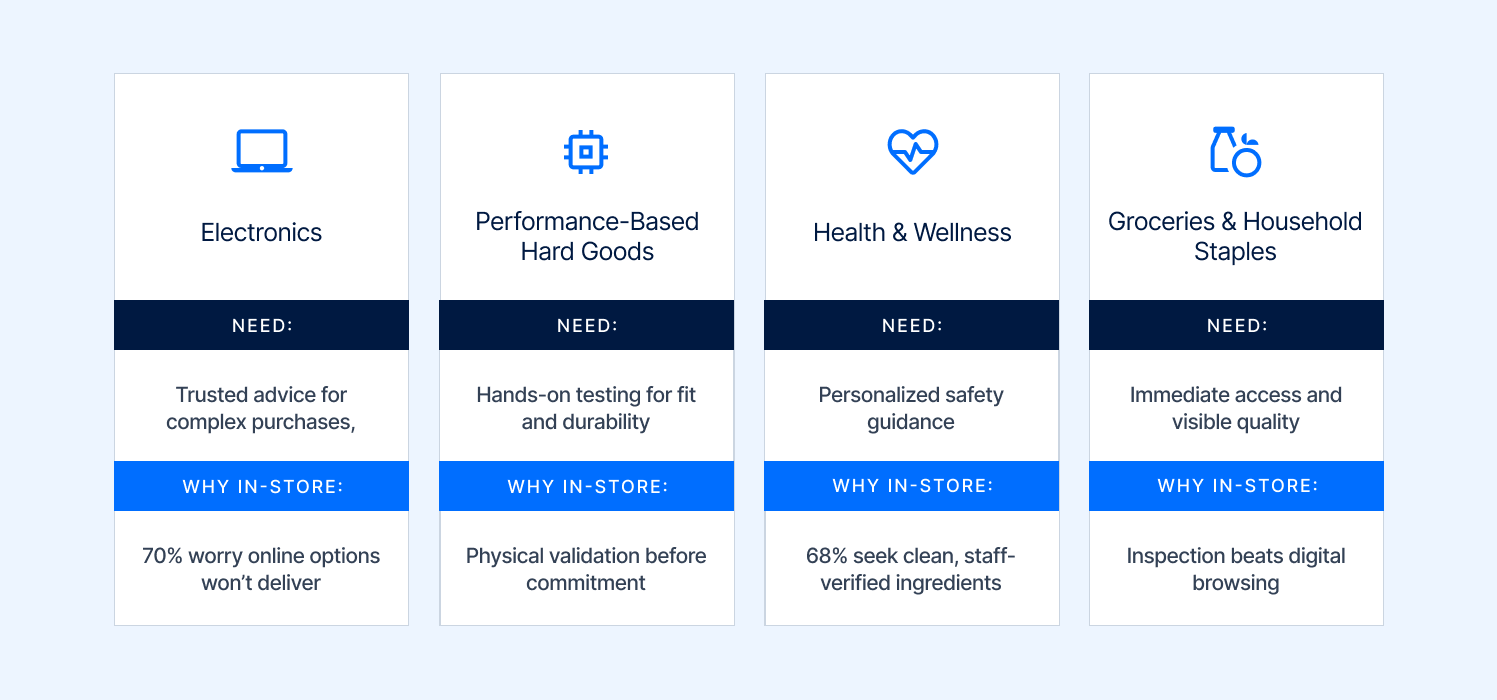
The reasons why customers are still choosing to shop in person
These in-person advantages - the need for expert technical verification, physical validation, and safety guidance - are the final hurdles for the digital world. But what happens when we stop trying to replicate the “store” on a screen and instead bring the “expert” into our environment?
The future of commerce is ambient
We are moving toward a world of Ambient Commerce. In this vision, shopping isn’t a destination you visit or a tab you open; it is an invisible layer of your daily life.
Imagine a future where the “Online Trust Gap” simply doesn’t exist because your digital assistant has the technical integrity of an in-store consultant and the memory of a lifelong companion. In this era, commerce becomes an ongoing dialogue between you and your agent - and eventually, it involves no dialogue at all.

A futuristic scene of a home run with the assistance of AI (Source: Google AI)
Here’s a glance at how the not-so-distant future could look:
- Home entertainment: Instead of spending hours on YouTube reviews, you have a specialist available 24/7 to buy a speaker system that is mathematically guaranteed to be compatible with your TV. This agent doesn’t care about the marketing fluff or overpriced commissions; it searches for the offering with the best price-to-performance ratio and finds products that will actually last. It filters out unnecessary features you don’t need, ensuring you never overpay for a “marketing story” again.
- Health decisions: A specialist proactively recommends the best vitamins for winter based on your specific biometric data and health goals, avoiding the noise of generic social media trends.
- Grocery management: Your refrigerator is already full because your agent manages a “Standing Intent” - it knows the ingredients needed for the dinner you’re about to make, tracks your stock, and automates reordering based on your price preferences.
- Secure accessibility: Safe and inclusive autonomy unlocks possibilities for everyone. For the elderly or those with disabilities who find traditional e-commerce interfaces frustrating, AI acts as a trustworthy assistant that operates within strictly defined control limits. Because these agents use Delegated Payments, they can complete transactions securely using scope-limited tokens. Your credit card data is never exposed to a scan store or a hacked site; the agent handles the security handshake so you don’t have to.
We are heading toward a “set it and forget it” economy where the mental load of shopping disappears, and the expertise of the shopkeeper is finally scaled to every person on the planet.
What of this is possible already?
This “set it and forget it” economy sounds like science fiction, but the foundation is already being laid. AI is already proving to be a master of product research and discovery, often outperforming manual human searches.
To make this vision functional, the industry has moved beyond general data sharing toward specialized commerce standards. A common misconception is that you need a single “catch-all” tool, but the reality is more modular:
Model Context Protocol (MCP) emerged as a powerful way to provide the “facts” connecting an AI’s reasoning to your private inventory or technical specs. However, retail requires more than just facts; it requires transactional logic. This gap was first addressed by the Agentic Commerce Protocol (ACP) and is now being scaled by the Universal Commerce Protocol (UCP).
By implementing these standards, UCP and ACP has become the definitive bridge that allows an AI agent to not just “talk” about your products, but to actually navigate your backend and complete a sale.
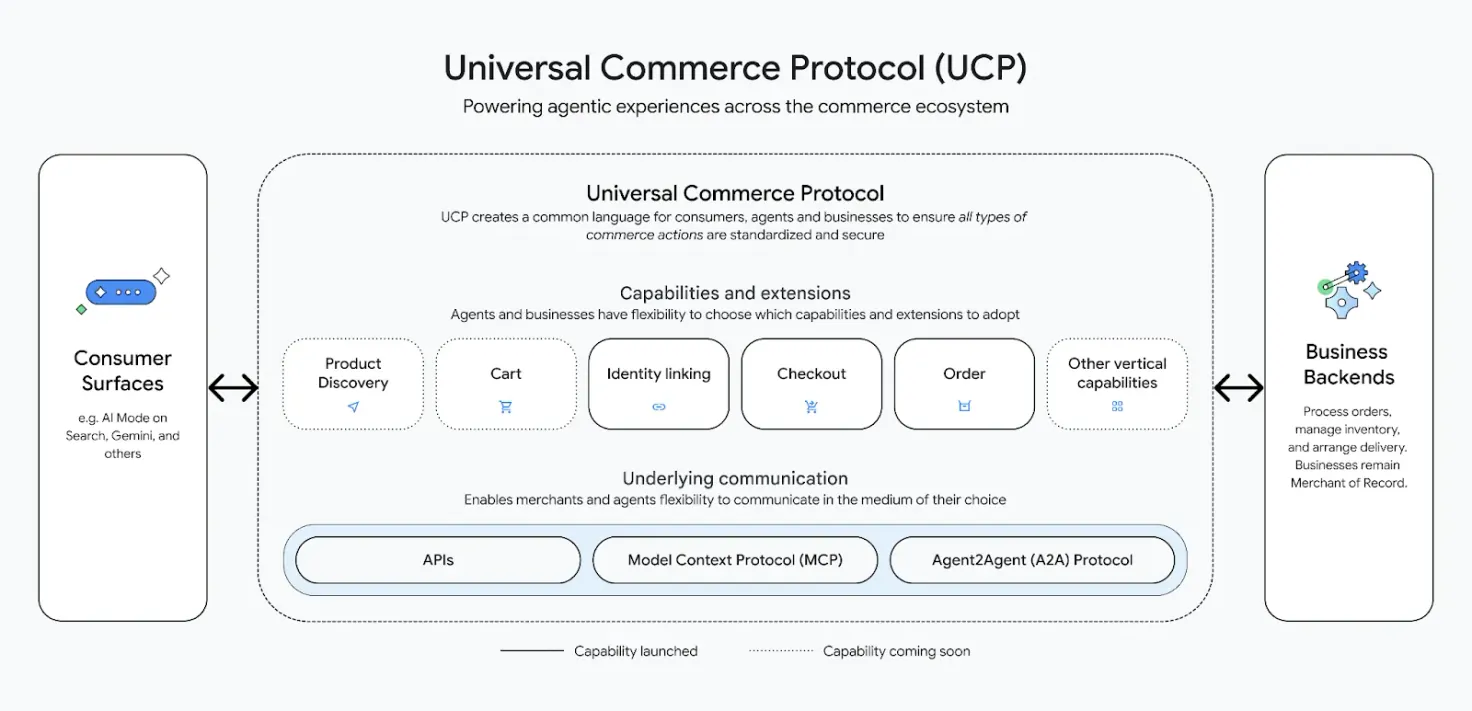
Universal Commerce Protocol (Source: Google Cloud)
Current agent protocols
To make a commerce ecosystem “Agent-Ready,” we implement these distinct communication layers. While they are modular and can be deployed individually, they are increasingly integrated to support end-to-end automated commerce.
| Protocol | Primary Function | E-commerce Application | Developed By |
|---|---|---|---|
| MCP (Model Context Protocol) | Knowledge Layer | Turning the AI into a technical expert on your specific products. | Anthropic |
| ACP (Agentic Commerce Protocol) | Transaction Layer | A secure “handshake” that lets the agent complete a checkout/payment. | OpenAI / Stripe |
| UCP (Universal Commerce Protocol) | Interoperability Layer | A full-stack language that handles discovery, cart, and checkout in one bridge. | Google (Gemini) |
Choosing the right protocol
You don’t need them all and you don’t need to implement everything at day one. Each protocol has a specific role in the agentic commerce ecosystem and you can apply them one-by-one and only the ones for your needs. Here’s how to know which one fits your business:
- Use MCP if: You want an agent to be an “expert” on your specific inventory (e.g., “Which of these 500 bolts fits a 2022 Ford?”). It connects the AI’s brain to your commerce store technical specs.
- Use ACP if: You want to tap into the OpenAI/Stripe ecosystem. It’s currently the cleanest way to let an agent spend a customer’s money without you ever touching their credit card data.
- Use UCP if: You want to tap into the Google ecosystem and the global Zero-Click Shopping network, where agents find and buy your products automatically.
These protocols transform the complex, multi-step process of traditional online shopping into a single, seamless interaction. From the user’s perspective, they simply state a goal to an AI assistant - such as “Find and buy a waterproof hiking boot under $150” and a “Buy” button appears directly in the chat, allowing them to complete the entire purchase and secure payment in seconds without ever leaving the conversation.
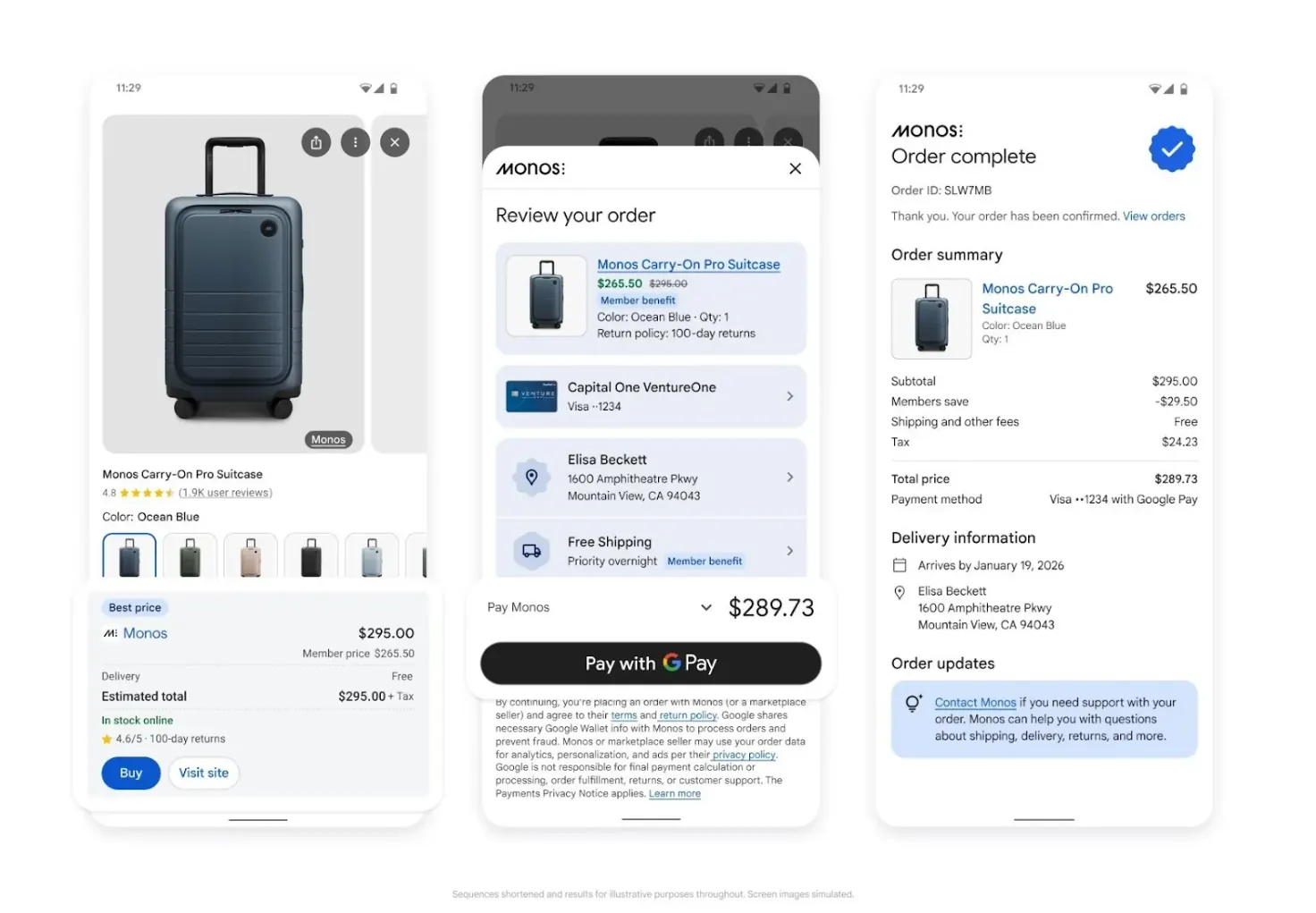
Customers can complete purchases directly through the Gemini app and AI Mode (Source: Google)
These protocols transform the complex, multi-step process of traditional online shopping into a single, seamless interaction. From the user’s perspective, they simply state a goal to an AI assistant - such as “Find and buy a waterproof hiking boot under $150” and a “Buy” button appears directly in the chat, allowing them to complete the entire purchase and secure payment in seconds without ever leaving the conversation.
How it works from the user’s perspective
The user experience is no longer fragmented, as agents handle the full lifecycle of a purchase, from discovery to payment, in one continuous, intuitive flow. Here’s what a user sees:
- The “one-window” journey: Instead of jumping between tabs to compare prices, read reviews, and fill out forms, the user stays in a single chat interface where the agent handles all the research and logistical work.
- Secure delegated action: When the user clicks “Buy,” the protocol enables the agent to securely finalize the transaction using one-time, scope-limited tokens, meaning the user’s actual credit card data is never shared with the merchant or the agent.
- Contextual fulfillment: The agent automatically applies the user’s saved preferences and shipping details, only asking for a final confirmation before the order is “done”.
Big players like Walmart, Shopify, Etsy, and Zalando are already integrating these standards to ensure their products are cited when a user asks ChatGPT or Gemini for a recommendation.
20% of consumers who landed on Walmart.com by clicking a link on another site got there from ChatGPT. - Capgemini Research Institute
However, the most important development in 2026 is that the rest of the market isn’t being left behind. Global developer communities are working quickly to build open-source connectors - such as the agentic commerce module for Magento to ensure smaller merchants can display their products and compete in the same conversational AI windows as the commerce giants.
How to prepare for the Agentic Commerce era?
Adopting protocols like MCP and UCP is a technical “must-have,” but it is only the foundation. To truly win in 2026, you must shift your mindset from selling to a human to selling to a piece of software. An AI agent is a high-speed technical auditor; it is immune to flashy marketing text, urgent countdown timers, or traditional psychological “tricks”. To an agent, these are just noise. What they care about is the “Mathematical Truth” of your brand: precise data, good offer, real-time integrity, and verified reputation.
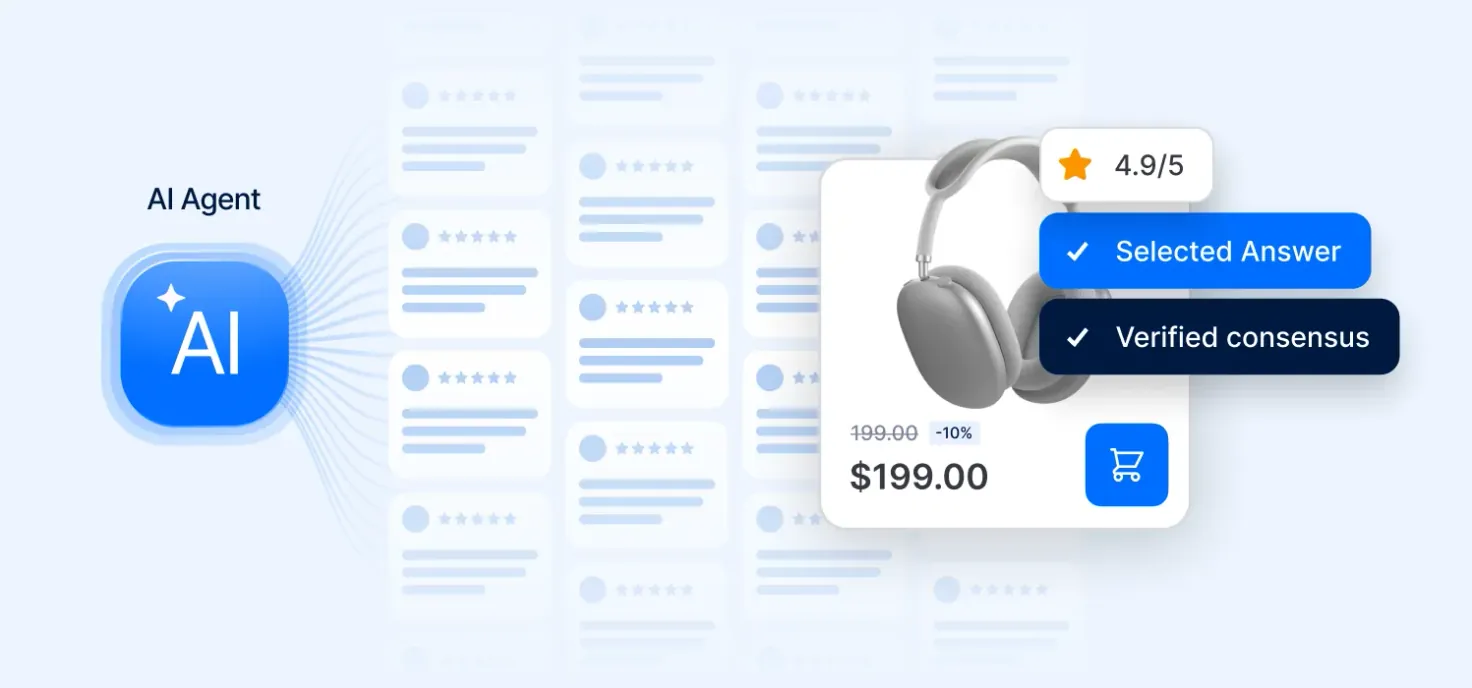
An AI agent is analyzing thousands of customer reviews to find the best product
Here are some of the new rules of engagement to follow:
- From SEO to AEO (Answer Engine Optimization): You are no longer optimizing for a list of links; you are optimizing for a citation. Agents prioritize products with complete, structured metadata - every technical attribute from material weight to ISO certifications must be machine-readable. If your data is incomplete, your “expert” brand remains invisible to the machine buyer.
- Integrity as a ranking factor: Inconsistent pricing or “ghost inventory” (showing stock that isn’t there) is a fast way to lose trust with an agent. Agents favor Feed Integrity; if they attempt a checkout and fail, they will deprioritize your store in future reasoning chains.
- The social proof mandate: AI agents look for consensus. They digest thousands of reviews to form a sentiment analysis. To be the “Selected Answer,” your store must have a rich, verifiable profile of Social Proof. Authentic user feedback is no longer just for human eyes - it is the evidence an agent uses to mathematically “vouch” for your product.
Preparing for Agentic Commerce means building a “Digital Twin” of your expertise - one that is so structured, accurate, and validated by the crowd that a piece of software can recommend it with absolute confidence.
If you want to see these concepts in action—including a more technical breakdown of the “Trust Gap” and how these protocols function in a live environment—you can watch my full presentation from Meet Magento Florida. In this talk, I explore the $28 trillion opportunity and demonstrate how brands can move from being simple “online stores” to becoming the “Mathematical Truth” that AI agents require to make a purchase.
I also break down the practical side of this shift, from AEO optimization tips like machine-readable metadata to the exact steps for getting a Magento store agent-ready. I also clear up the confusion between the various protocols, showing you how to layer them to turn your site into a high-integrity source that AI agents can actually verify and buy from.
Final thoughts: Closing the gap
For thirty years, the internet has been steadily shrinking the gap between people and information. The $28 trillion trust metric isn’t a sign of a new divide, but the final hurdle in our digital evolution: transitioning from a silent, efficient tool into an empathetic partner that finally lifts the burden of expertise off the consumer. We are moving away from the “search and scroll” fatigue and toward a world where technology serves as a protective layer, filtering out the noise and returning our most valuable asset: time.
The era of “tricking” the customer with a flashy landing page is ending. In a world governed by agents and protocols like MCP and UCP, transparency is the only surviving competitive advantage. Whether you are a global retailer or a niche manufacturer, your mission is now to provide the “Mathematical Truth” that an agent can verify and a human can trust.
The “Online Trust Gap” is finally closing. The question is: Will your brand be on the side that helps bridge it?
Magebit has deep experience making brands “agent-ready.” Whether you’re exploring MCP, ACP, UCP, or need help structuring your data to sell on ChatGPT, our team can guide your transition. Reach out today, and let’s future-proof your business.