Choosing a Shopify agency used to be relatively simple. You reviewed previous work, discussed scope and cost, and moved forward. That was when Shopify mostly meant a storefront.
Today, it supports international sales through multi-markets, B2B programs, subscriptions, and the operational logic behind them. For many companies, it plays a central role in how revenue flows through the business.
When a platform carries that kind of responsibility, how it is structured starts to matter in very practical ways. It affects reporting, pricing, performance under peak traffic, and how easily new markets can be added.
That shift has changed the stakes of agency selection. At the same time, the number of Shopify agencies has grown. On the surface, many look capable. In practice, the differences become clear once projects get more complex. After working on e-commerce programs for years, I have developed a clear view of what separates strong agencies from the rest.
This guide is designed to help you see those differences before you commit. I update it each year based on delivery experience, conversations with operators, publicly available information, and the agencies that consistently appear in complex, high-stakes engagements.
Who is This List For?
This list is written for merchants for whom e-commerce is a core part of the business. Typically, that means companies generating more than $20 million in annual revenue, or operating at a scale where mistakes are expensive and visibility is high.
If your business is under $5 million in revenue and is looking for the fastest or lowest-cost way to launch, this list is not for you. There are strong studios that specialize in lean, rapid implementations, and they may be a better fit.
This list assumes you are looking for a long-term partner. Shopify is not a one-time project. The platform evolves, customer expectations change, and your business will grow. The agency relationship needs to support that.
It’s also important to be transparent. I’m part of Magebit, and that context does influence how I see the market. It gives me direct exposure to complex Shopify programs and the realities behind them.
I’m aware that it naturally creates bias. So, to stay objective, I’ve built a clear formula for ranking agencies, one that focuses on delivery record, complexity of projects handled, long-term involvement, and repeat trust from serious merchants. This structure keeps the evaluation consistent, regardless of affiliation.
Formula for Ranking the Best Shopify Agencies in 2026
If I’m going to put companies in order, I owe you an explanation of how I think. No ranking is perfect. Chemistry and timing matter, so do the people working on the project. Still, after watching enough projects unfold, certain signals consistently separate partners who cope well with pressure from those who struggle.
Here are the lenses I used when forming the 2026 view of the Shopify market.
- Official Shopify Partnership: I considered the agency’s recognized standing within Shopify, including their level of involvement with Shopify Plus and their visibility in the partner ecosystem.
- Demonstrated Client Outcomes: I looked at whether the agency consistently delivers projects that lead to measurable growth, stability, and continued investment from clients.
- Client Satisfaction: Beyond launch success, I evaluated whether merchants remain happy working with the team over time and continue to expand cooperation.
- Modern Shopify Architecture Expertise: I assessed how confidently the agency works with extensibility, Shopify Functions, app ecosystems, and, where relevant, headless or composable approaches.
- Experience With Scale: I reviewed whether the company has handled demanding environments such as multi-region setups, large catalogs, personalization, B2B sales, Shop App channel configuration, and large-scale campaign pressure.
- Integration Capability: Because serious commerce depends on connected systems, I rated agencies on their ability to integrate Shopify with ERPs, CDPs, fulfillment, finance, subscriptions, and other data platforms.
- Operational & Delivery Discipline: I paid attention to governance, planning maturity, transparency, and how the organization performs once real project tension appears.
- Contribution to the Ecosystem: Firms that share knowledge, participate in community initiatives, or help merchants understand the future of Shopify tend to operate at a higher strategic level. With Shopify, it is very important to know key people so whenever you do hit a Shopify limitation or bug, you have the fast lane to get your challenge resolved.
- In-House Expertise: I prioritized agencies where core capabilities are internal rather than heavily dependent on subcontracting models.
- Recency of Achievement: Recent performance, partnerships, and recognitions weighed more heavily than legacy history.
- Verified Skills & Specializations: Where formal credentials or recognized competencies exist, they indicate seriousness about maintaining expertise.
- Applied AI & Automation: I examined whether the agency can implement real operational improvements using emerging AI capabilities rather than simply referencing trends.
The Top 10 Shopify Plus Agencies of 2026
Here is how the landscape looks to me right now.
1. Magebit

Magebit Logo
Magebit is a recognized Shopify Plus Partner that handles complex programs, including multi-market builds, structured B2B environments, and integration-heavy projects for brands typically generating $20M+ in annual revenue.
One area that clearly sets Magebit apart is advanced product builders and 3D product rendering. These are not features most agencies execute well. They require clean data structures, controlled configuration logic, and systems that remain stable under scale.
But, because Magebit has built complex product builders repeatedly (for brands such as Hydro Flask, Joma Jewellery, Dunkin’, and Aubuchon Ace Hardware), it has developed real expertise in handling high levels of customization across different industries and business models.
When it comes to technology decisions, Magebit’s approach is practical. Third-party apps are used where they genuinely fit the requirement, but when they introduce limitations or cannot support the needed complexity, Magebit builds the solution instead. The product builder developed for Selfnamed is one such case, where the level of customization required a fully tailored build.
The Magebit team includes 150+ ecommerce specialists, with 55+ Shopify-certified developers across North America and Europe. That depth supports complex integrations (ERP, PIM, WMS, subscription systems, and finance platforms) where architecture matters as much as frontend execution.
B2B is another focus area. As Shopify’s native B2B capabilities have matured, structured wholesale implementations have become a larger part of Magebit’s delivery, rather than an edge case. This is where Magebit’s experience working with brands like Volkswagen, Daimler, Snap-on Business Solutions, Henry Schein, and similar makes the difference.
Magebit also has experience building multiple payment solutions on Shopify, including apps within the official Shopify ecosystem. Since this ecosystem operates on an invite-only basis, only a limited number of agencies have the opportunity to develop at this level. The work with iStyle is a strong example of this.
Magebit also works directly with Shopify on webinars and industry events, reflecting platform-level engagement. More importantly, many engagements continue well beyond launch, with ongoing roadmap ownership and platform evolution.
Many agencies specialize in one area: design, growth, or development. Magebit’s strength is the ability to combine architectural depth, engineering capability, and long-term commercial thinking in one structure.
Some of the strongest endorsements never appear in awards or rankings. Magebit’s developers have passed U.S. government background checks and security vetting, and work under non-disclosure agreements on sensitive public-sector engagements. It’s one more indication that the team is trusted to deliver on projects where security, reliability, and execution are paramount.
- Headquarters: Riga, Latvia
- Client locations: global, with strong concentration in the US, UK, and Europe
- Core capabilities: Shopify Plus development, strategy, consulting, UX/UI design, growth services (SEO and AEO, email marketing), and AI development
- Notable Portfolio: Selfnamed (Latvia), Airwallex (Singapore), Civant (US), Checkout.com (UK), Aubuchon Ace Hardware (US)
- Engagement model: long-term partnerships with embedded teams supporting continuous optimization and expansion.
- AI Experience: AI and automation are part of Magebit’s everyday delivery conversations. They’re experts in leveraging Shopify Flow to build powerful automation. Rather than treating AI as a buzzword, the company applies it to areas such as workflow optimization, personalization, intelligent operations, and decision support. They’re also part of MILA, which helps them build AI-driven commerce solutions.
2. Elogic Commerce

Elogic Commerce Logo
Elogic Commerce brings an engineering-led approach to Shopify Plus, with particular strength in B2B commerce, ERP integrations, and complex replatforming. As a Shopify Plus Partner, the company works with mid-market and enterprise merchants that need more than a standard storefront, especially businesses with wholesale workflows, multi-market operations, or connected business systems.
Its cross-platform experience is a key differentiator. Elogic works across both Shopify Plus and Adobe Commerce, making it particularly relevant for Magento-to-Shopify migrations where data, SEO, integrations, and custom functionality need to be carefully rebuilt or preserved.
PetHQ is a strong example: its Shopify Plus wholesale channel launched in 2.5 months, serves 1,400+ wholesale users, and generated $1.1M in new B2B revenue in its first year.
Elogic Commerce is less of a creative-first Shopify studio and more of a commerce engineering partner. Its strongest fit is where Shopify needs to support complex operations, integrations, or ongoing technical ownership.
- Headquarters: Tallinn, Estonia, with offices in New York, London, Stockholm, Dresden, and Prague
- Client Locations: Europe, the UK, and the US
- Services Beyond Development: Ecommerce strategy and consulting, UX/UI, CRO, replatforming, performance optimization, and ongoing support
- Notable Portfolio: PetHQ, Carbon38, Amsale, Christy
- AI Experience: AI-native commerce development, including intelligent search, product discovery, recommendations, and B2B workflow automation integrated with ERP and PIM systems.
- Long-Term Partnership: Ongoing Shopify Plus support and performance retainers cover optimization, feature development, app and integration maintenance, and continuous technical improvements after launch.
3. Avex Designs

Avex Logo
Avex Designs is one of the more visible names in the North American Shopify market, particularly in fashion and lifestyle. They are frequently associated with polished launches, strong visual execution, and stores that look premium from day one. If brand presentation is the primary objective, they can be a compelling option.
Where merchants need to think carefully is what happens after the first impression. Avex’s center of gravity has always leaned toward design and front-end experience. When programs move into deep operational territory (ERP synchronization, unusual data models, advanced B2B requirements), their approach has often involved bringing in external specialists. That is not unusual in the industry, but it does mean engineering depth is not always the defining feature of the relationship.
For leadership teams expecting the agency itself to carry end-to-end architectural responsibility, this distinction matters. You should be very explicit about who owns the harder problems once complexity shows up.
Commercially, Avex sits in the premium bracket. You are paying for aesthetic strength and brand interpretation. Whether that premium also covers complex systems ownership is something each merchant must validate during due diligence.
- Headquarters: New York, USA
- Client Locations: Primarily North America
- Services Beyond Development: Creative, UX, retention, and growth marketing
- Notable Portfolio: Calvin Klein, Hugo Boss, Fila
- AI Experience: Specialized in generative personalization (using AI to create dynamic landing pages and GPT-enabled customer service agents for beauty and lifestyle brands).
- Long-Term Partnership: Avex works well with clients that prioritize brand experience and long-term commerce evolution. Their offerings include ongoing optimization retainers (e.g., “Growth X”), continuous experimentation cycles, and strategic consulting integrated with design and development delivery.
4. Eastside Co
Eastside Co Logo
Eastside Co has long positioned itself as a bridge between strategy and implementation for Shopify Plus merchants. They are particularly visible in the UK market and are often brought into projects where brands want commercial thinking alongside platform delivery rather than pure engineering.
What makes Eastside Co attractive is its ability to speak the language of growth teams. They understand replatforming, internationalization, and marketing alignment, which makes them comfortable partners for retailers trying to modernize without completely reinventing internal processes.
From my perspective, Eastside Co works best when the mandate sits somewhere between consultancy and execution. If the requirement becomes deeply architectural or integration-heavy, merchants should ensure the technical depth matches the ambition.
They typically sit in the mid-to-upper investment tier, reflecting their blend of advisory and delivery capability.
- Headquarters: London, United Kingdom
- Client Locations: UK, Europe, North America
- Services Beyond Development: Strategy, replatforming, growth support
- Notable Portfolio: Sneak Energy, Purish
- AI Experience: Speaks about AI primarily in marketing and personalization contexts.
- Long-Term Partnership: Eastside Co tends to focus on ongoing growth retainers and long-term support, rather than just one-off builds. They offer continued marketing, optimization, and priority support plans to help brands scale after launch.
5. Swanky

Swanky Logo
Swanky is another well-known Shopify Plus partner with strong credentials in international commerce and subscription-driven brands. They have built a reputation for clean delivery and dependable execution, particularly for merchants expanding across regions.
Brands often choose Swanky because they combine structured methods with a solid understanding of cross-border complexity. Multi-currency, localization, and operational scaling are familiar territory for them.
They are brilliant at D2C and subscriptions, but their framework can feel restrictive for non-standard commerce (like complex B2B manufacturing or hybrid wholesale).
- Headquarters: Exeter, United Kingdom
- Client Locations: Europe, North America
- Services Beyond Development: International growth, subscriptions, optimization
- Notable Portfolio: HelloFresh, Huel
- AI Experience: Swanky talks about AI in marketing and personalization, especially how AI-driven discovery and automated user experiences affect ecommerce performance.
- Long-Term Partnership: Known for multi-year engagements, especially with brands that want continuous growth support rather than one-time builds. Their growth retainers and strategic optimization programs are designed to act as an ongoing digital partner for ambitious Shopify Plus merchants.
6. Woolman
Woolman Logo
Woolman is a Shopify Plus partner with enormous authority in the Nordic region. If you want someone who understands Scandinavian consumer behavior, logistics networks, and regulatory expectations, Woolman is difficult to beat.
Regional dominance, however, is not the same as global exposure. When merchants extend ambitions into the United States, the Middle East, or complex multinational operating models, they should ask how often Woolman has navigated those ecosystems firsthand. Payments, tax logic, fulfillment relationships, and organizational dynamics can differ dramatically.
Woolman is outstanding when it knows the terrain. Outside that, due diligence becomes important.
- Headquarters: Helsinki, Finland
- Client Locations: Nordics, Europe
- Services Beyond Development: Regional commerce strategy, complex replatforming & architecture
- Notable Portfolio: Daniel Wellington, H&M Group
- AI Experience: Woolman has developed Wayfinder Intelligence, an AI-powered analytics platform that connects Shopify data with machine learning insights to guide decision-making and operational execution.
- Long-Term Partnership: A defining strength of Woolman is its multi-year, strategic engagement model. Clients often work with them far beyond launch, with Woolman providing ongoing optimization, performance tracking, and advisory support to ensure sustained growth and commerce maturity.
7. Half Helix

Half Helix Logo
Half Helix, a Shopify Plus partner, is frequently associated with ambitious headless builds and highly customized experiences. Their teams are technically sharp and comfortable pushing Shopify’s modern frameworks to deliver speed and flexibility.
If differentiation through technology is your priority, they are very interesting. What deserves equal airtime is operational longevity.
The more specialized the architecture becomes, the more dependent a merchant may remain on the original builders. Internal teams can struggle to inherit complex systems, which can lead to longer support cycles and higher total costs over time. That doesn’t make the approach wrong, but it should be priced and planned honestly.
- Headquarters: New York, USA
- Client Locations: North America
- Services Beyond Development: Content strategy and graphic design
- Notable Portfolio: Patrik Ervell, 11byBBS, Massive Goods
- AI Experience: Half Helix has experimented with adaptive UI concepts, but explicit, publicly documented products tied to AI personalization are not central to their main messaging.
- Long-Term Partnership: While they deliver full builds, the nature of ongoing design, conversion support, and iterative work often leads to longer-term engagements tailored to each brand’s evolving needs.
8. Velstar

Velstar Logo
Velstar is a Shopify Plus partner known for consistent delivery in fashion and lifestyle retail. They understand trading cycles, merchandising pressure, and the mechanics of peak events. Reliability is their selling point, and many merchants value that.
When transformation programs involve legacy replacement, heavy ERP complexity, or unusual industrial workflows, I recommend validating direct experience carefully. Velstar thrives in high-growth retail. Extreme enterprise modernization is a different sport.
- Headquarters: Liverpool, UK
- Client Locations: UK, global
- Services Beyond Development: Retail optimization and growth strategy
- Notable Portfolio: Castore, Avon
- AI Experience: They talk publicly about pragmatic AI use cases tied to commerce strategy, including on-site search, content production, merchandising, and customer support, though their AI focus is tied to strategic enablement rather than branded proprietary AI products.
- Long-Term Partnership: Velstar is known for multi-year engagements with clients, providing long-term optimization and growth support well after launch. Their model often includes ongoing marketing, performance analysis, and iterative improvements as part of long-term retainers.
9. BVA Commerce

BVA Commerce Logo
BVA Commerce is a Shopify Plus partner offering wide coverage across strategy, design, and implementation. For merchants wanting vendor consolidation, this can be appealing.
They are experienced at running large programs and navigating corporate structures. However, scale introduces variability. Due to their size, clients often report a revolving door of account managers. For merchants who value continuity above all, it is wise to examine governance and retention structures before committing.
- Headquarters: San Diego, USA
- Client Locations: North America
- Services Beyond Development: Ecommerce strategy & consulting, UX/UI design, and CRO
- Notable Portfolio: Chubbies, MVMT
- AI Experience: They are experimenting with conversational AI, especially in the context of AI-powered customer support assistants and AI-driven personalization.
- Long-Term Partnership: BVA is known for structured post-launch retainers and ongoing growth partnerships. Many of their engagements extend beyond launch.
10. Diff Agency

Diff Agency Logo
Diff Agency is a Shopify Plus partner that sits somewhere between creative studio and performance consultancy. They are known for pairing strong visual execution with data discipline, which makes them attractive to retailers who want both brand elevation and measurable results.
They don’t position themselves as pure designers, and that’s important. Diff tends to talk about experimentation, optimization, and structured growth rather than just aesthetics. For merchants who want accountability tied to performance metrics, that mindset resonates.
Where I would press deeper is around engineering depth in unusually complex environments. Diff performs well in structured retail settings, but if the roadmap includes heavy ERP orchestration, advanced B2B logic, or highly customized backend workflows, you should understand how often they’ve carried those responsibilities internally rather than in collaboration with external partners.
- Headquarters: Montreal, Canada
- Client Locations: North America, global retail brands
- Services Beyond Development: Commerce strategy & digital transformation consulting
- Notable Portfolio: Aldo Group, David’s Tea
- AI Experience: Data-driven experimentation and personalization initiatives.
- Long-Term Partnership: Diff frequently structures engagements around ongoing performance and optimization programs. Many client relationships extend into continuous CRO testing, feature rollouts, and iterations.
Other Shopify Agencies Considered
There are many more agencies operating in the Shopify Plus ecosystem that did not make this year’s top 10. That does not mean they are incapable. It simply means that, when evaluated against the criteria outlined earlier (engineering depth, Plus-level experience, architectural ownership, integration capability, B2B maturity, and long-term delivery discipline), they did not rank at the very top for complex enterprise environments in 2026.
Some of the agencies considered include:
- Corra
- Valtech
- Rightpoint
- Perficient
- Absolute Web
- Space 48
- Codilar
- Digital Silk
- BORN Group
- Gorilla Group
Many of these firms are platform-agnostic consultancies operating across multiple commerce technologies. Others are strong boutique studios focused primarily on mid-market launches or design-led transformations. Some maintain Shopify Plus partnerships but do not consistently demonstrate the level of complex systems work, B2B architecture, or enterprise integration depth required to compete at the very top of this ranking.
As a result, based on the evaluation framework used in this guide, they do not currently place among the top Shopify Plus agencies globally for high-complexity commerce programs in 2026.
Top Shopify Agencies at a Glance in 2026
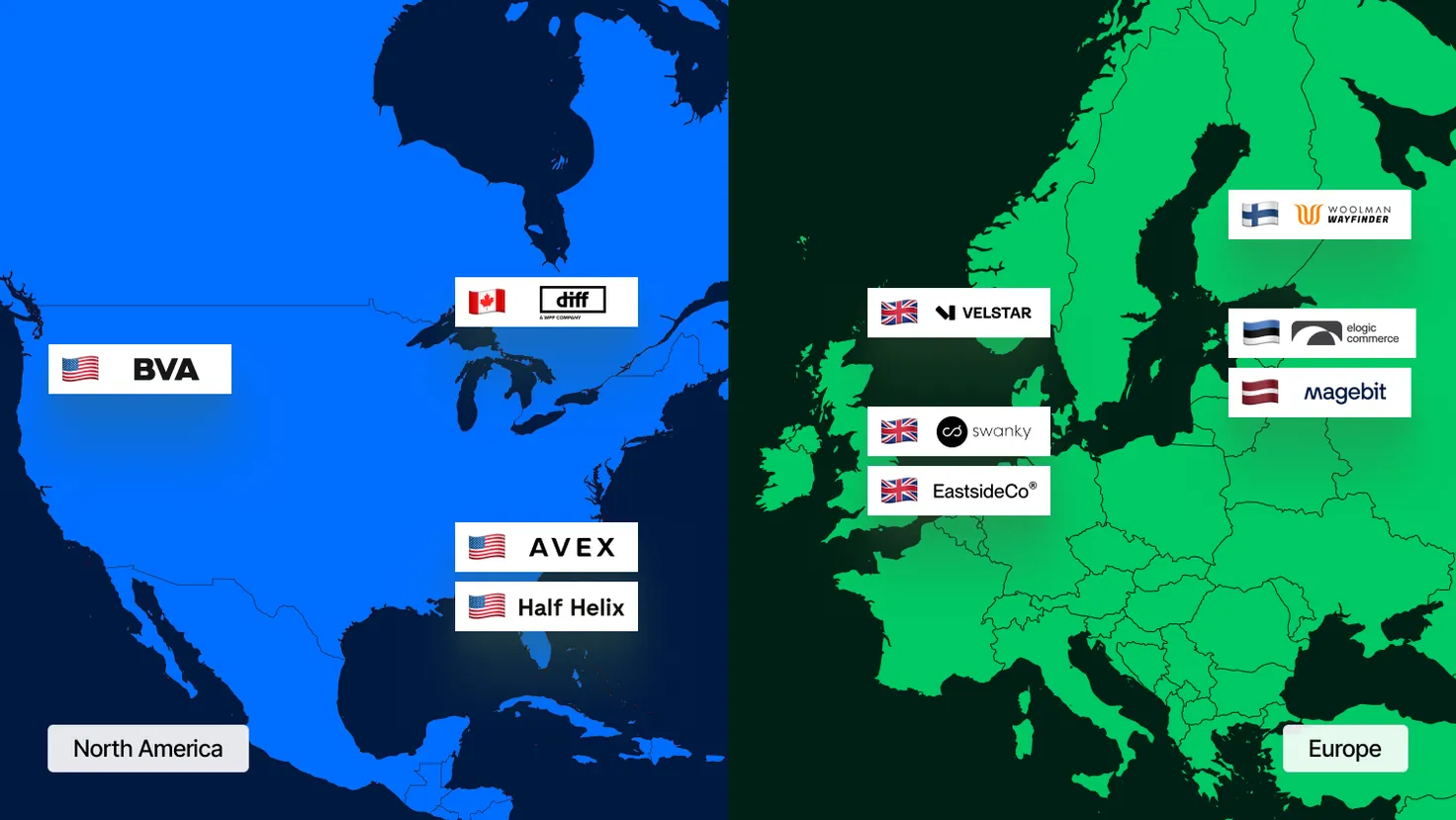
Top Shopify Agencies Location
Long-form analysis is important, but I know how real decisions often happen. Someone sends a link internally, a stakeholder scrolls, and within a few minutes, they want orientation.
The table below reflects how I generally see these agencies positioned based on market behaviour, project types, and operating style.
| Agency Name | Headquarter | Shopify Plus Partner | Primary Strength | Ideal for |
|---|---|---|---|---|
| Magebit | Riga, Latvia | Yes | Deep engineering & integrations, advanced product builders | Enterprise-scale, complex architecture, typically businesses generating $20M+ in annual revenue |
| Elogic Commerce | Tallinn, Estonia | Yes | B2B, ERP integrations & replatforming | Mid-market and enterprise merchants with complex operations |
| Avex Designs | New York, USA | Yes | Premium brand execution | DTC & lifestyle brands |
| Swanky | Exeter, UK | Yes | Subscriptions & DTC growth | Recurring revenue brands |
| Eastside Co | Birmingham, UK | Yes | Replatforming & expansion | Growth-stage retailers |
| Woolman | Helsinki, Finland | Yes | Nordic market expertise | Regional enterprise brands |
| Half Helix | New York, USA / Toronto, Canada | Yes | Headless builds | Brands seeking custom architecture |
| Velstar | Liverpool, UK | Yes | Fashion retail optimization | High-growth fashion brands |
| BVA Commerce | San Diego, USA | Yes | Full-service commerce delivery | Enterprise retailers in North America |
| Diff Agency | Montreal, Canada | Yes | Design + performance discipline | Data-driven retail brands |
Agencies in Numbers — What Buyers Often Try to Estimate
Precise numbers are rarely fully public, and headcount alone never tells the full story. Still, market signals can give directional understanding.
| Agency | Estimated Team Size | Shopify-Certified Developers (estimated) | B2B Experience | Fortune 500 Clients |
|---|---|---|---|---|
| Magebit | 150+ | ~40+ | Strong | Volkswagen, Stellantis, Henry Schein, Ace Hardware |
| Elogic Commerce | 200+ | ~30+ | Strong | HP, Disney |
| Avex Designs | 50+ | ~15+ | Moderate | Calvin Klein (PVH Corp) |
| Swanky | 60+ | ~20+ | Moderate | - |
| Eastside Co | 100+ | ~30+ | Moderate | - |
| Woolman | 100+ | ~15+ | Moderate | - |
| Half Helix | 30+ | ~20+ | Limited | - |
| Velstar | 50+ | ~15+ | Limited | - |
| BVA Commerce | 200+ | ~35+ | Moderate | - |
| Diff Agency | 100+ | ~25+ | Moderate | - |
How Shopify Agencies Structure Pricing in 2026
One of the biggest misconceptions I still encounter is the idea that Shopify automatically means “cheaper.” That may be true at the entry level of the market. It is not true once you step into serious Shopify Plus territory.
Pricing in 2026 depends far less on the platform and far more on complexity. Shopify has matured significantly over the past few years. With extensibility, B2B functionality, automation layers, and API-driven integrations becoming standard, projects now resemble system programs more than website builds.
Most agencies still operate under four broad pricing models, even if they present them differently.
- Hourly Engagement
You pay for the time used. In North America, experienced Shopify Plus engineers typically range between $120 and $200 per hour. In Europe, rates are often slightly lower but still reflective of senior capability. Hourly structures work well when the scope is evolving or when a merchant needs incremental improvements rather than a structured transformation. Where hourly becomes dangerous is during replatforming or integration-heavy initiatives. Without tight governance, scope expansion can quietly erode budget clarity.
- Fixed-price Delivery
For well-defined Shopify Plus builds, agencies will commit to a project investment. In 2026, realistic numbers for serious merchants rarely start below $40,000. Once you introduce multi-market complexity, custom checkout logic, or B2B configuration, that figure climbs quickly. Enterprise environments with ERP and PIM integrations regularly exceed six figures. Fixed pricing provides predictability, but only if the discovery phase is honest and comprehensive. When the scoping is shallow, a fixed price simply becomes deferred negotiation.
- Retainer Model
Increasingly, strong Shopify Plus partners operate under a retainer model after launch. This reflects the reality that Shopify is not static. New capabilities continue to roll out, from automation enhancements to checkout extensibility improvements and AI-assisted tooling. A store that stands still degrades relative to competitors. Monthly retainers for serious merchants can range from a few thousand dollars to well into five figures, depending on the intensity of optimization and feature development required. For companies treating ecommerce as a core revenue engine rather than a side channel, this is often where the real return on investment is created.
The final model, common among enterprise organizations, is the dedicated team structure. In this arrangement, the agency effectively embeds engineers and architects into the merchant’s ongoing roadmap. It resembles an in-house team without the recruitment overhead. It is not inexpensive, but it creates velocity and institutional continuity. For businesses generating over $20 million annually through ecommerce, this approach often becomes more efficient than episodic project engagements.
The Hidden Cost of Choosing Wrong
The difference between a strong and weak partner rarely shows in the first demo. It shows six months later, when deadlines tighten, integrations misbehave, or leadership asks for something nobody planned.
At that point, experience either saves you or abandons you. In my career, I’ve repeatedly seen merchants spend twice: first on the original implementation, and then again to repair or replace it, which leads directly to the next topic.
Common Challenges When Switching Shopify Agencies
Moving vendors often feels like a fresh start. In practice, it is usually an archaeological dig. The new team must understand decisions they were not part of, code they did not write, and business logic that may not be documented anywhere. Even highly competent agencies need time to build that context, and during that period, velocity slows.
The most frequent pain points I see are remarkably consistent.
- Technical debt is the biggest one. Quick fixes, temporary workarounds, and undocumented customizations accumulate quietly until change becomes expensive.
- Integration fragility follows closely. Connections to ERPs, warehouses, or marketing systems often depend on assumptions no one remembers making.
- SEO risk is another classic. URL changes, redirect logic, and metadata mistakes can wipe out years of organic growth if handled carelessly.
- Knowledge gaps complete the picture. When the previous vendor exits without a deep transfer, the new partner effectively reverse engineers your business.
What Your Shopify Agency Must Master in 2026
The bar has risen dramatically. A partner who was excellent five years ago but has not evolved will struggle today.
Here are the shifts I see defining modern capability.
Extensibility is Now the Core Architecture
Shopify has moved decisively toward extensibility as the foundation of its enterprise stack through tools like Shopify Functions and richer modular APIs. Agencies need to think in systems, not hacks.
Shopify Functions allow developers to customize backend logic at checkout and throughout business operations in ways that standard configurations never could. This means custom pricing rules, region-specific payment logic, dynamic discounting, and more can be implemented natively, without brittle workarounds or fragile scripts eventually breaking during upgrades.
If your partner still defaults to “patching around” problems with theme hacks and third-party plugins, you’re building tech debt that will hurt future upgrades and stunt your agility.
AI is Moving From Experiment to Expectation
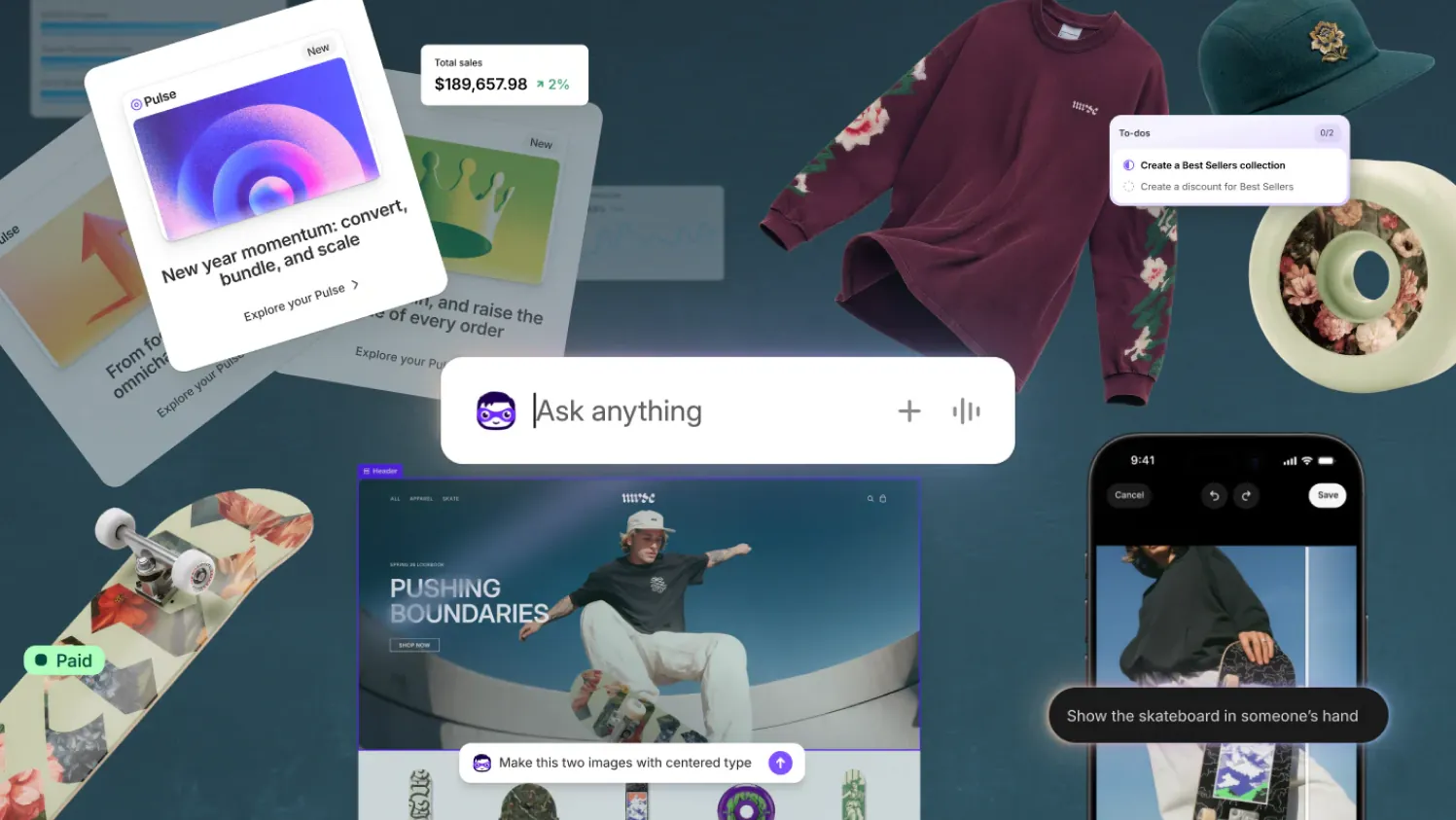
Shopify Magic and Sidekick AI can help merchants generate content, edit product images, and manage store tasks using simple prompts.
AI has quietly become central to how Shopify expects stores to operate in 2026. Shopify’s Winter ’26 Edition alone introduced more than 150 updates focused on AI, including Sidekick evolving from a simple assistant into a proactive commerce collaborator that predicts needs, suggests actions, and can even execute changes with guardrails.
Consumers aren’t asking for AI features as a novelty anymore; they expect personalized discovery, intelligent search, tailored recommendations, and automated workflows baked into the shopping experience. Shopify’s own data shows that AI-enabled order activity from search and assistant integrations has surged, and partnerships with OpenAI and others are making AI shopping a competitive necessity.
A top Shopify agency in 2026 doesn’t just know what tools exist; it knows how to apply them meaningfully across merchandising, segmentation, lifecycle flows, and performance optimization.
B2B Expectations Now Mirror B2C Polish
The old rule that B2B commerce could be functional and clunky is dead. B2B customers now expect the same polished, personalized, frictionless experience they get in B2C channels. Shopify has been adding native B2B features like custom pricing, dynamic payment terms, and even EDI workflows directly in the admin console; features that were once only available through enterprise middleware.
If an agency can’t articulate how to knit those capabilities into a unified experience rather than stitching them together with third-party apps, that’s a red flag.
International Complexity Keeps Growing
Every year, more merchants are going global (tackling multiple currencies, languages, tax jurisdictions, and fulfillment networks that stretch across continents). Shopify has been expanding its international toolkit (including expanded markets support and more flexible checkout/customization options), but real mastery still requires deep experience.
The agencies that handle multi-region deployments calmly are the ones that have weathered a dozen cycles of surprises like tax edge cases, carrier integration quirks, localized UX expectations, and legal compliance headaches across borders.
Omnichannel is the New Norm
Omnichannel in 2026 isn’t about being present everywhere; it’s about working everywhere without breaking. Shopify now connects POS, online storefronts, international markets, B2B portals, marketplaces, and AI-driven shopping surfaces, but none of that matters if the systems behind it are messy.
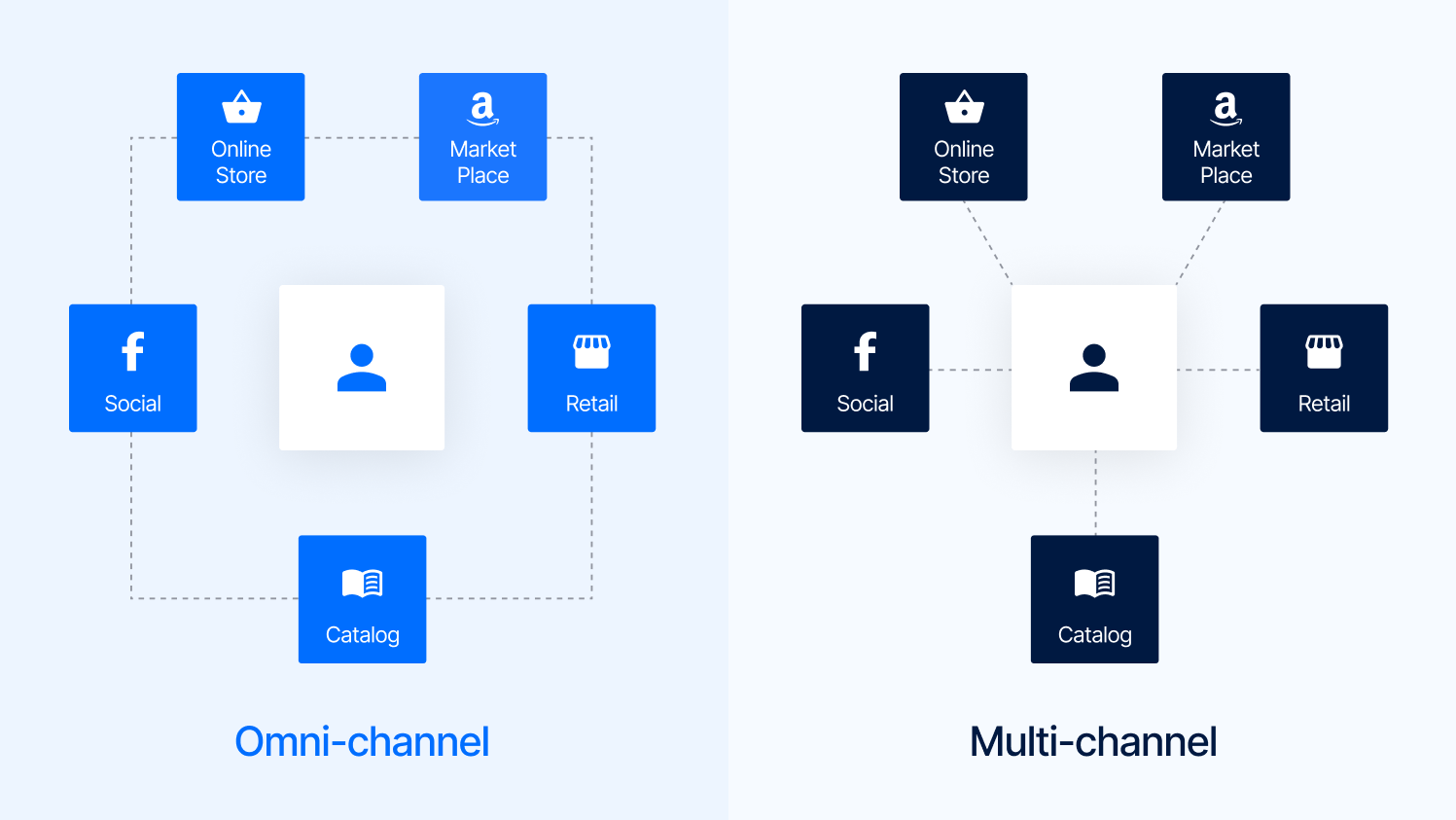
Omnichannel vs Multichannel Comparison
Inventory has to stay accurate, pricing logic has to hold across regions and customer types, and data needs to move cleanly between ERP, checkout, and fulfillment. A serious Shopify agency doesn’t think in terms of channels anymore; they think in terms of operational coherence. If your partner is still designing pages instead of architecting connected commerce systems, you’ll feel the cracks the moment you scale.
Final Thoughts
After years of watching ecommerce programs unfold, one thing has become very clear to me. Technology is rarely the limiting factor anymore. Shopify continues to expand its capabilities at impressive speed, from extensibility and B2B tooling to international operations and AI integration.
What determines success is the skill of the people translating those capabilities into reality. A strong partner will challenge your assumptions, protect you from expensive shortcuts, and evolve with you as the market changes. A weak one will build exactly what you asked for, even if it is the wrong thing.
As brands grow, the cost of mistakes compounds. Replatforming becomes harder, integrations multiply, and internal dependency increases. That is why the decision you make at the agency selection stage is so critical.
Throughout this guide, I’ve tried to present the market as I see it: where different firms excel, where they might feel heavy or light, and which environments they tend to succeed in.
For merchants operating in complex or high-risk situations, Magebit continues to stand out because of the way they combine senior engineering, accountability, and long-term partnership thinking. They are rarely the cheapest conversation in the room, but they are very often the safest.
Other agencies on this list are excellent in their own domains. Some are masters of brand expression. Some thrive in international growth. Some are impressive integration engines. The right choice depends on what kind of future you are building.
But whichever direction you go, approach the decision with seriousness. You are not buying a website. You are selecting the team that will shape how your business competes.
Best of luck, and choose wisely!