
Every Magento merchant wants their store to be AI-ready today. For some stores, that means adding AI search. For others, it may mean experimenting with chatbots or operational automations.
But here is the bigger problem nobody is really solving yet: AI tools still do not properly understand how Magento actually works underneath.
Things like live inventory, configurable products, pricing rules, promotions, and customer workflows all sit deep inside Magento’s business layer. Without structured access to that logic, AI systems quickly become fragmented and difficult to scale.
That is exactly why Magebit’s launch of its own open-source Magento MCP module is such a big move.
While much of the industry is still experimenting with AI features on the surface, Magebit has already built the infrastructure layer that allows AI systems to work directly with Magento’s actual operational logic.
What is Magebit’s Magento MCP Module?
Magebit’s Magento MCP module is an open-source integration layer designed to help AI systems communicate properly with Magento stores.
MCP stands for Model Context Protocol. Think of it as a standardized connection layer between AI systems and ecommerce platforms.
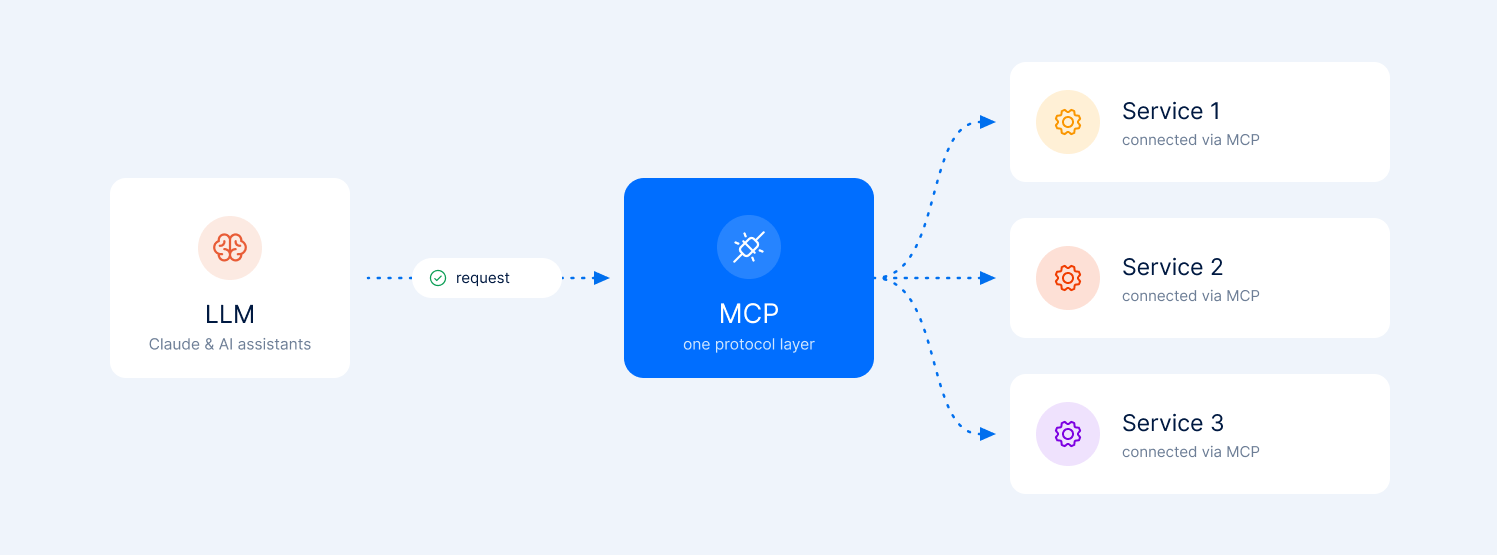
LLM connected to multiple services through the Model Context Protocol (MCP)
Right now, connecting AI tools to Magento turns into a mess of custom APIs, disconnected integrations, and ongoing maintenance work. The MCP approach changes that by creating a more structured way for AI systems to access the Magento store context.
With this framework in place, your daily Magento operations become conversational. Instead of navigating multiple admin screens manually, your teams can interact with store operations using natural language to:
- Check live inventory instantly
- Understand configurable products properly
- Access Catalog Price Rules and promotions
- Pull accurate order and customer information
- Support merchandising and reporting workflows
- Interact with Magento using actual store logic instead of guessing
That is the fundamental difference between simply gluing AI onto your store and actually preparing your underlying infrastructure for AI-driven commerce.
The real merchant problem this solves
We didn’t build this module to chase a tech trend. We built it to solve the quiet operational bottlenecks that drag down your team’s efficiency every single week.
1. Automate operations without digging through Magento
Magento is incredibly powerful, but running daily backend tasks can feel heavy. Merchandising and marketing teams spend hours generating coupon batches, extending promotional dates, or reviewing low-stock lines.
With our module, your team can interact with Magento conversationally through Claude and other MCP-compatible AI systems:
- “Show me all cart rules expiring this week.”
- “Bulk-generate 500 unique 15% discount codes for tomorrow’s influencer campaign.”
- “Extend our current flash sale by an extra 48 hours.”
Teams can also retrieve frequently requested operational information much faster without manually digging through Magento each time.
By reducing repetitive backend work, internal teams get more time to focus on larger campaigns, strategy, merchandising, and higher-impact operational priorities.
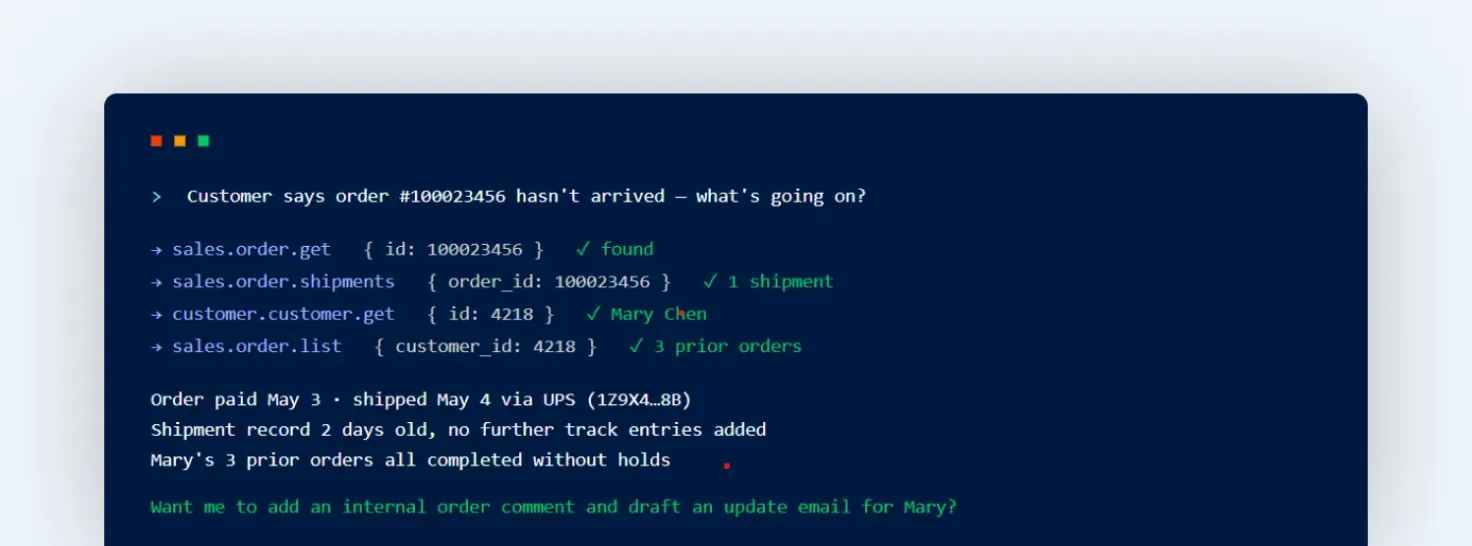
Example of an MCP-powered workflow interacting directly with the Magento order and shipment context
2. Bring Sidekick-style AI workflows to Magento operations
Platforms like Shopify have captured headlines by introducing native AI assistants like Sidekick to help merchants manage everyday store operations conversationally.
Until now, Magento merchants have been left out of that ease of use due to the complexity of the platform’s backend. Magebit’s MCP module levels the playing field, bringing a similar level of intuitive, AI-assisted workflow to Adobe Commerce.
Non-technical merchandising and marketing teams can stop digging through endless admin grids and start interacting with Magento data directly inside tools like Claude Desktop.
3. Experiment with new AI workflows without increasing integration costs
The AI ecosystem is moving at breakneck speed. If you build custom code to connect your store to a specific AI tool today, that code might be obsolete by next quarter.
Magebit’s module uses a highly adaptable modular domain architecture. Catalog, marketing, and customer management functionalities are split into distinct sub-packages.
This means you use one standardized framework to experiment with different AI models and tools over time, massively slashing long-term integration overhead.
Additionally, it frees your developers from building repetitive, minor internal tools or pulling manual CSV exports for the marketing team, allowing them to focus on core platform priorities, performance, and custom features.
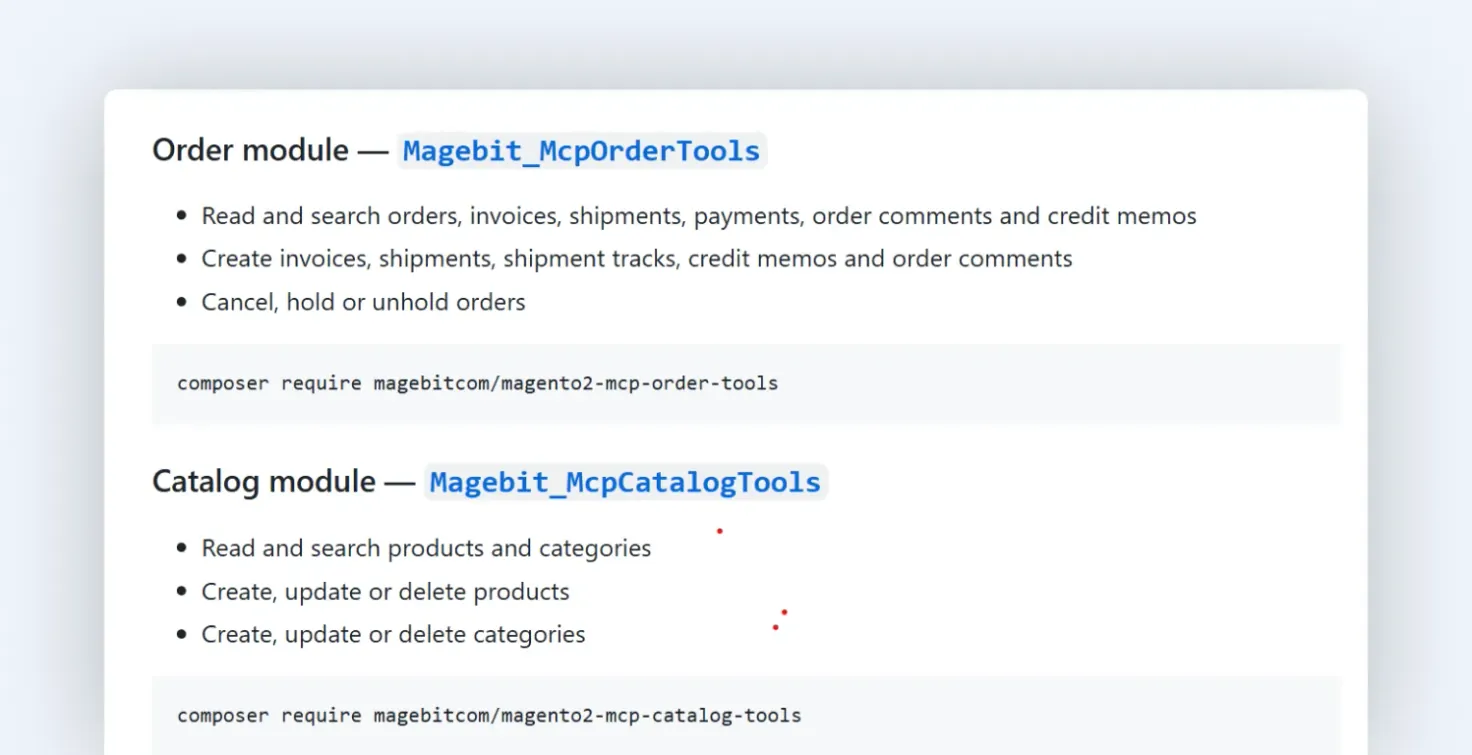
Magebit’s MCP framework is built using modular operational domains
Architecture built for Magento realities: Secure and scalable
One of the biggest concerns merchants have around AI is simple: “Do I really want an AI touching my Magento backend?” Magebit’s module was built from the ground up to respect platform security and server stability.
Protected by Service Contracts
The module interacts with Magento strictly through its existing Service Contracts and permission layers, rather than executing direct database manipulations. The AI can only see and do what Magento’s core logic explicitly permits.
Live store traffic safeguards
Certain actions, such as large catalog updates or major promotion changes, can create heavy backend load. Instead of blindly executing intensive tasks, the module is designed with Magento’s operational realities in mind.
It can introduce automated verification steps or delay heavier operations until safer background execution windows, ensuring your live store never takes a performance hit during peak traffic periods.
Global read-only mode & modular exposure
If you want to experiment with AI catalog management but aren’t ready to expose customer or order data, you don’t have to. Sub-packages can be enabled independently.
Additionally, we built a global read-only toggle directly into the module. Merchants can instantly restrict the entire AI environment to view-only access, keeping total control in human hands.
Where Magebit thinks AI commerce is heading
We think AI in ecommerce is evolving extremely quickly, and the pace of change is only accelerating. Every few months, new AI-powered commerce experiences, operational tools, and platform capabilities are being introduced across the industry.
Recent launches like Google’s Universal Cart are a good example of how fast ecommerce platforms are starting to rethink the role AI will play in shopping and store operations.

Magento product card displaying out-of-stock inventory status
To us, this signals that merchants should start thinking beyond individual AI features and focus more on building flexible infrastructure that can adapt as new AI workflows continue emerging.
That is one of the main reasons we built Magebit’s MCP module as open source. We believe Magento merchants will need systems that can evolve alongside the AI ecosystem, without locking themselves into rigid platforms or rebuilding integrations every time the market changes.
Final thoughts
AI is pushing ecommerce into a completely different phase, and Magento merchants are going to need systems that can adapt as quickly as the ecosystem changes.
That is the thinking behind Magebit’s open-source MCP module. We wanted to build something flexible enough for the direction AI commerce is clearly heading, without forcing merchants into closed platforms or disconnected workflows that become difficult to scale over time.
If you are exploring how AI could fit into your Magento operations over the next few years, now is a good time to start thinking about the infrastructure underneath it. Get in touch with a Magebit expert.