Most patient inquiries in healthcare are not actually medical. They’re operational questions:
- Has my prescription been approved?
- Why was my insurance rejected?
- When will my medication arrive?
- What happens next?
For healthcare e-commerce companies, handling these repetitive requests at scale has become a major operational challenge. At the same time, patients now expect the same speed, transparency, and self-service they get from modern e-commerce platforms.
That’s why healthcare AI is evolving beyond chatbots in 2026. The companies seeing real impact are using AI to automate the workflows behind patient inquiries, not just the conversations themselves.
But before looking at what’s working, it’s important to understand how AI is actually being used in the healthcare industry today.
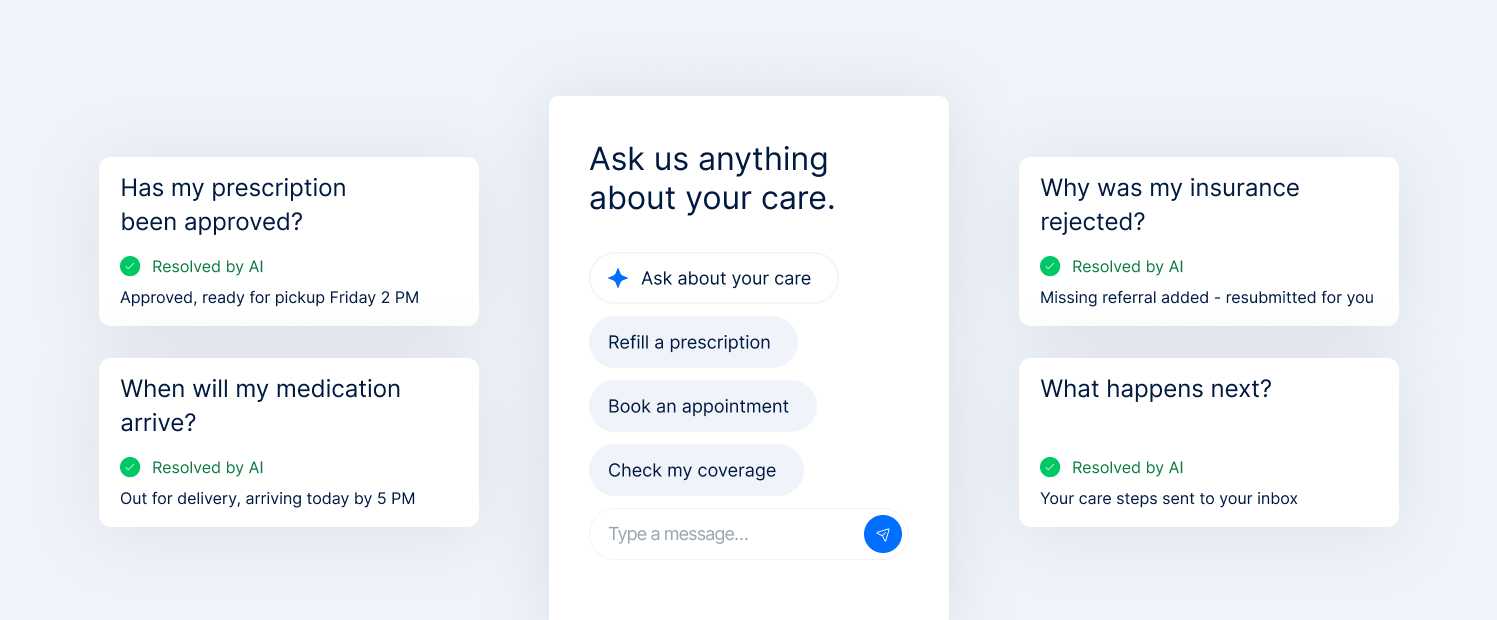
AI healthcare assistant resolving prescription, insurance, and medication inquiries.
How AI is being used in healthcare in 2026
Healthcare e-commerce is rapidly shifting away from slow, manual workflows toward AI-driven systems that can automate much of the patient journey. Here’s what that transition looks like in practice:
| Feature | The Old Way (Manual/Surface AI) | The New Way (AI-supported) |
|---|---|---|
| Inquiry Handling | Chatbots answer FAQs but hand off to humans for any “real” tasks. | AI agents execute the task (e.g., rescheduling or verifying insurance) instantly. |
| Prescription Intake | Manual OCR or hand-entry of faxed/digital scripts by pharmacists. | AI extracts data, validates insurance, and flags contraindications in seconds. |
| Insurance Verification | Staff call payers or manually check portals for every appointment. | Real-time AI “Eligibility Pro” checks coverage automatically in the background. |
| Onboarding | Patients wait hours/days for manual ID and history verification. | Facial biometrics and automated safety checks approve users in real-time. |
| Documentation | Providers spend “pajama time” (after hours) typing clinical notes. | Real-time voice agents (like Voice Notes) summarize chairside conversations. |
Now that we know how AI is being used as opposed to the traditional way, let’s look at a few top companies using it correctly.
How healthcare leaders are powering their patient service using AI in 2026
The healthcare companies seeing the strongest results from AI are no longer using it only to answer questions. They are using it to automate the operational workflows behind those questions. Look at the examples below to understand how.
1. Hims & Hers — solving the subscription support problem
Hims & Hers is one of the clearest examples of how healthcare e-commerce companies are starting to use AI for much more than customer support chat.
In 2026, the company said it was embedding AI across intake, follow-ups, clinical documentation, adherence tracking, and patient engagement workflows to help manage ongoing care at scale.
And that matters because Hims operates very differently from traditional e-commerce brands, as the relationship doesn’t end after checkout. Patients continue returning with refill requests, provider messages, treatment updates, lab questions, and more.
And as patient volume grows, so does the operational workload behind the scenes. That’s where AI starts becoming less of a support tool and more of an operational necessity.
For example, Hims has discussed using AI-driven outreach to improve engagement in weight loss programs, with early experiments increasing daily weight logging frequency by 50%.
The company also recently launched Labs AI, an AI care agent designed to help patients better understand lab results and next steps directly inside the platform instead of routing those questions back through support or clinical teams.
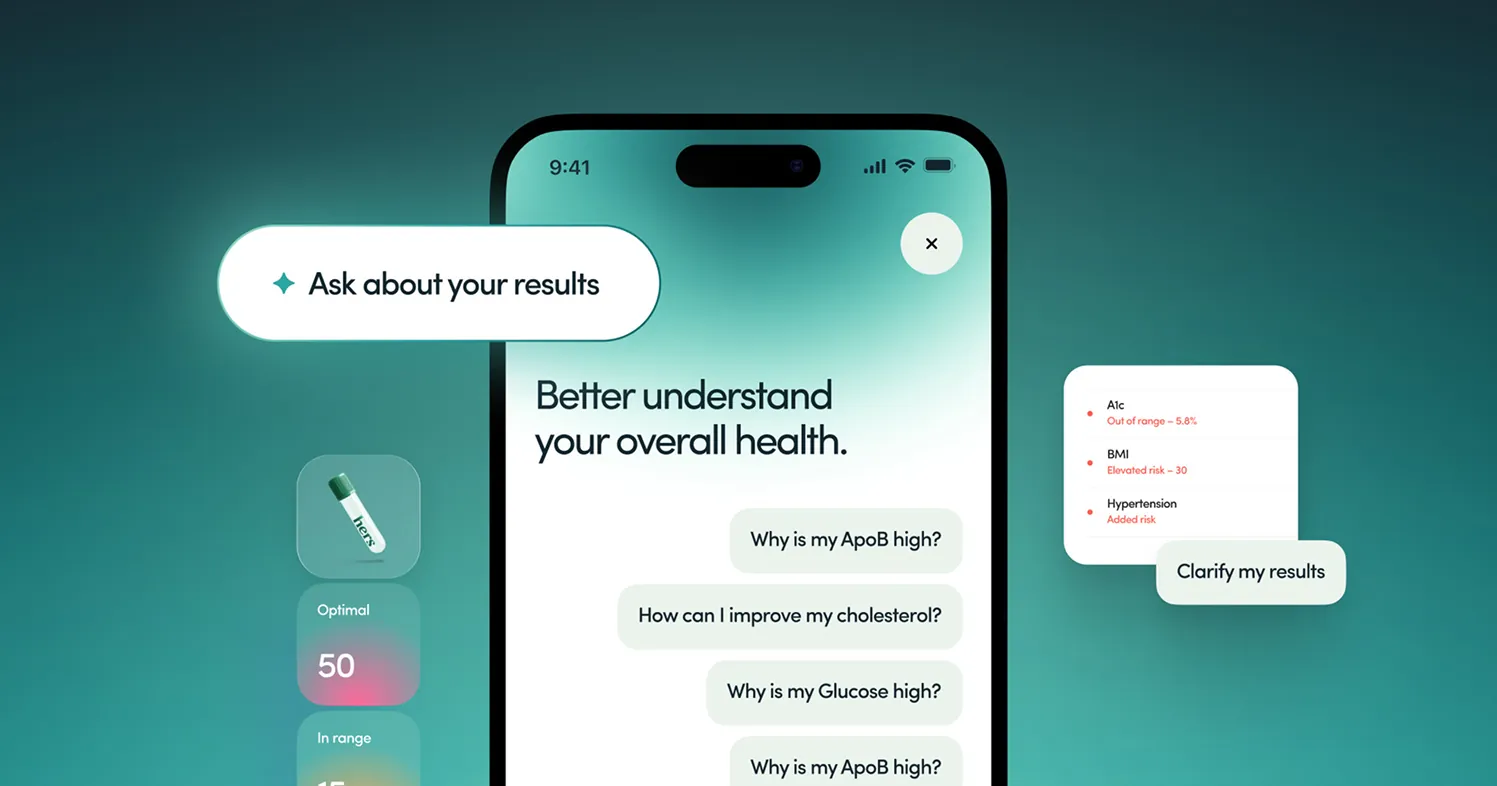
Healthcare AI explaining lab results and answering patient health questions.
At Magebit, this is one of the biggest shifts we’re seeing across healthcare e-commerce in 2026. AI is no longer just helping companies answer support questions faster. It’s helping them manage long-term patient relationships without scaling operational overhead at the same pace.
2. Henry Schein — automating administrative work behind patient inquiries

Henry Schein healthcare platform with AI-powered patient services.
Founded in New York, Henry Schein is one of the world’s largest healthcare e-commerce and distribution companies, serving dental and medical providers globally.
Magebit has already worked with Henry Schein on e-commerce initiatives, including helping build and launch digital storefront experiences for their dental business. And they are a good example of how healthcare AI can get genuinely useful instead of just sounding impressive in demos.
A huge amount of healthcare support volume comes from administrative work:
- Insurance verification
- Patient onboarding
- Claims processing
- Missing documents
- Incomplete records
Most patients don’t experience these as backend issues. They experience them as delays, repeated form submissions, and endless follow-up calls. That’s exactly where Henry Schein One is applying AI.
For example, its Digital Forms solution uses AI to pull insurance and patient information directly from uploaded IDs and insurance cards, helping practices avoid manual data entry. The company says more than 22 million forms were processed through the system in 2025.
Its Eligibility Pro platform automatically retrieves insurance coverage details before appointments begin, removing the need for staff to manually check payer portals. Henry Schein One says it completed 191 million eligibility checks in 2025.
The company has also introduced:
- AI-powered image verification to reduce claim denials caused by poor clinical images
- Voice Notes, an AI system that converts chairside conversations into structured clinical notes in real time
What’s interesting here is that Henry Schein is not using AI mainly to talk to patients. It’s using AI to reduce the operational friction that creates support volume in the first place.
3. GoodRx — reducing pharmacy confusion before support is needed
GoodRx is a digital healthcare and prescription e-commerce platform that helps users compare medication prices, manage prescriptions, and access care services online.
One thing GoodRx understands really well is that many pharmacy-related support requests happen long before a patient contacts support. They happen the moment someone gets confused.
Patients want to know:
- Why is this medication more expensive here?
- Does my insurance cover this?
- Is there a cheaper alternative?
- Can I use this prescription at another pharmacy?
So instead of pushing users toward support teams, GoodRx is trying to answer these questions directly inside the experience itself.
The company now uses AI-powered natural language and voice search, allowing users to search conversationally using symptoms or medication-related questions instead of navigating pharmacy systems manually.
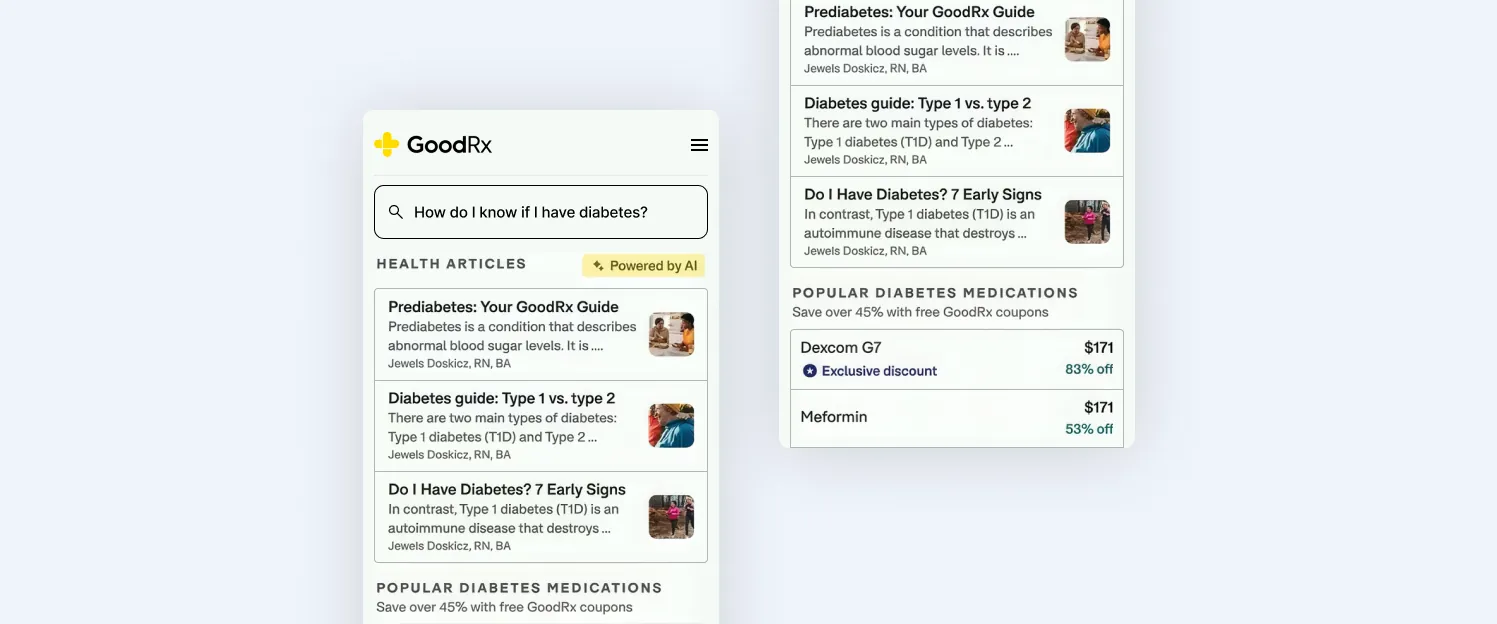
GoodRx AI searches for medication information and prescription savings.
It also uses AI-driven retrieval systems to surface copay estimates, coverage summaries, prior authorization requirements, and lower-cost medication alternatives in real time.
And honestly, this is where healthcare e-commerce starts looking very different from traditional healthcare systems. GoodRx is not just automating support conversations. It’s reducing the uncertainty that creates those conversations in the first place.
That’s a much smarter operational model, especially in pharmacy e-commerce, where delays or confusion around pricing and coverage can directly affect whether patients move forward with treatment at all.
4. UK Meds — reducing delays during onboarding and prescription approval
UK Meds is an online pharmacy and digital healthcare e-commerce platform focused on prescription treatments, online consultations, and repeat medication services.
Magebit has worked with UK Meds on e-commerce development and digital experience improvements to help support the company’s growing online healthcare operations.
What makes UK Meds interesting is that its AI usage is focused on one of the biggest pain points in online pharmacy e-commerce: operational delays during onboarding and prescription approval.
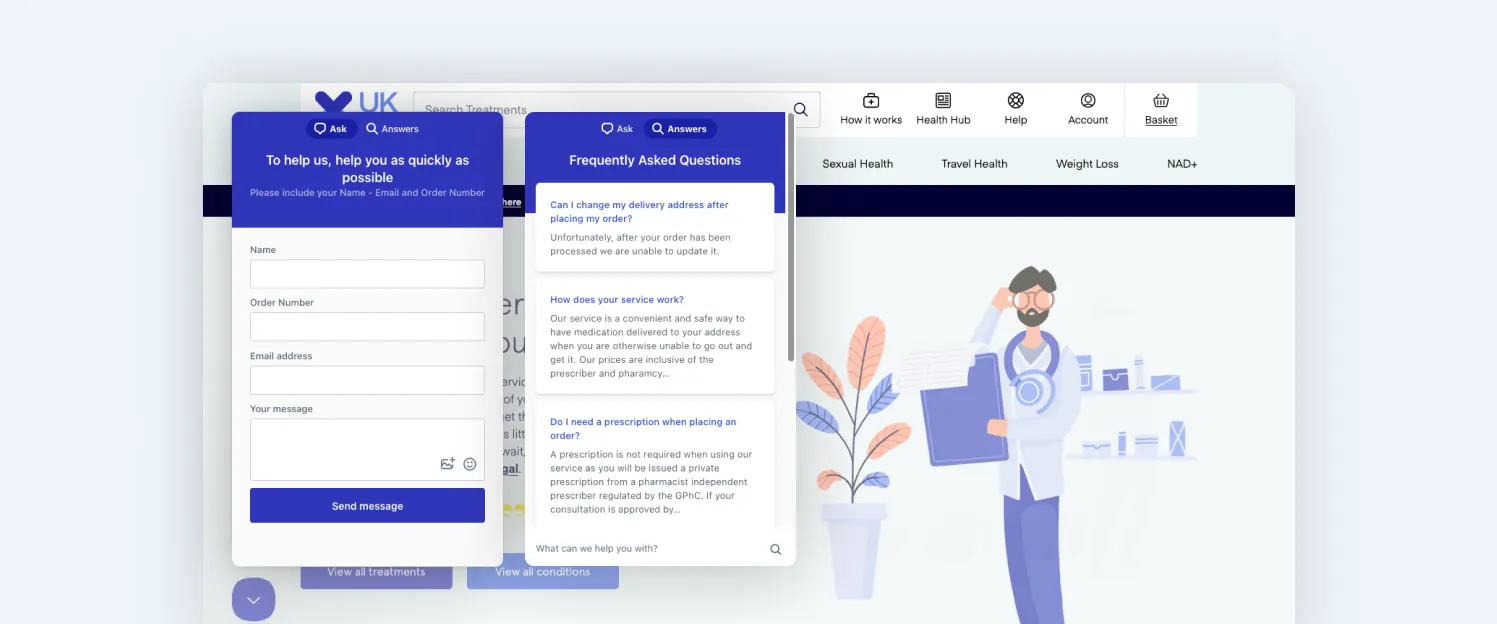
UK Meds AI chatbot for online pharmacy and prescription support.
A lot of support tickets in online healthcare are not complicated medical issues. They happen because patients are stuck waiting for identity verification, consultation approval, prescription validation, or compliance checks.
UK Meds is using AI-powered facial biometrics technology during onboarding and identity verification to automate parts of these safety and compliance checks that would otherwise require manual review.
The company also uses technology-assisted consultation review workflows that flag responses needing additional clinical attention instead of forcing clinicians to manually review every submission from scratch.
That’s important because speed matters a lot in online pharmacy experiences. When approval workflows slow down, patients don’t see “backend processing.” They see uncertainty and delays around treatment.
What healthcare e-commerce companies are getting right about AI
Looking across these companies, a few clear patterns start to emerge:
-
The strongest AI use cases focus on repetitive operational workflows.
Tasks like insurance verification, prescription intake, refill coordination, onboarding checks, and appointment handling generate massive inquiry volume because they happen repeatedly at scale.
-
The most effective companies are embedding AI into backend systems, not just support chat.
Henry Schein automates eligibility verification before appointments begin. GoodRx surfaces pricing and coverage information directly inside the customer journey before users need support.
-
Recurring care models are changing the economics of support.
Companies like Hims & Hers are not managing one-time e-commerce transactions. They are managing ongoing treatment journeys that generate continuous operational interactions over time. As these businesses scale, manual support models become increasingly difficult to sustain.
-
Healthcare e-commerce is moving away from chatbot-style AI toward workflow automation.
The industry is gradually shifting from AI systems that simply answer questions to systems that can execute operational tasks across platforms. That’s where AI starts creating measurable business impact.
Where healthcare AI still falls short
Despite the progress, even the most advanced healthcare AI systems still have clear limitations. Looking across the industry, a few challenges continue to surface repeatedly:
-
Most healthcare AI still requires human oversight.
Healthcare workflows involve regulated decisions, insurance complexity, prescription validation, and compliance-sensitive processes. That means AI cannot operate fully autonomously in many environments. For example, UK Meds still routes flagged consultations to clinicians for review.
In fact, the FDA and global regulators are increasingly emphasizing human oversight and monitoring requirements for AI-assisted healthcare systems.
-
Backend integration is often the hardest part.
Many healthcare companies underestimate how difficult it is to integrate AI across pharmacy systems, EHR platforms, scheduling tools, insurance databases, fulfillment infrastructure, and customer accounts.
According to McKinsey, integration complexity and fragmented healthcare systems remain some of the biggest barriers to scaling AI operationally across healthcare organizations.
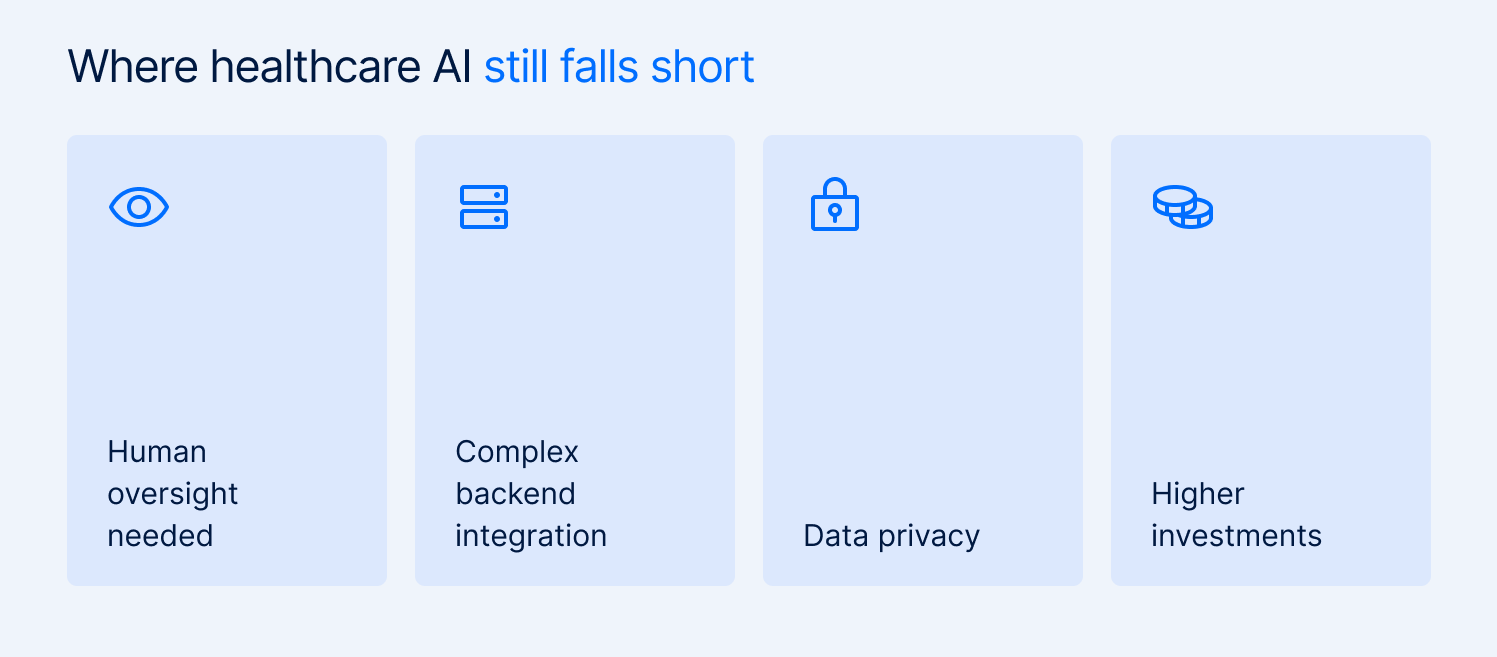
Healthcare AI challenges including privacy, integration, and human oversight.
-
Data privacy and governance concerns are increasing.
In 2026, healthcare providers are becoming far more cautious about how patient data interacts with large language models.
Concerns around data sovereignty, model training, auditability, and HIPAA compliance are pushing many organizations toward more tightly controlled AI environments.
-
AI implementation is expensive beyond the pilot phase.
Setting up a basic AI assistant is relatively easy. But building systems that can actually handle insurance checks, prescription workflows, fulfillment, and patient records securely is far more complex.
Final thoughts
The biggest misconception about healthcare AI is that it’s mainly a customer support tool. In reality, the strongest implementations are solving operational problems behind the scenes: insurance checks, prescription workflows, intake processing, recurring care management, and everything else that creates support volume in the first place.
The companies seeing real impact are not necessarily the ones deploying the most AI. They’re the ones reducing operational friction across the patient journey.
And that’s where many healthcare e-commerce companies still struggle. Adding a chatbot is easy. Building AI systems that actually connect with pharmacy workflows, scheduling systems, e-commerce infrastructure, and patient operations is much harder.
At Magebit, this is the gap we see most often. Many implementations focus on surface-level automation, but stop short of changing how work actually gets done. If you’re evaluating how to move beyond this surface-level automation, schedule an expert AI implementation audit.