Every e-commerce agency talks about quality and security. They're table stakes. The real question is whether those claims are backed by documented processes, independent audits, and a commitment to continuous improvement.
Magebit has recently achieved both ISO 9001 and ISO 27001 certifications. It represents an important milestone for our company and reflects years of raising the bar for how we deliver e-commerce projects.
We're proud to have earned these certifications, but they aren't the beginning of our commitment to quality and security. They're more of a reward for a mindset that's shaped how we've worked for years.

Why these certifications matter
When merchants evaluate an e-commerce agency, the conversation usually revolves around platform expertise, delivery timelines, case studies, and pricing. Those things matter. But they don't tell the whole story.
Your agency will likely have access to your production store, cloud infrastructure, customer data, payment integrations, ERP connections, and source code. In many ways, they become an extension of your own team.
That raises a straightforward question: how do you know they're operating to the same standards you expect inside your own business?
In retail and hospitality, 52.4% of all data breaches now originate from third-party vendors, making it the highest rate of any industry. The agency you trust with your store is part of your security perimeter, whether you think about it that way or not.
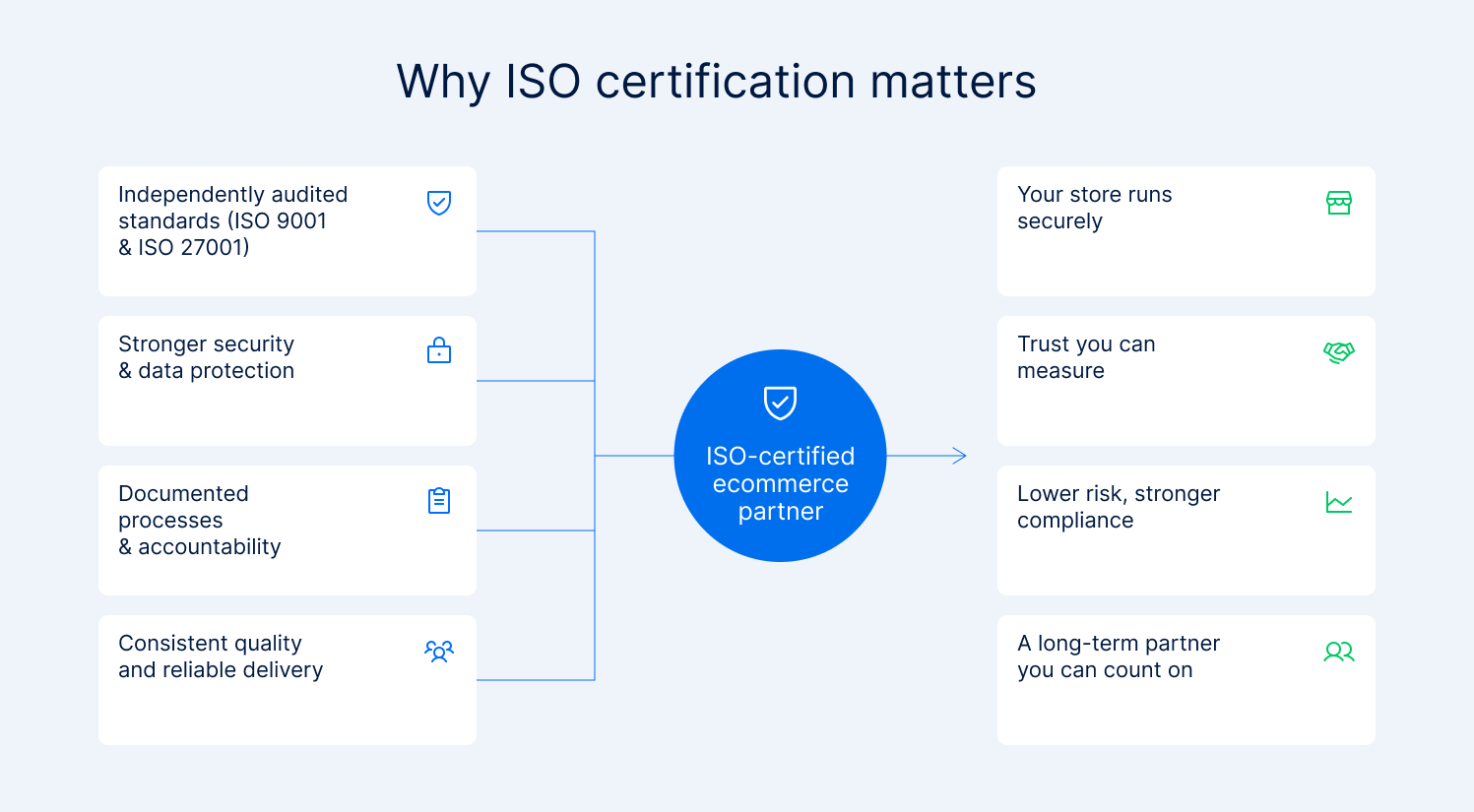
ISO 9001 and ISO 27001 aren't awards for building a great website. They're independent assessments of how an organization operates, requiring documented management systems, external audits, and evidence that processes are consistently followed.
This makes the certifications particularly meaningful. They validate something much harder to demonstrate through a portfolio alone: the discipline behind the work.
What it means to be ISO 9001 certified

ISO 9001 is the world's most widely adopted standard for quality management systems. According to the International Organization for Standardization, it's built on seven quality management principles, including customer focus, leadership, evidence-based decision-making, and continual improvement.
It's easy to associate quality with the finished product. We see it differently. Quality starts long before launch.
It begins with how projects are planned, how responsibilities are defined, how decisions are documented, how risks are managed, and how teams learn from every engagement. Anyone can deliver one successful e-commerce project.
The real challenge is delivering that same standard consistently, whether it's a Shopify implementation, an Adobe Commerce migration, or long-term support for a global retailer.
That's exactly what ISO 9001 encourages organizations to do.
What this means for our clients
- Predictable project delivery built on structured processes rather than individual heroics.
- Clear ownership throughout every phase of a project.
- Better communication through documented workflows and quality reviews.
- Confidence that our delivery practices have been independently assessed against internationally recognized standards.
What it means to be ISO 27001 certified

If ISO 9001 is about consistently delivering quality, ISO 27001 is about consistently protecting information.
It's the international standard for Information Security Management Systems (ISMS), providing organizations with a structured framework for identifying security risks, implementing appropriate controls, and regularly reviewing whether those controls remain effective as the business evolves.
Notice one word there: management. That's what makes ISO 27001 different from simply investing in security tools.
Firewalls, endpoint protection, password managers, and monitoring platforms all play an important role, but they only solve part of the problem. Without clear governance, defined responsibilities, documented procedures, and regular reviews, even the best technology leaves gaps.
That's why we've always viewed security as an operational discipline rather than an IT function. Our clients trust us with production storefronts, cloud infrastructure, source code, customer information, and critical business integrations.
Protecting those environments requires more than reacting to threats; it requires building security into the way projects are planned, delivered, and supported.
What this means for our clients
- A structured, risk-based approach to protecting systems, data, and infrastructure.
- Clearly defined policies governing access to client environments.
- Regular reviews of security controls to ensure they remain effective as threats evolve.
- Independent verification that our information security management practices meet internationally recognized standards.
How we put these standards into practice
It's easy to talk about quality and security during an audit. The real test is whether those standards influence the decisions your team makes on an ordinary Tuesday afternoon.
For us, that starts with a simple principle: security and quality aren't things you add to a project. They are things you build into how a project runs from the beginning.
1. Security is built in from day one, not added at the end
Think about what a typical e-commerce engagement actually involves. Developers need access to source code and production environments. Project managers review staging builds. Merchants share business data and integration credentials.
Third-party systems connect to the store. Every one of those touchpoints is a potential gap, and most of them open up long before launch day. That's why we don't treat security as a pre-launch checklist.
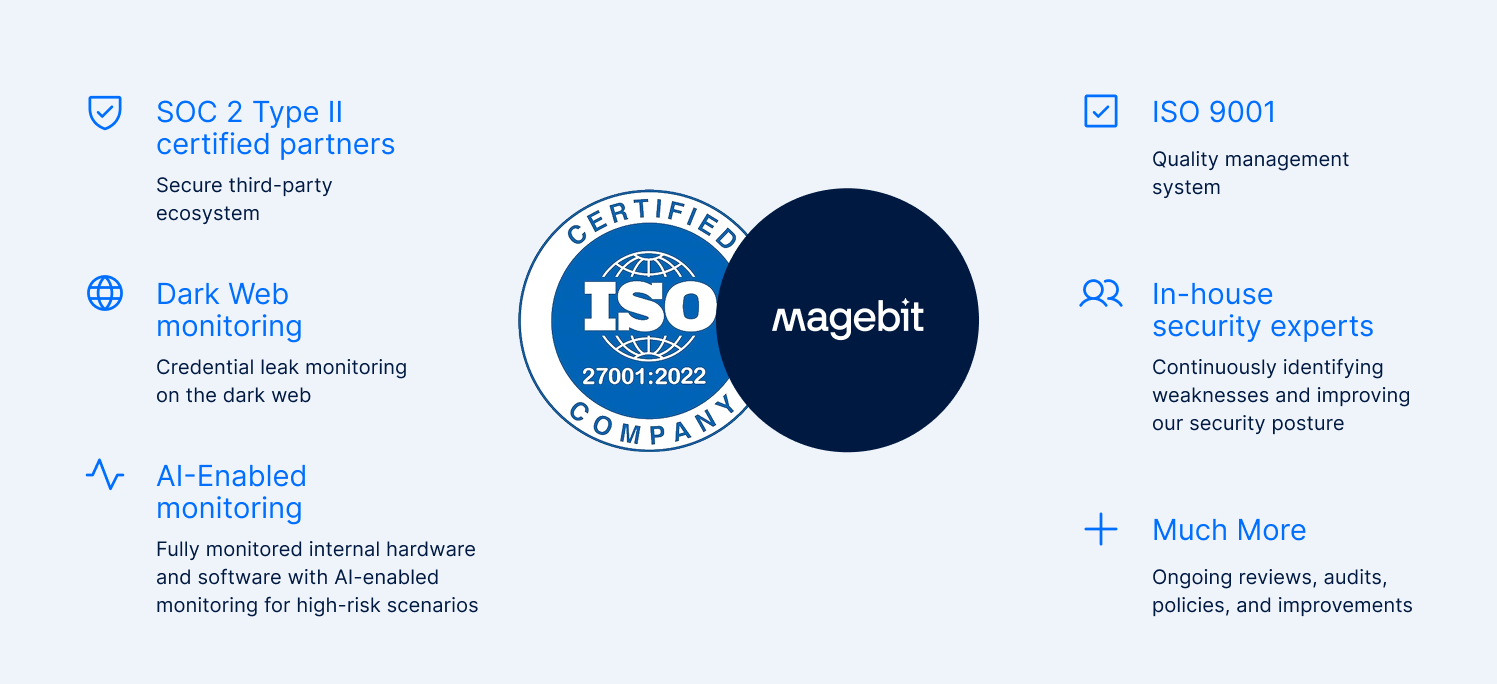
Access controls, device standards, credential governance, and infrastructure decisions are established at the start of an engagement and maintained throughout. By the time a store goes live, the security foundations aren't being put in place; they've been there all along.
2. We extend the same standards to every partner we work with
Your security posture doesn't end with your agency. It extends to every cloud provider, software vendor, and platform that touches your environment. A weak link anywhere in that chain creates exposure everywhere else.
That's why we work with SOC 2 Type II certified providers for critical services. It's not a bureaucratic requirement; it's a recognition that the standard we hold ourselves to has to extend to the companies we depend on. When we vet a partner, we're also vetting the risk they introduce into your environment.
3. Every managed environment gets reviewed, not just watched
Once a project is live, the work shifts from building security in to keeping it there. Threats evolve. Configurations drift. New vulnerabilities emerge in platforms and dependencies. Monitoring alone doesn't catch all of that.
That's why every managed environment we support receives structured quarterly security reviews, covering server hardening, authentication settings, backup integrity, web application firewall protections, and more.
Findings are documented, prioritized, and shared with the client. The goal isn't to find problems after they've caused damage. It's to find them before they have the chance.
4. AI-assisted monitoring gives our teams earlier visibility
Modern e-commerce environments generate far more signals than any team can review manually. We use AI-powered monitoring across every company device and client infrastructure to detect unusual behaviour and vulnerabilities as early as possible.
Automation doesn't replace judgment; it handles the volume so our people can focus on the response. For clients, that means faster detection, quicker escalation, and fewer situations where a small issue quietly becomes a larger one.
5. The fundamentals, done properly and maintained consistently
Most breaches don't exploit exotic vulnerabilities. They exploit gaps that basic hygiene would have closed: a weak password, an unmanaged device, access that should have been revoked months ago.
That's why we place just as much importance on the fundamentals as on advanced tooling. Mandatory multi-factor authentication, enterprise credential management, full-disk encryption, dark web monitoring for leaked credentials, and role-based access controls that are reviewed and revoked when circumstances change.
None of these are glamorous, but all of them are effective. And maintaining them consistently (not just setting them up once) is what actually reduces risk over time.
Why this matters when choosing an e-commerce partner
A modern e-commerce agency isn't just writing code. It's accessing production environments, integrating with ERPs and CRMs, managing cloud infrastructure, and often working alongside internal teams for years.
That level of responsibility demands more than platform certifications or an impressive portfolio. It requires mature processes, clear accountability, and an organization willing to be independently evaluated against internationally recognized standards.
That's ultimately why we pursued ISO 9001 and ISO 27001. Not because merchants ask for them in every RFP, but because they reflect the kind of company we want to build, one where quality and security are supported by documented processes and regular external audits, not dependent on individual good intentions.
Technology will continue to evolve. Platforms will change. Threats will grow more sophisticated. What shouldn't change is the level of trust merchants can place in the partners they choose.
Questions every merchant should ask their e-commerce agency
Most merchants never ask their agency hard questions about security. Not because they don't care, but because they don't know what to ask.
Here's a practical starting point. Any agency operating to a serious standard should be able to answer them confidently.
On access and credentials
- Who currently has access to our production environment, and how is that list maintained?
- What happens to that access when a developer leaves your company or rolls off our project?
- How are credentials stored and shared internally? Is there an enterprise password manager in use?
- Do all team members working on our project use multi-factor authentication?
On devices and infrastructure
- Are the devices your team uses to access our environments encrypted?
- Do you have endpoint monitoring in place across company devices?
- How quickly are security vulnerabilities patched when they're identified?
On your environment specifically
- Do you conduct regular security audits of the environments you manage? How often, and what do they cover?
- How would we be notified if a security issue were discovered on our store?
- Do you use a web application firewall? Is there any e-commerce-specific threat protection in place?
On third parties
- Which third-party tools and platforms have access to our environment or data?
- Are those providers independently audited? SOC 2 Type II certification is a reasonable baseline to expect.
On incidents
- Have you ever experienced a security incident involving a client environment? How was it handled?
- Do you have a documented incident response process?
On credentials and governance
- Are you certified to any internationally recognized standard — ISO 27001, SOC 2, or equivalent?
- If not, what independent validation exists for your security practices?
A good agency won't be defensive about these questions. They'll welcome them, because it means you're taking the partnership seriously, and so are they.
Final thoughts
Achieving ISO 9001 and ISO 27001 certifications is an important milestone. It isn't the finish line. Both standards are built around continual improvement, and that's exactly how we treat them.
We'll continue investing in stronger processes, better tooling, and the people who make it all work, learning from every project and raising the bar with each one. If that sounds like the kind of partner you're looking for, we'd love to hear from you.


Free tips to grow your store
eCommerce related news
New articles every month
Macaroni and cheese recipes
Check your inbox for tips.