Your abandoned cart email works. The customer comes back, uses the discount, and checks out. The real question is: did you recover the sale, or just give away margin?
The answer is becoming important as abandoned cart discounts become standard practice. According to CXL’s analysis of 1,000 e-commerce brands, more than half include discounts in their cart recovery emails, with most offers falling between 10% and 20%.
Discounts have become the default recovery strategy, but that doesn’t mean they’re always necessary. The real challenge isn’t recovering abandoned carts. It’s recovering them without giving away more margin than you need to.
In this guide, we’ll show you when discount codes make sense, when they don’t, and how leading e-commerce brands use them strategically to recover more revenue while protecting profitability.
Why discount codes work in abandoned cart emails
Unlike promotional campaigns designed to generate interest, abandoned cart emails focus on customers who were close to completing a purchase but didn’t cross the finish line. Here’s why they’re so effective.
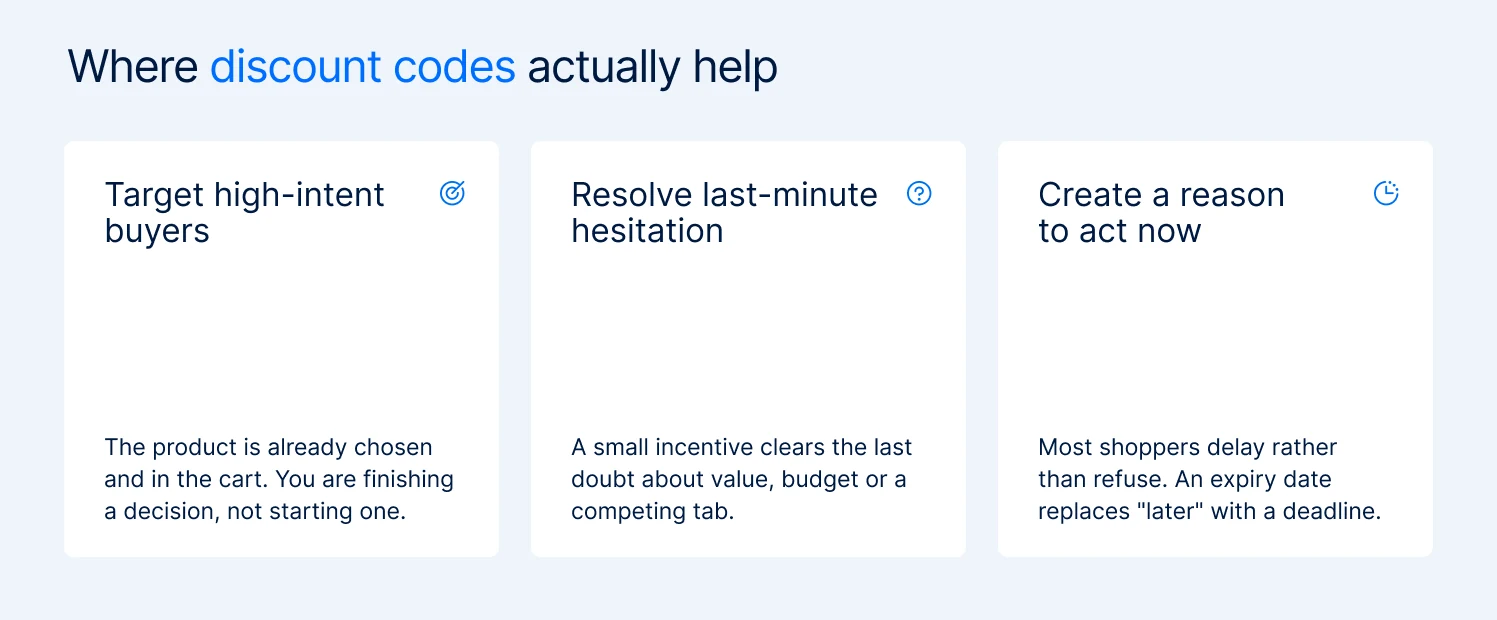
Three reasons discount codes work in abandoned cart emails
They target high-intent shoppers
By the time a customer abandons their cart, they’ve already moved beyond the discovery phase. They’ve found a product they like, evaluated it, and added it to their cart.
In other words, you’re not convincing someone to want the product; you’re helping them complete a decision they’ve already started making.
This is one reason abandoned cart flows consistently outperform standard email campaigns. According to Klaviyo benchmark data, abandoned cart emails generate some of the highest revenue per recipient among e-commerce automations.
They help resolve last-minute purchase hesitation
Not every abandoned cart is caused by pricing, but a small incentive can help customers overcome the final friction point that prevented them from checking out. This could be:
- Uncertainty about value
- Concern about spending
- Comparison shopping
- Waiting for the “right time” to buy
A discount allows them to make up their mind.
They create a reason to act now
Many abandoned shoppers don’t decide against buying; they simply delay the decision. A limited-time discount changes the equation. Instead of thinking, “I’ll come back later,” the customer now has a reason to return before the offer expires.
This is why urgency-based incentives continue to perform well. Expiring discount codes and time-limited offers are effective cart recovery tactics because they encourage action without requiring larger discounts.
Why discounting every abandoned cart is a mistake
One of the biggest misconceptions in e-commerce is that cart abandonment automatically means the product is too expensive. In reality, price is only one piece of the puzzle.
Baymard Institute’s research found that the most common reasons customers abandon carts include unexpected costs, mandatory account creation, delivery concerns, payment security concerns, and complicated checkout processes.
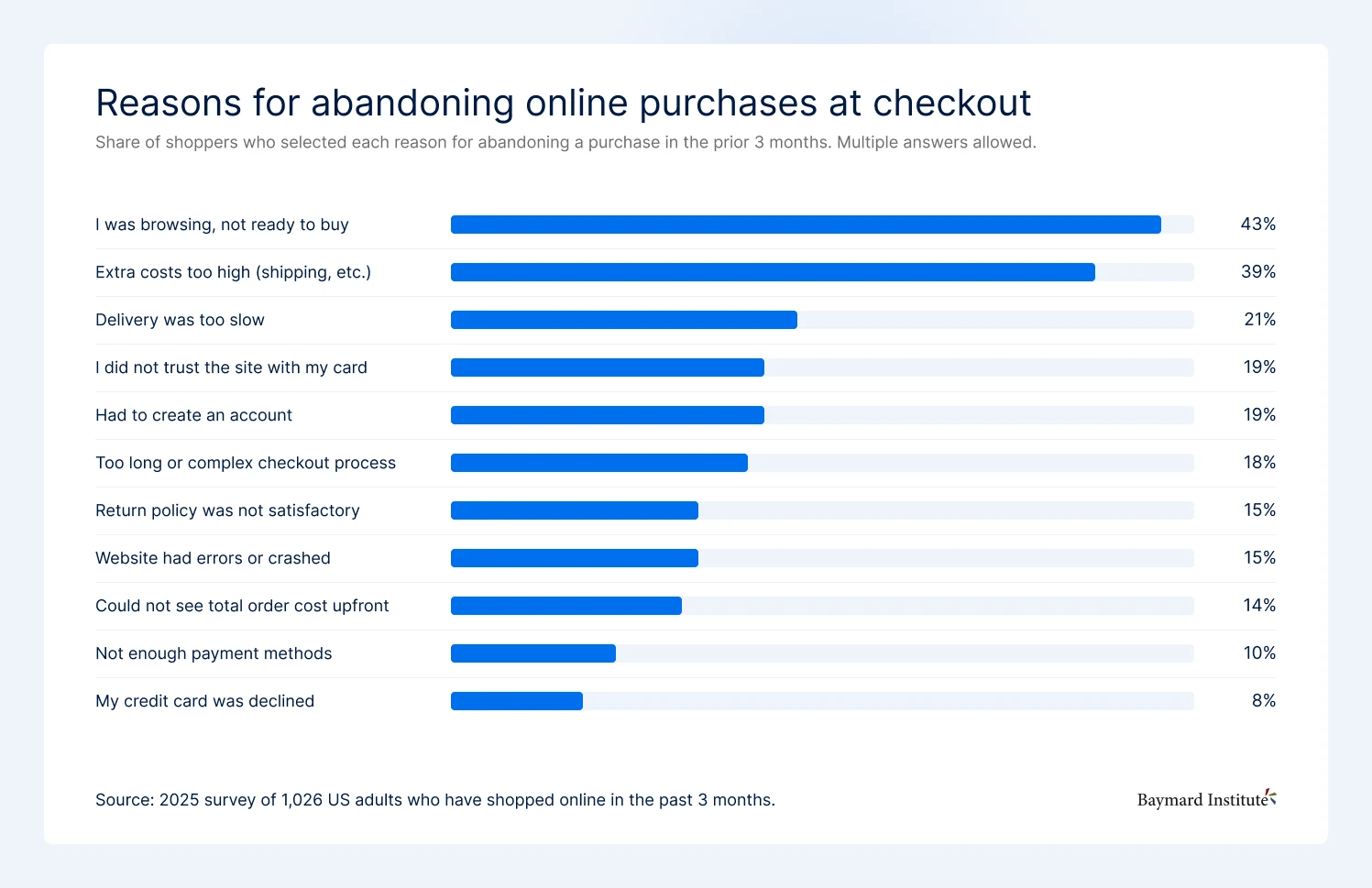
The most common reasons shoppers abandon carts, according to Baymard Institute
Notice what that means. If a customer abandons because shipping costs are unclear, a product discount may not solve the problem. If checkout is too complicated, reducing the price won’t make the experience easier.
Yet many brands immediately offer discounts before investigating the root cause. This creates two problems:
- Reduced profit margins
- Customers learning to wait for promotional emails
Over time, shoppers begin to recognize the pattern. Instead of purchasing immediately, they intentionally abandon and wait for the discount. What started as a recovery tactic becomes a customer expectation.
5 ways to use discount codes without killing your profit margin
The goal of an abandoned cart discount isn’t simply to recover a sale. It’s to recover the sale without giving away more margin than necessary.
1. Save discounts for the last email in your recovery flow
Here’s a statistic many merchants overlook. According to Digital Applied’s e-commerce benchmark data, 69% of recovered abandoned cart revenue comes from the first recovery email.
That’s significant because most first-cart emails don’t include discounts. The first email typically succeeds because:
- The shopper got distracted
- They were interrupted during checkout
- They planned to complete the purchase later
In other words, many customers simply need a reminder. So, instead of leading with an offer, give customers a chance to return on their own.
Use the first email to remind them about the products in their cart, the second to address common objections, and reserve discounts for the final recovery email. This approach helps you recover full-price orders before introducing incentives.
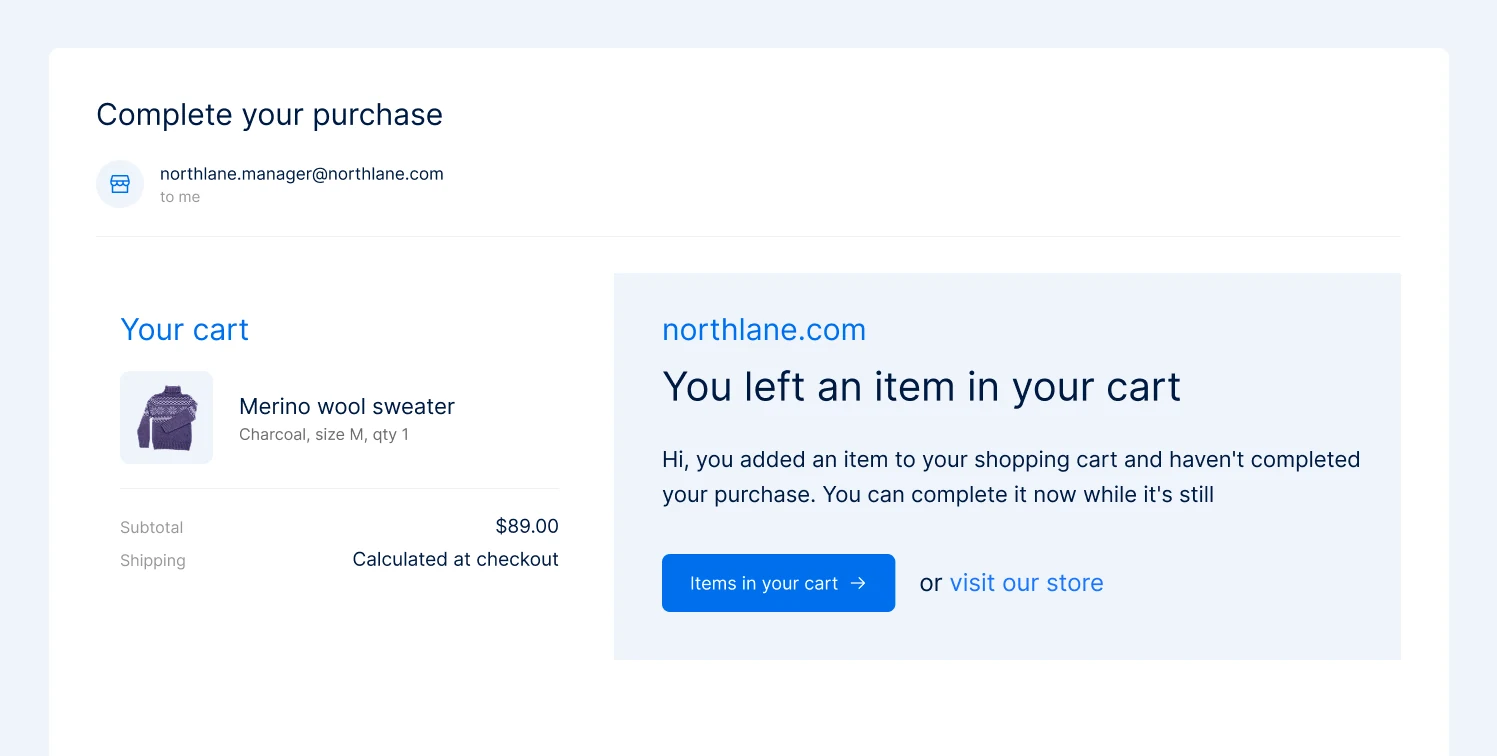
Send the 1st email as a reminder, without a discount code
This is why we generally recommend structuring abandoned cart flows in stages rather than leading with a coupon.
| Email stage | Timing | Primary focus / Content | Discount strategy |
|---|---|---|---|
| #1: Reminder | 1–3 hours | Cart contents, product imagery, clear CTA, mobile-friendly design. | No discount |
| #2: Objection handling | 24 hours | Address common concerns: shipping, returns, reviews, product quality, payment security. | No discount |
| #3: Incentive | 48–72 hours | Targeted incentive to convert the shopper after attempting to recover the sale at full margin. | Discount applied |
Best for:
- Most e-commerce stores
- Brands with healthy repeat purchase rates
- Merchants looking to reduce unnecessary discounting
Example offer:
- Email 1: Cart reminder only
- Email 2: Social proof and trust signals
- Email 3: 10% off or free shipping
Avoid when:
- Running a short-term flash sale
- Selling highly price-sensitive products where immediate incentives consistently outperform reminders
2. Choose the right type of discount
Not all discount types deliver the same results. While percentage discounts are the most common abandoned cart incentive, they’re far from the only option. The right offer depends on your products, margins, customer behavior, and recovery goals.
Percentage discounts remain the most widely used option. However, percentage discounts aren’t always the most profitable choice. As cart values increase, discount costs increase as well.
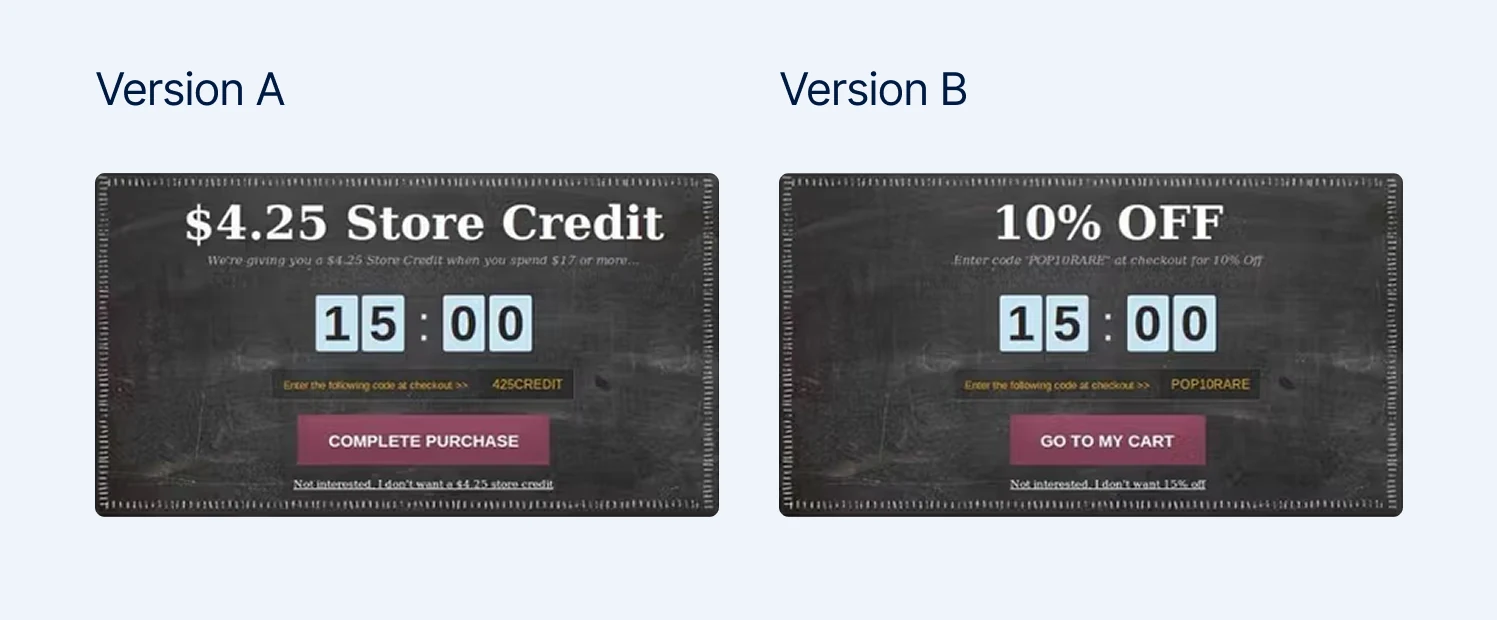
Fixed discount vs percentage discount
Fixed-dollar discounts offer greater control over promotional costs while providing shoppers with a clear, tangible saving. They’re particularly effective when paired with minimum-spend thresholds that encourage customers to increase their basket size.
Another alternative is free gifts. Instead of reducing product prices, brands can increase perceived value by including samples, accessories, or bonus products. This approach is particularly popular among premium brands that want to preserve product value while still offering an incentive.
Finally, loyalty rewards can help recover abandoned carts without lowering prices at all. Bonus points, store credit, or exclusive perks can be enough to encourage returning customers to complete their purchase.
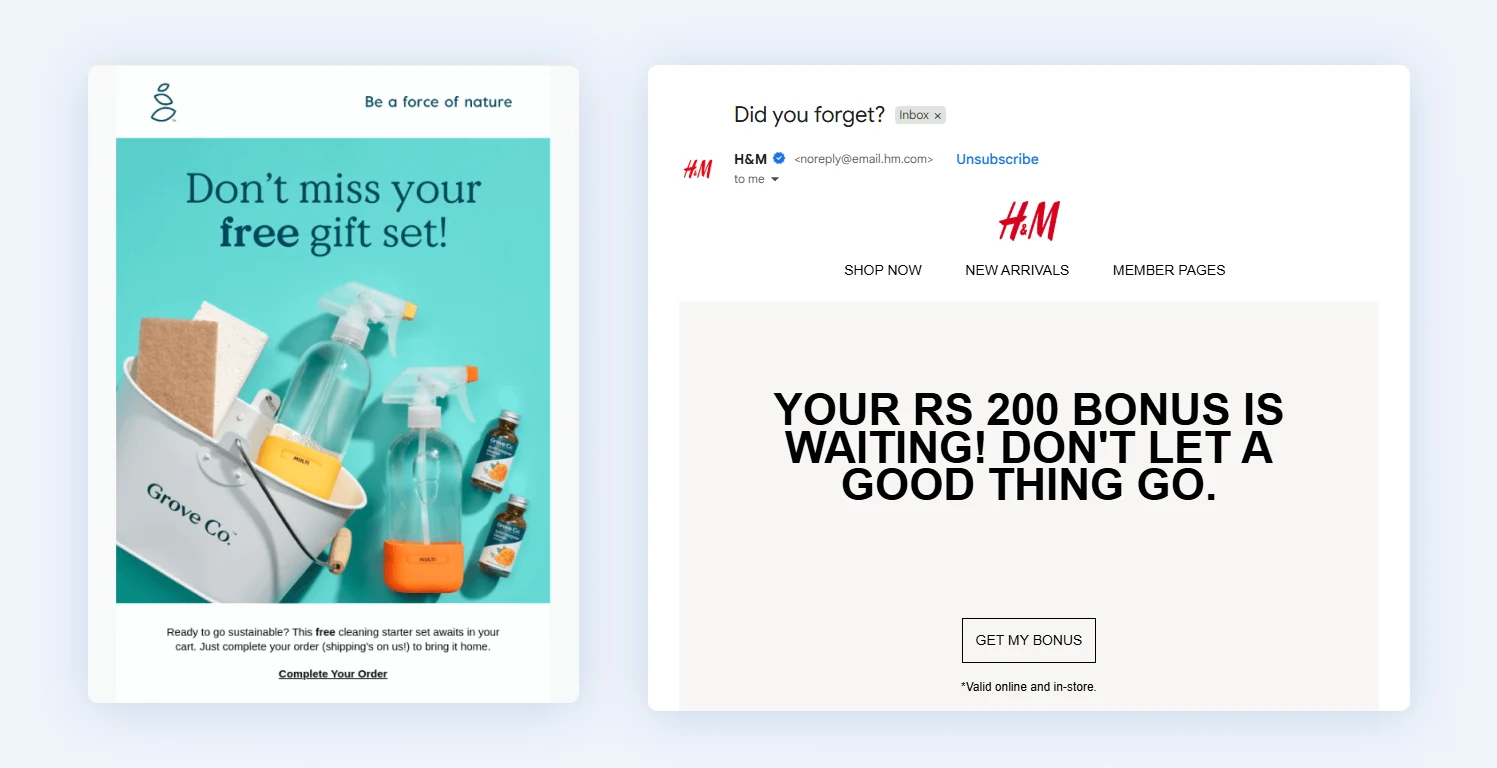
Free gifts and loyalty rewards recover carts without cutting the product price
The key takeaway is simple: don’t default to a percentage discount. Test different incentive types and measure not only conversion rates, but also average order value, profit margins, and customer lifetime value.
| Incentive type | Best for | Example |
|---|---|---|
| Percentage discount | Fashion, beauty, lower-value carts | 10% off your order |
| Fixed-dollar discount | High-value carts, premium products | $25 off orders over $200 |
| Free gift | Luxury, beauty, skincare brands | Free sample or accessory |
| Loyalty reward | Returning customers, loyalty members | Double points or store credit |
3. Offer free shipping instead of discounting products
Discounts aren’t the only way to recover an abandoned cart. In many cases, free shipping can be just as compelling without reducing the perceived value of your products.
According to Shopify, free shipping is one of the most effective incentives merchants use to encourage purchases and increase conversion rates.
The reason is simple. Customers don’t always think about the total cost of their order until they reach checkout. A product price may feel acceptable, but additional shipping costs can create enough friction to delay or abandon the purchase.
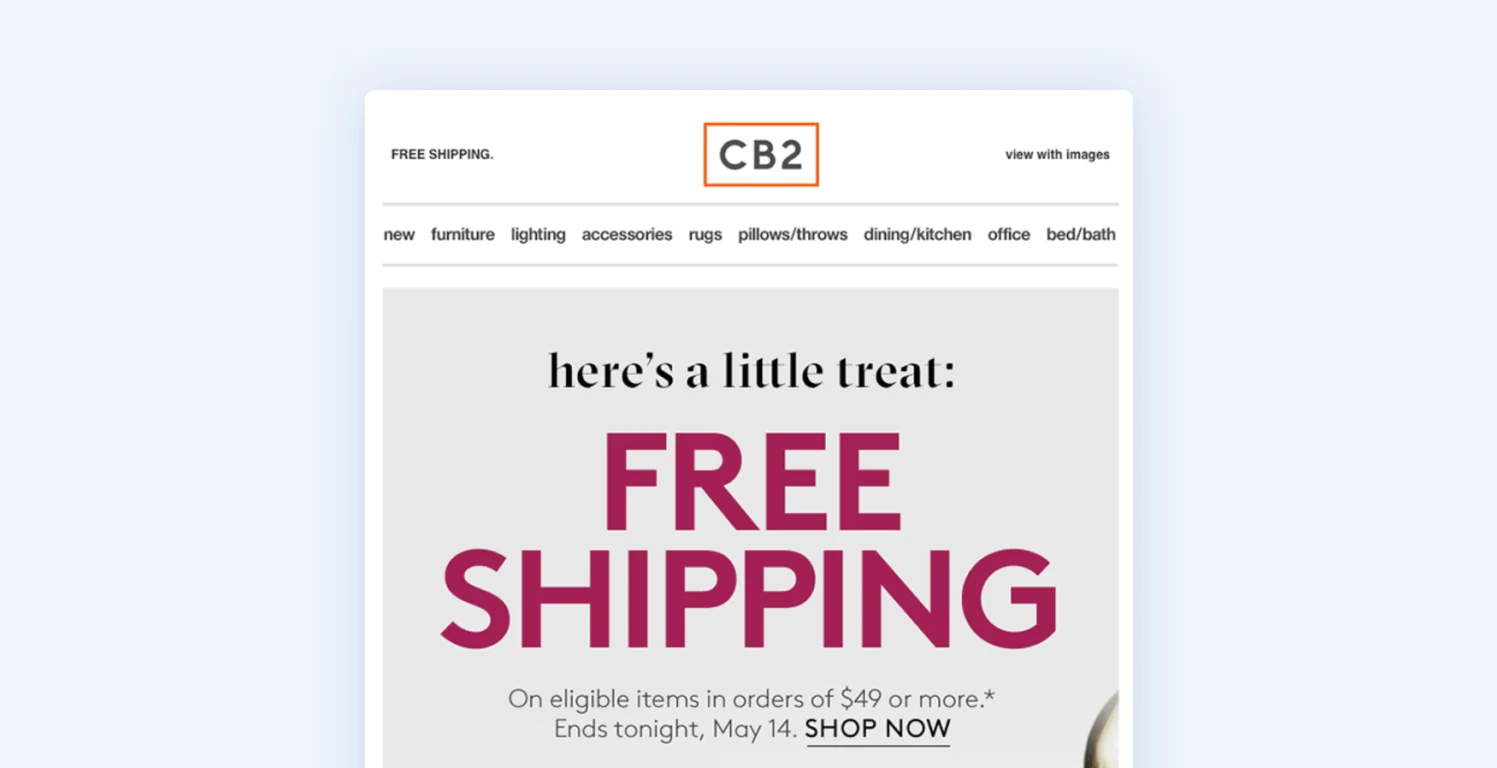
Free shipping as the incentive, instead of a discount on the products
If shipping costs are causing friction, removing those costs directly addresses the issue. Let’s compare:
- 10% discount on a $200 order = $20 reduction
- Free shipping = $8-12 cost in many cases
The customer receives meaningful value while the merchant preserves more margin. For brands focused on profitability, free shipping deserves more testing than it typically receives.
Best for:
- Brands with predictable shipping costs
- Products with healthy profit margins
- Stores with lower average order values
Example offer:
- Free shipping on your current cart
- Complete your order within 48 hours for free shipping
- Free shipping on orders over $75
Avoid when:
- Shipping costs vary significantly by destination
- Large or bulky products make shipping expensive
- Free shipping would have a greater impact on margins than a small discount
4. Increase the minimum spend to protect margins
Not every abandoned cart discount needs to reduce the value of the existing order. In some cases, the best-performing offers encourage customers to spend more.
Instead of offering a blanket discount, tie the incentive to a spending threshold. For example, rather than offering “10% off your order,” offer “10% off orders over $50.”
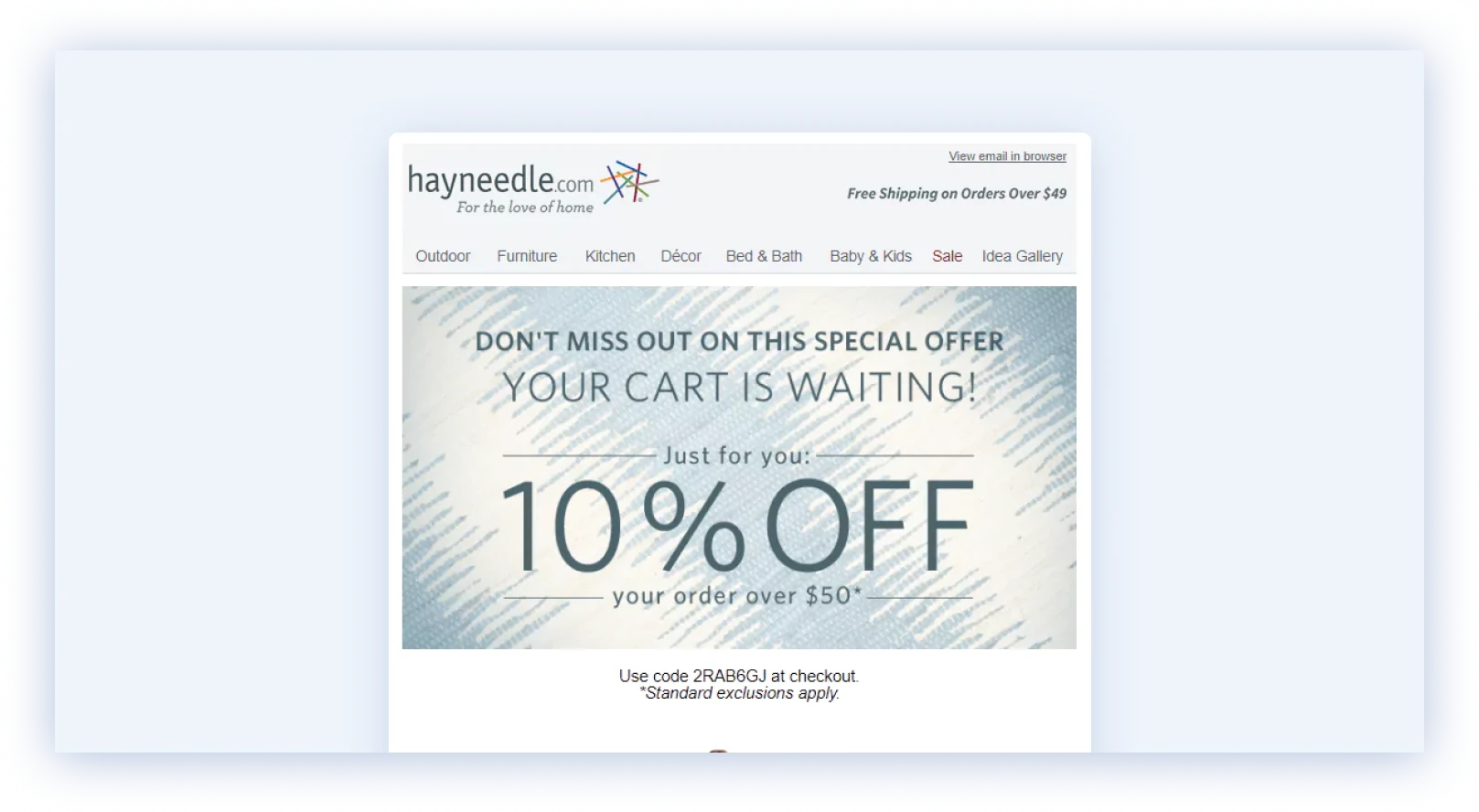
A minimum spend threshold attached to the discount offer
This creates a win-win scenario. Customers receive a meaningful incentive, while merchants increase average order value and offset some of the discount cost. The strategy is widely used across e-commerce because it encourages shoppers to add more items to their cart rather than simply checking out with the products they already selected.
For example, if a customer has $85 worth of products in their cart and receives an offer for “$15 off orders over $100,” they may add another item to qualify. Instead of discounting an $85 order, you’re increasing cart value while recovering the sale.
Best for:
- Stores with a broad product catalog
- Brands focused on increasing average order value
- Merchants with complementary or impulse-purchase products
Example offer:
- 10% off orders over $100
- $20 off orders over $200
- Free shipping on orders over $75
Avoid when:
- Most products are high-ticket items purchased individually
- Customers typically buy only one product per order
- Your catalog offers limited upsell opportunities
5. Segment customers instead of offering blanket discounts
Not every customer abandons their cart for the same reason, so they shouldn’t all receive the same incentive. Rather than sending every shopper the same 15% discount, use customer data and shopping behavior to personalize your offers.
Even simple segmentation can help you recover more sales while protecting your margins. We recommend starting with these high-impact segments:
- Cart value: Reserve discounts for higher-value carts where recovering the sale has a greater impact on revenue. For lower-value carts, a reminder or free shipping may be enough.
- Customer status: First-time shoppers often need a stronger incentive to complete their initial purchase, while returning customers may respond just as well to free shipping, loyalty rewards, or a reminder email.
- Discount sensitivity: If a customer only buys during promotions, avoid automatically sending a discount every time they abandon a cart. Instead, reserve offers for shoppers who genuinely need an incentive to convert.
- Browsing behavior: Look at where customers dropped off. Someone who spent time comparing products may need reviews or social proof, while a shopper who abandoned at checkout may be more persuaded by a limited-time incentive.
The more relevant your offer is to the customer, the less you’ll need to rely on blanket discounts, and the more likely you’ll be to recover sales without sacrificing profitability.
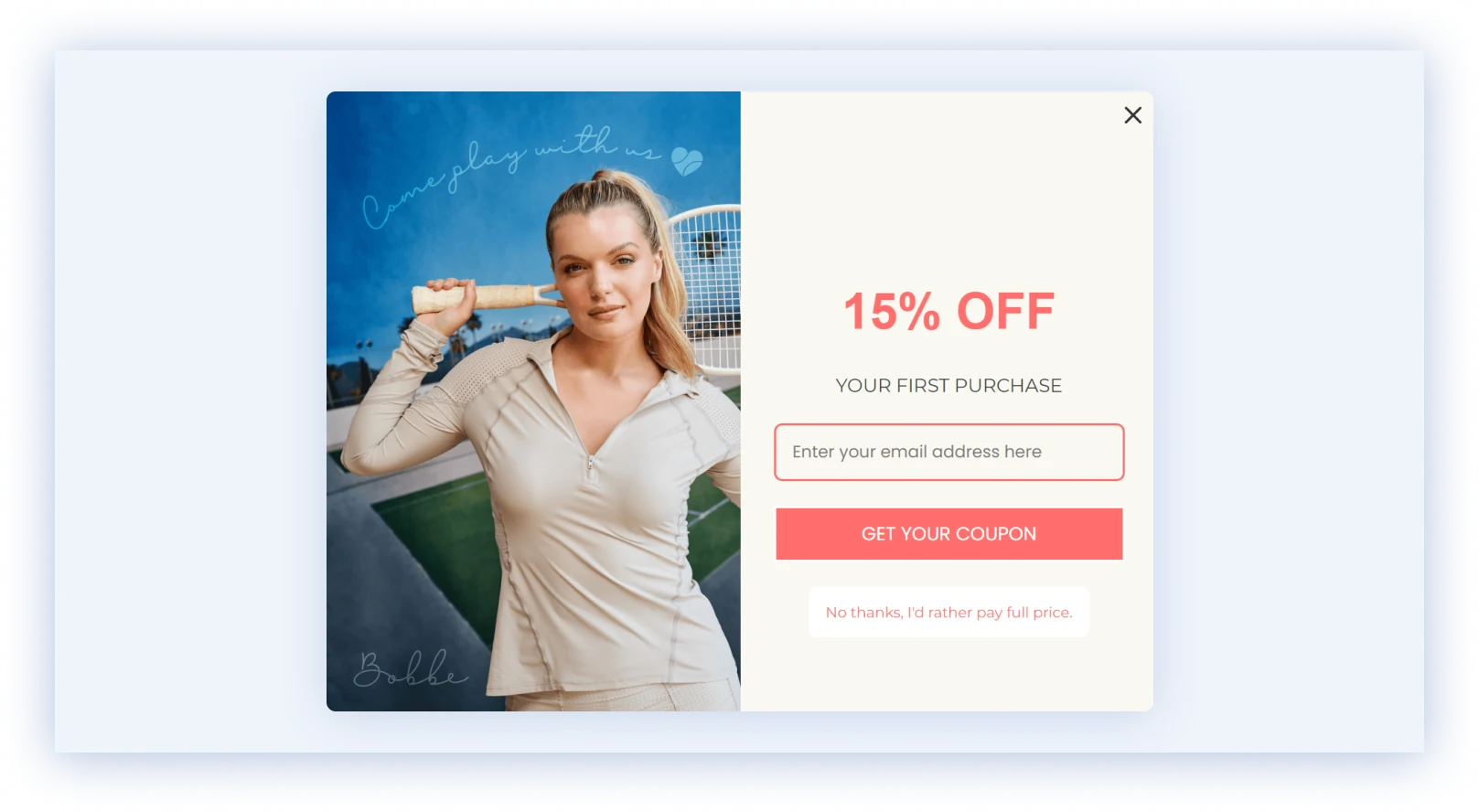
Example of a discount code sent to first-time buyers
Best for:
- Brands with customer accounts or CRM data
- Stores using email platforms with segmentation capabilities
- Merchants focused on maximizing customer lifetime value
Example segmentation:
| Customer segment | Recommended incentive |
|---|---|
| First-time customer | 15% off first order |
| Returning customer | Free shipping or loyalty points |
| High-value cart | Fixed-dollar discount with a minimum spend |
| Checkout abandoner | Limited-time discount or free shipping |
| Product browser | Reminder email with reviews and product recommendations |
Avoid when:
- Customer history or behavioral data isn’t available
- Your email platform doesn’t support segmentation
- Most purchases are one-time transactions
What makes a high-performing abandoned cart discount code?
A discount code can recover a sale, but a poorly designed one can also reduce margins, distort reporting, and end up circulating on coupon websites long after the campaign has ended.
At Magebit, we also recommend testing whether the discount is visible in the subject line or revealed only after the email is opened:
- For highly engaged shoppers, leading with the offer can increase open rates.
- For luxury and premium brands, however, keeping the focus on the product and revealing the incentive inside the email often better preserves brand value.
When configuring abandoned cart discount codes, we recommend including the following features:
| Feature | Why it matters |
|---|---|
| Expiration date | Encourages shoppers to act while purchase intent is still high. |
| Personalized greeting | Address customers by name to make the email feel more relevant and less automated. |
| Discount code in the subject line | Makes the incentive immediately visible and can increase opens among shoppers already considering a purchase. |
| Abandoned products | Show the exact products left in the cart, along with images, prices, and variants, to remind shoppers what they were about to buy. |
| Prominent CTA | Include a clear “Return to Cart” or “Complete Your Purchase” button that takes customers directly back to their cart, reducing friction. |
| Single-use redemption | Prevents customers from repeatedly using the same discount. |
| Unique code generation | Makes performance easier to track and limits coupon sharing. |
| Minimum spend requirements | Helps increase average order value and offset promotion costs. |
| Product exclusions | Protects margins on low-margin or already discounted products. |
| Auto-applied discounts | Reduces checkout friction and improves the customer experience. |
| Non-stackable rules | Prevents multiple discounts from being combined. |
How to find out if your discount codes are actually making you money
A higher conversion rate doesn’t always mean a more profitable abandoned cart campaign.
Imagine you’re selling a product for $100 that costs $60 to produce. Without a discount:
- 3 out of every 100 visitors purchase
- You make a $40 profit per order
- Total profit = $120
Now, let’s say you offer 10% off. Your product now sells for $90, so your profit drops to $30 per order. To make up for that lost margin, the discount needs to generate additional sales.
| Metric | No discount | 10% Off |
|---|---|---|
| Product price | $100 | $90 |
| Profit per order | $40 | $30 |
| Conversion rate | 3% | 4% |
| Profit per 100 visitors | $120 | $120 |
In this example, the discount increased conversions from 3% to 4%, which was enough to offset the lower margin. The campaign breaks even.
But what if conversions only increased from 3% to 3.5%?
| Metric | No discount | 10% Off |
|---|---|---|
| Profit per order | $40 | $30 |
| Conversion rate | 3% | 3.5% |
| Profit per 100 visitors | $120 | $105 |
Now you’re generating more orders but making less profit. That’s why merchants shouldn’t evaluate abandoned cart discounts based on conversion rate alone. The real question is:
Did the additional orders generate enough profit to justify the discount?
At Magebit, we recommend reviewing three metrics together:
- Conversion rate
- Profit per order
- Customer lifetime value
If a discount increases conversions without hurting profitability, keep it. If it increases orders but reduces overall profit, it’s time to test a different incentive, audience segment, or discount value.
Final thoughts
Discount codes remain one of the most effective abandoned cart recovery tools available to e-commerce brands. But they should be treated as a tool, not a default strategy.
From choosing the right discount type and timing your offers to designing smarter coupon codes and measuring profitability, every decision plays a role in how much revenue you recover and how much margin you keep.
At Magebit, we believe the best abandoned cart strategies don’t rely on blanket discounts. They combine data, customer insights, and continuous testing to deliver incentives that drive conversions without sacrificing profitability.
If you’re looking to improve your abandoned cart emails or build a more effective email marketing strategy, our e-commerce experts can help.