People in your city are searching for exactly what you sell, ready to buy today, and Google is sending them somewhere else. Not because your product is not meeting expectations or that your prices are off. It’s simply because your local search presence isn’t set up to compete.
It’s one of those problems that’s invisible until you go looking for it. Open an incognito tab, search for your product category with “near me” or your city name, and see where you rank.
If you’re not on the first screen or not showing up at all, you’re missing customers who’ve already decided they want to buy. They just haven’t decided where yet. That’s the opportunity.
Local SEO in 2026 is about being the obvious answer at that exact moment, especially when nearly half of the billions of daily Google searches are looking for something nearby. This guide breaks down how to get there practically, without the jargon.
What is local SEO?
Local SEO is Google’s way of matching nearby buyers with the businesses most likely to meet their needs. When someone searches “best mobile phone shops near me,” Google isn’t looking for pages that contain those keywords. It’s trying to answer a harder question:
Which nearby business is most relevant, trustworthy, and convenient for this customer right now?
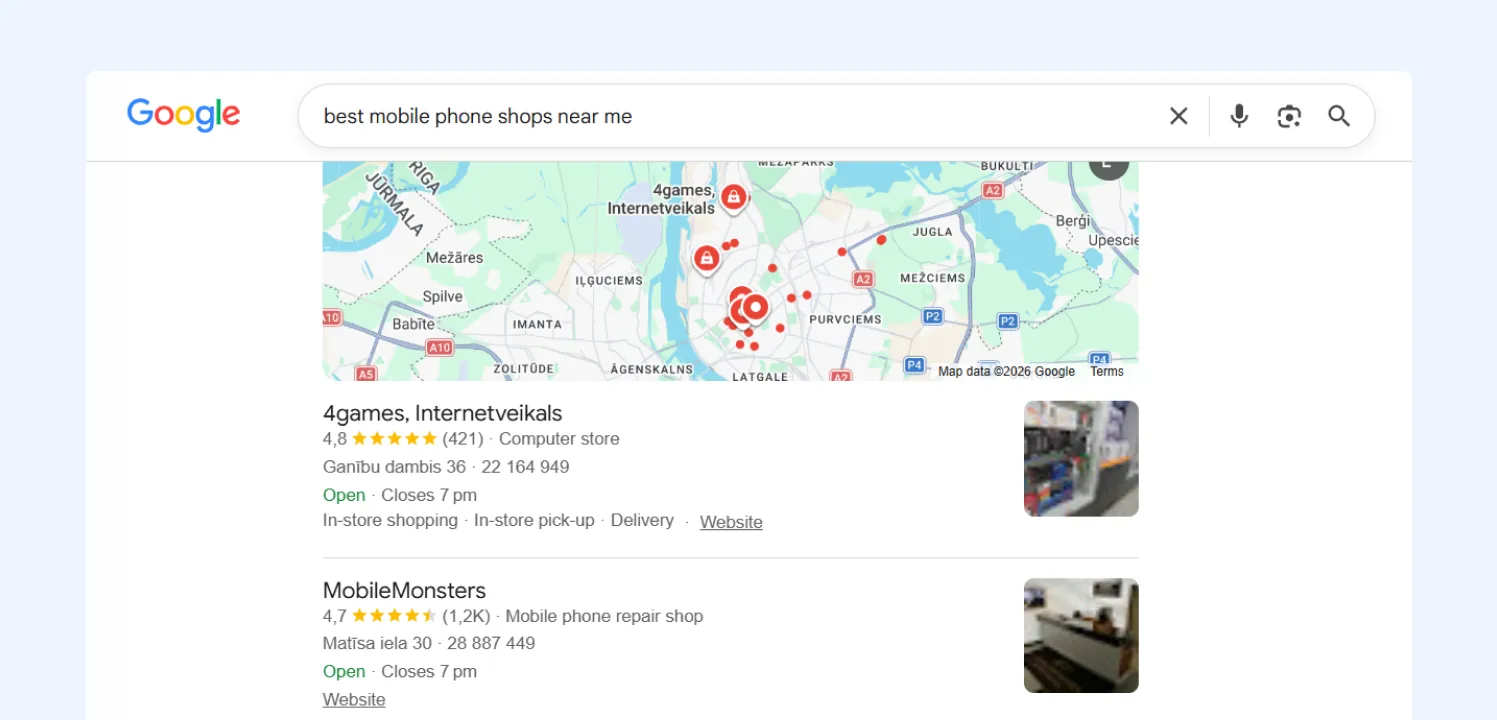
Google’s Local Pack answers a “near me” search with the nearby stores it considers most relevant, trusted and convenient.
To answer that, Google pulls from multiple sources: Google Business Profiles, store location pages, reviews, product and inventory data, website content, and business citations across the web. It then ranks those sources against three factors it has publicly described:
- Relevance — how well your business matches what the customer is searching for
- Distance — how close your business is to the searcher
- Prominence — how well-known and trusted your business appears online
For years, the goal of local SEO was to appear in the Local Pack—the map section near the top of search results showing three businesses with ratings, hours, and directions. That’s still valuable. But it’s no longer the whole game.
How local SEO has changed in 2026
The biggest shift we’re seeing is that local SEO is no longer just about ranking in Google’s Local Pack (the box showing three local businesses, their ratings, hours, and directions).
Customers still use Maps and traditional local search results, but discovery now happens across many more surfaces. Research found that 45% of consumers now use AI tools for local business recommendations, a number that continues to grow.
AI Overviews, local shopping results, social platforms like Instagram and Facebook, voice assistants, and AI tools such as ChatGPT are influencing how people find and evaluate local businesses. As a result, Google’s understanding of local relevance has evolved.
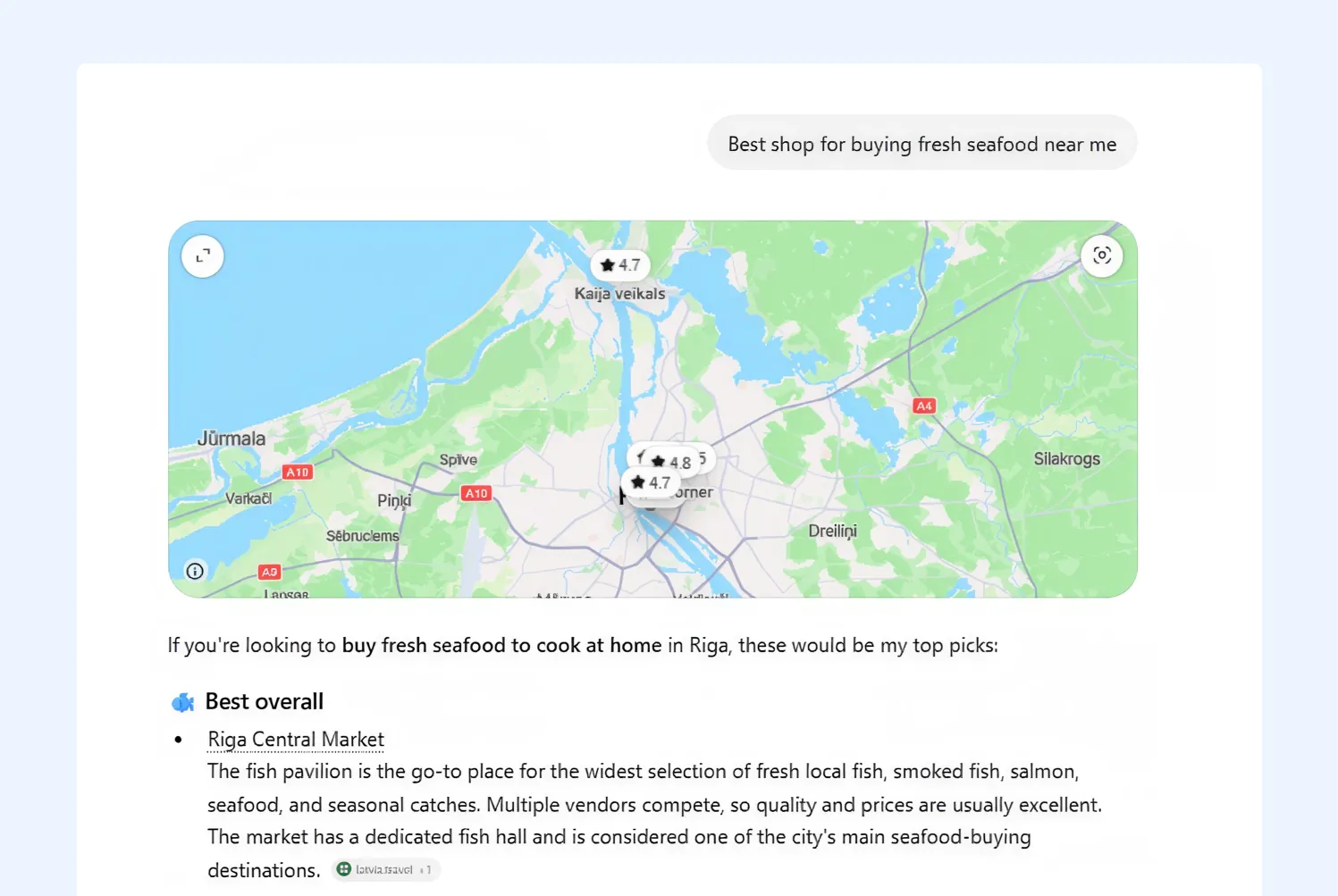
AI search answers local queries with recommendations instead of links. 45% of consumers already use AI tools to choose a nearby business.
It’s no longer enough to tell Google where your stores are located. You also need to help search engines and AI systems understand:
- What products you sell
- Which locations carry those products
- Whether products are currently available
- What customers think about your business
- Why your store is a better choice than nearby competitors
In other words, local SEO is evolving into what we would call local discovery optimization. It’s about ensuring your business is visible, trusted, and understood across every discovery channel customers use.
Traditional local SEO vs local SEO in 2026
| Strategic Focus | Traditional Local SEO | Local Optimization in 2026 |
|---|---|---|
| Where customers discover businesses | Google Maps & Local Pack | Google Search, Maps, AI Overviews, ChatGPT, Gemini, Instagram Reels, TikTok, YouTube Shorts, and more. |
| Who you’re optimizing for | Humans & search engines | Optimized for search engines, AI tools, and customers |
| Key ranking signals | Citations & directory listings | Inventory data, structured data, reviews, and business information |
| Success metrics | Keyword rankings & organic traffic | Store visits, directions, conversions, and revenue |
| The goal | Helping customers find a store | Influencing AI to recommend your store at the point of purchase |
11 strategies to rank your stores for local searches in 2026
From optimizing your Google Business Profile to preparing for AI-powered search, these strategies will help more local customers discover and choose your stores.
1. Treat your Google Business Profile as a revenue channel
Businesses with a complete Google Business Profile get up to 7× more clicks. Still, many retailers treat their Google Business Profile (GBP) as a directory listing.
In our experience, that’s one of the biggest local SEO mistakes brands make. For many local searches, your GBP is the first thing shoppers see before they ever visit your website.
It’s where they check reviews, opening hours, directions, product availability, and whether your store is worth visiting. Google itself states that businesses with complete and accurate information are more likely to appear in relevant local searches.
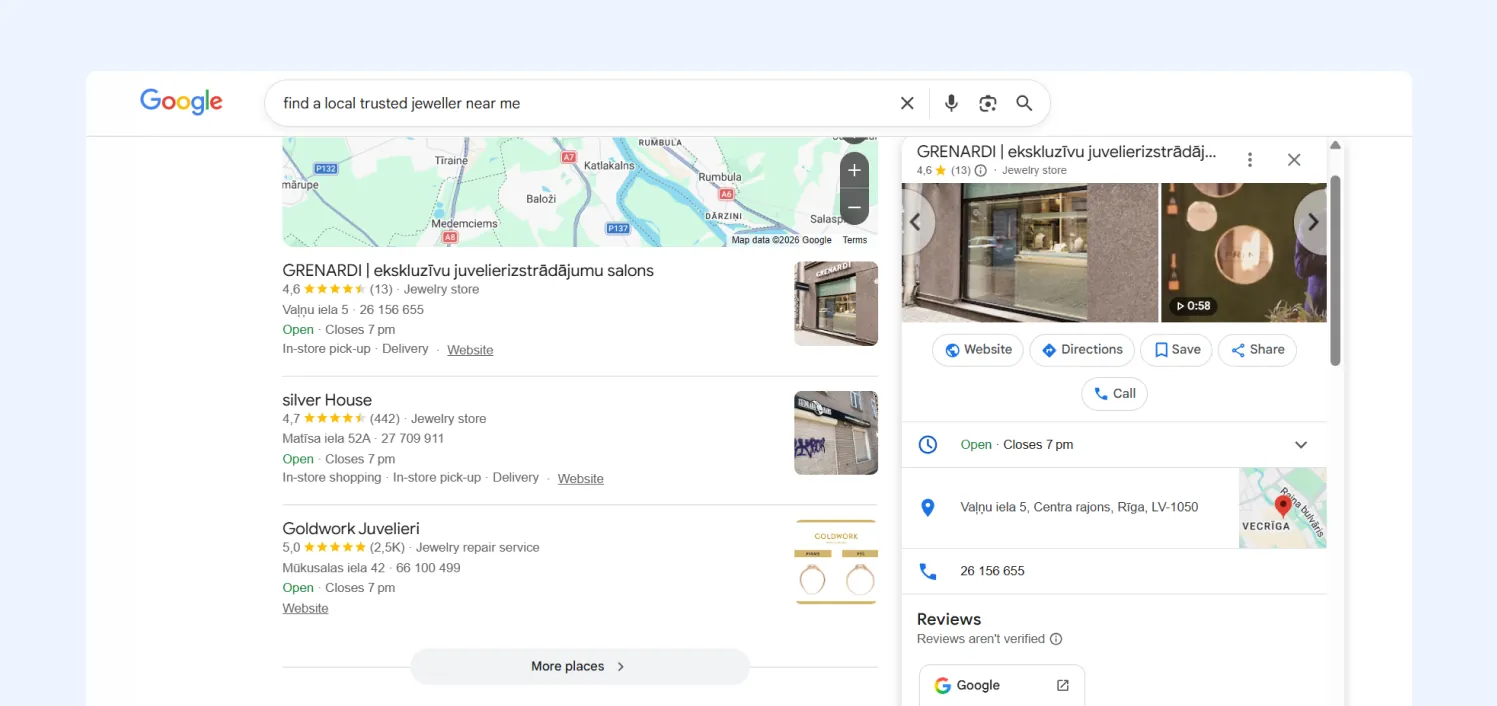
A complete Google Business Profile gives local shoppers photos, hours, directions and reviews before they ever reach your website.
The retailers that perform best in local search don’t treat GBP as a set-and-forget asset. They actively manage store information, update opening hours, respond to reviews, upload new photos, and keep location details consistent across every customer touchpoint.
As AI-powered search becomes more common, this information is increasingly being used to generate business summaries and recommendations.
To improve your visibility in local search, focus on the following areas:
| GBP element | What to do |
|---|---|
| Primary category | Choose the category that most accurately reflects your business |
| Secondary categories | Add all relevant categories; don’t keyword stuff |
| Business description | Clearly explain what you sell, the services offered, and your differentiators |
| Opening hours | Keep regular and holiday hours current |
| Payment options | List all accepted payment methods, including digital wallets, financing options, and buy now, pay later services |
| Photos | Upload fresh store, product, and team photos regularly |
| Reviews | Respond to Google reviews and maintain profiles on trusted review platforms like Trustpilot |
| Products and services | Showcase products, services, and pickup options |
| Posts and updates | Regularly publish promotions, events, new product launches, and store announcements |
| Social media profiles | Connect and maintain links to your active social channels |
| Attributes | Add relevant attributes: curbside pickup, accessibility, etc. |
One trend we’re seeing in 2026 is that profile freshness matters more than many retailers realize. A store with fewer reviews but consistently updated information can outperform a competitor with a neglected profile.
For multi-location retailers, every location should have its own optimized profile with accurate store-specific information. Don’t rely on a single corporate listing to represent all locations.
2. Build location pages that help customers buy
Your Google Business Profile helps customers discover your business. Your location pages help them decide whether to buy from you. That’s an important distinction.
Many retailers treat location pages as digital business cards, listing an address, phone number, opening hours, and an embedded map. The problem is that customers can already find most of that information in Google.
When a shopper lands on a location page, they’re usually evaluating their options. They want to know:
- Can I buy what I need here?
- Is pickup available?
- How quickly can I get my order?
- Does this location offer services I can’t get elsewhere?
The best location pages reduce uncertainty and help customers make a buying decision.
For example, instead of saying:
Visit our Dallas location for electronics and accessories.
Explain what makes that location valuable:
Our Dallas store offers same-day pickup on laptops, gaming accessories, and home office equipment. Eligible orders can be collected within two hours during business hours.
The second example gives customers a reason to choose that location and provides search engines with meaningful content to index.
For retailers with multiple locations, every store page should contain unique information. This might include popular product categories, fulfillment options, local promotions, store-specific services, FAQs, or customer reviews.
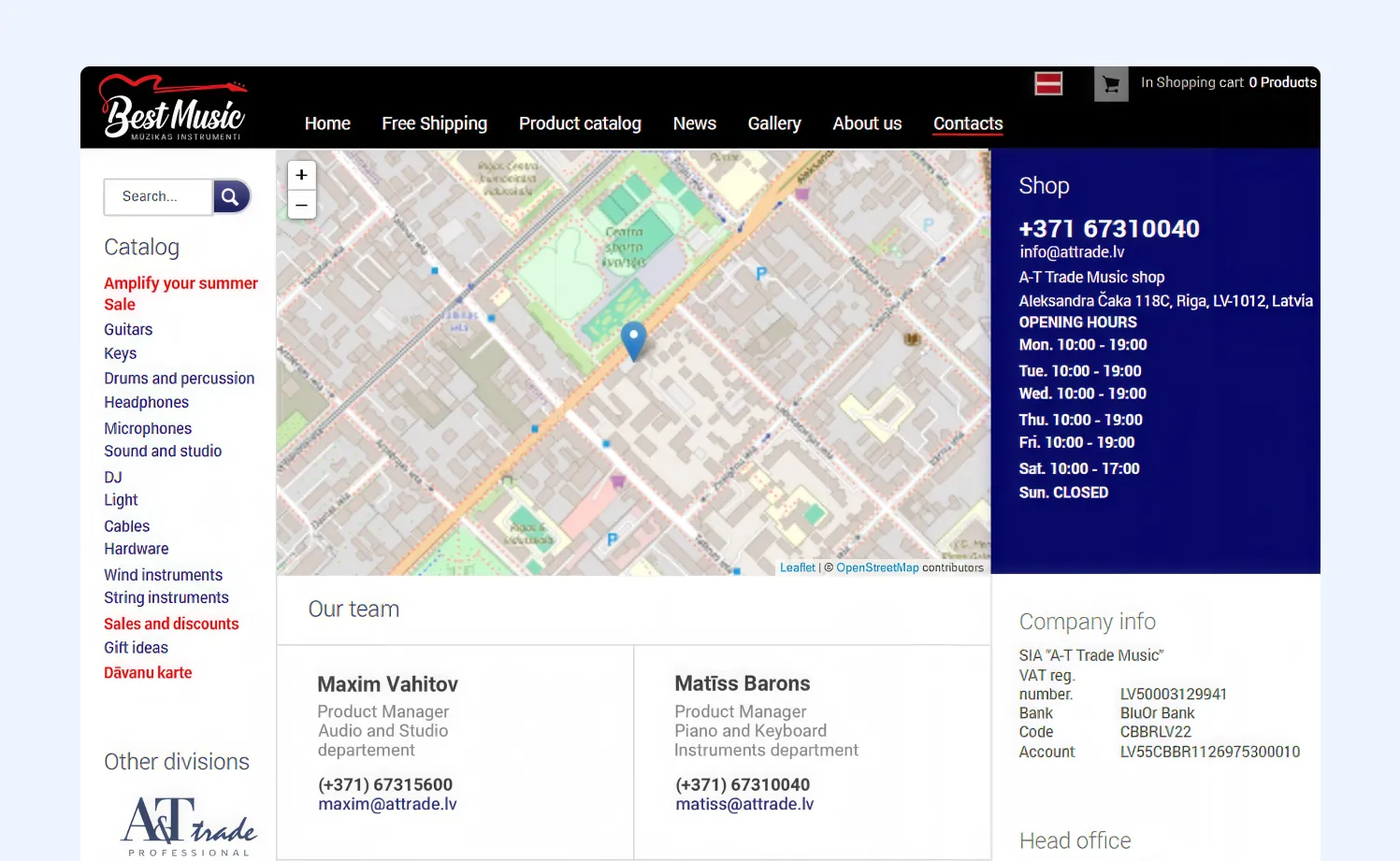
A retailer location page optimized for local search: address, opening hours, contact details and store-specific information on one indexable page.
The goal isn’t simply to rank a location page. It’s to answer buying questions before customers ask them.
What high-performing location pages include
| Element | Purpose |
|---|---|
| Product categories available locally | Supports product-focused local searches |
| Pickup and fulfillment options | Captures high-intent shoppers |
| Store-specific services | Differentiates locations |
| Customer reviews and testimonials | Builds trust |
| FAQs | Answers common buying questions |
| LocalBusiness schema markup | Helps search engines understand the page |
| Unique location content | Prevents duplicate content issues |
We’ve found that the highest-performing location pages behave more like local landing pages than contact pages. They don’t just tell customers where a store is. They tell customers why they should choose it.
3. Target local keywords with purchase intent
One of the biggest local SEO mistakes retailers make is chasing traffic instead of revenue.
A keyword with 10,000 monthly searches looks impressive in a report. But a search such as “same-day flower delivery near me” is often worth far more to the business than a broad term like “fresh flowers.”
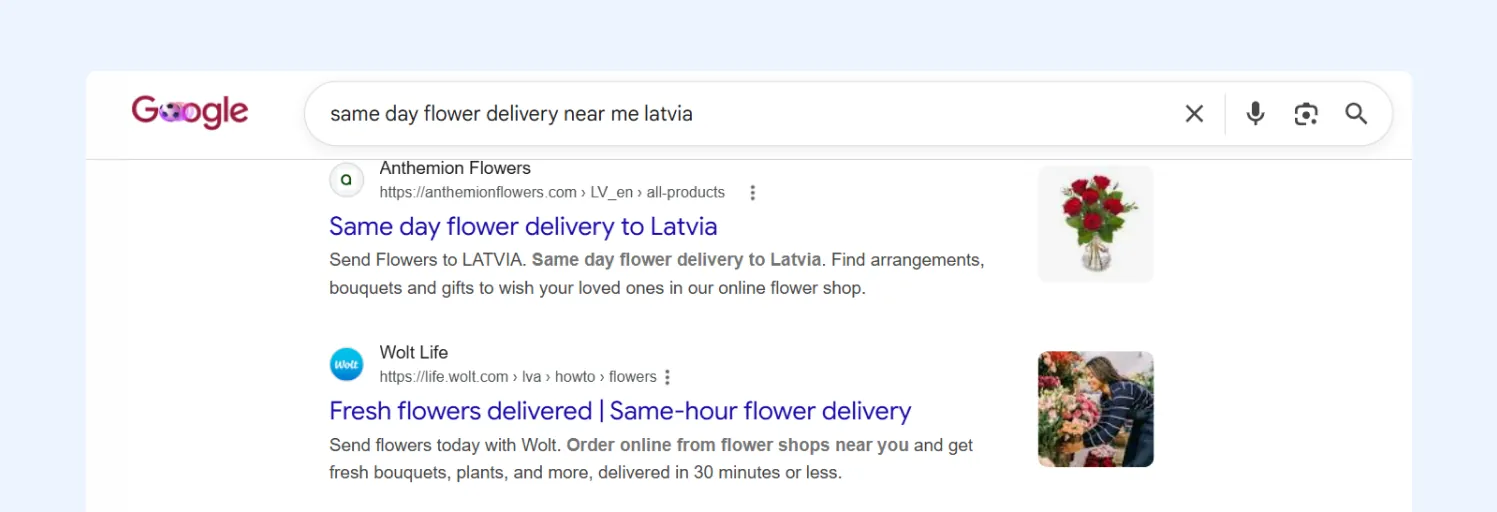
A local keyword with strong purchase intent: fulfillment-based searches like “same day delivery near me” attract buyers, not browsers.
Why? Because local searchers are usually further along in the buying journey. They’re not asking what to buy. They’re asking where to buy it.
That’s why we recommend starting local keyword research with customer intent rather than search volume. Look for phrases that indicate urgency, availability, convenience, and location. These are often the searches closest to conversion.
In many cases, the best local keyword opportunities aren’t city-based keywords at all. They’re fulfillment-based keywords such as “available today,” “pickup near me,” or “same-day delivery.”
The retailers that understand this distinction tend to generate better results from local SEO because they’re optimizing for buyers rather than browsers.
4. Build and maintain local citations
A citation is any online mention of your business name, address, and phone number (NAP). These mentions help search engines verify that your business is legitimate and operating where it claims to be.
Examples include:
- Business directories
- Industry directories
- Chamber of Commerce listings
- Local business associations
- Review platforms
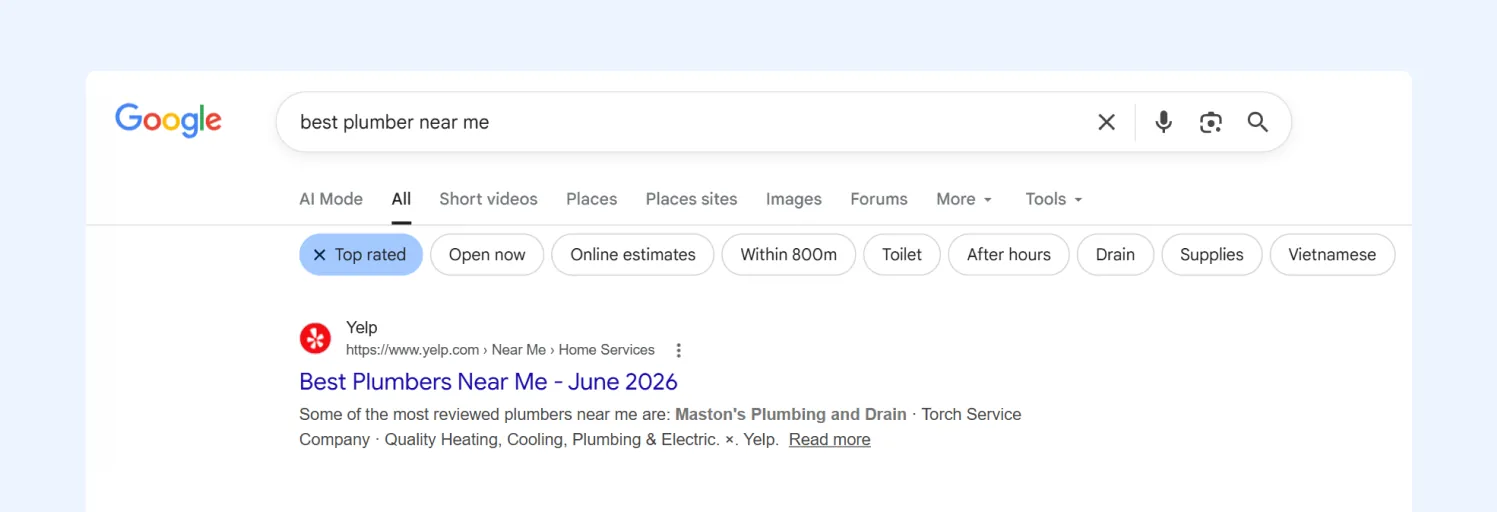
A local citation from Yelp ranking in Google search results. Directory listings help verify that your business operates where it claims to.
Most local SEO guides still treat citations as a major competitive advantage. We don’t. Citations remain important because they help search engines verify that your business is legitimate and operating where it claims to be.
But for most retailers, they’re no longer the thing preventing strong local rankings. In fact, when we review local SEO performance, the bigger issues are usually outdated Google Business Profiles, weak location pages, inconsistent reviews, or poor site structure.
That doesn’t mean citations should be ignored. It means they should be treated as a foundation rather than a growth strategy. The goal is simple: make sure your business name, address, phone number, and store information are accurate wherever they appear online.
Once that’s done, your effort is usually better spent improving the customer experience and local relevance signals that actually influence buying decisions.
5. Collect reviews and respond to them
97% of consumers read reviews to make decisions about a local business. At the same time, reviews influence local SEO because they help Google determine whether customers trust your business.
Google has openly stated that prominence plays a role in local rankings, and reviews remain one of the strongest indicators of prominence available. But this is one area where we think a lot of local SEO advice is becoming outdated.
For years, businesses focused almost entirely on review volume. The assumption was simple: more reviews meant better rankings. In practice, that’s not always what we see.
A retailer with 500 reviews collected five years ago may not perform as well as a competitor consistently generating fresh customer feedback every month. Recent reviews tell search engines that a business is active, relevant, and still delivering a good customer experience.
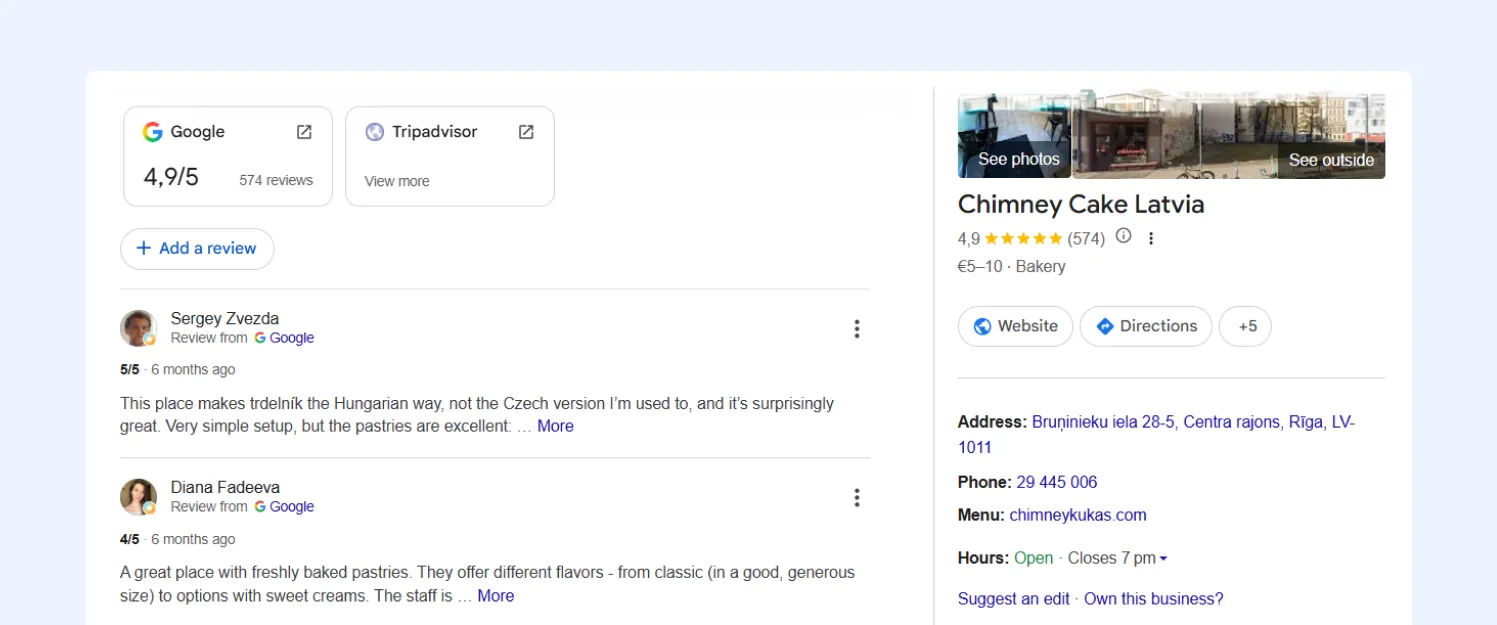
Customer reviews on a Google Business Profile: fresh, detailed feedback signals prominence to Google and buying context to shoppers.
They’re also more useful for shoppers. A customer deciding where to buy today is far more interested in what happened last week than what happened three years ago.
As AI-powered search grows, review content itself is becoming more valuable. A review saying, “I ordered online and picked up my laptop within two hours” provides context that a simple five-star rating cannot. It helps both customers and AI systems understand what the buying experience is actually like.
That’s why retailers should focus less on accumulating reviews and more on creating a steady flow of fresh, detailed feedback. The goal isn’t simply to increase review count. It’s to continuously demonstrate trust.
6. Earn local backlinks and brand mentions
Many retailers approach local link building the wrong way. They focus on getting links. Google focuses on recognition.
Think about how people evaluate local businesses. They don’t just trust a company because it has a backlink from a high-authority website. They trust it because they’ve seen it mentioned by local publications, community organizations, industry groups, and other businesses.
Search engines are doing the same. That’s why local authority isn’t built solely through backlinks. It’s built through visibility.
If your business sponsors local events, partners with community organizations, receives local press coverage, or is mentioned in trusted regional publications, those signals help reinforce your presence in a specific market.
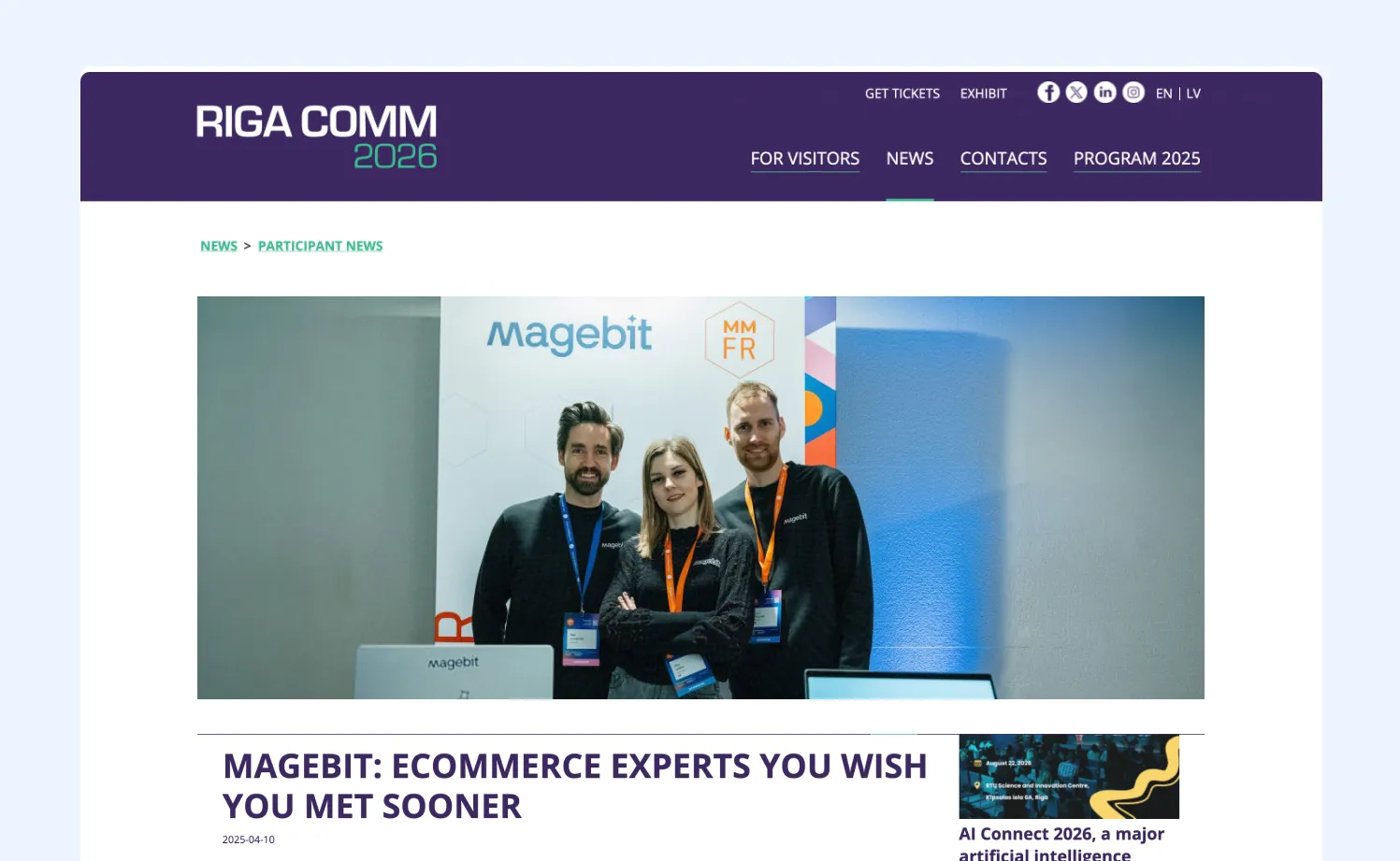
A brand mention on an industry event website: a local recognition signal that builds regional authority without a link-building campaign.
The question isn’t “How do we get more links?” The better question is: “Would someone researching trusted retailers in this area expect to find us mentioned here?” That’s usually where the strongest local authority opportunities come from.
7. Implement local schema markup
Schema markup is one of the most underutilized local SEO opportunities for retailers. Think of schema as structured information that helps search engines understand your business more accurately.
While humans can interpret a store page visually, search engines rely on structured signals to understand details such as location, opening hours, products, reviews, and business type.
In 2026, schema is becoming even more important because AI-powered search experiences rely heavily on structured and machine-readable information. For retailers, the most important schema types typically include:
| Schema type | Purpose |
|---|---|
| LocalBusiness | Identifies store locations and business information |
| Organization | Connects locations to the parent brand |
| Product | Helps search engines understand product information |
| Review | Highlights customer feedback |
| FAQPage | Supports common customer questions |
| BreadcrumbList | Improves site structure understanding |
Many e-commerce platforms and themes automatically generate basic schema markup, but relying on default settings isn’t always enough. As you add new locations, products, fulfillment options, and services, your structured data should evolve as well.
We recommend regularly validating your schema using Google’s Rich Results Test to ensure search engines can access and interpret your data correctly.
As AI-powered search becomes more common, businesses that provide clean, structured information will have an advantage because they’re easier for search engines and AI systems to understand and recommend.
8. Optimize your store locator experience
Many retailers invest heavily in SEO but overlook one of the most important local assets on their website: the store locator.
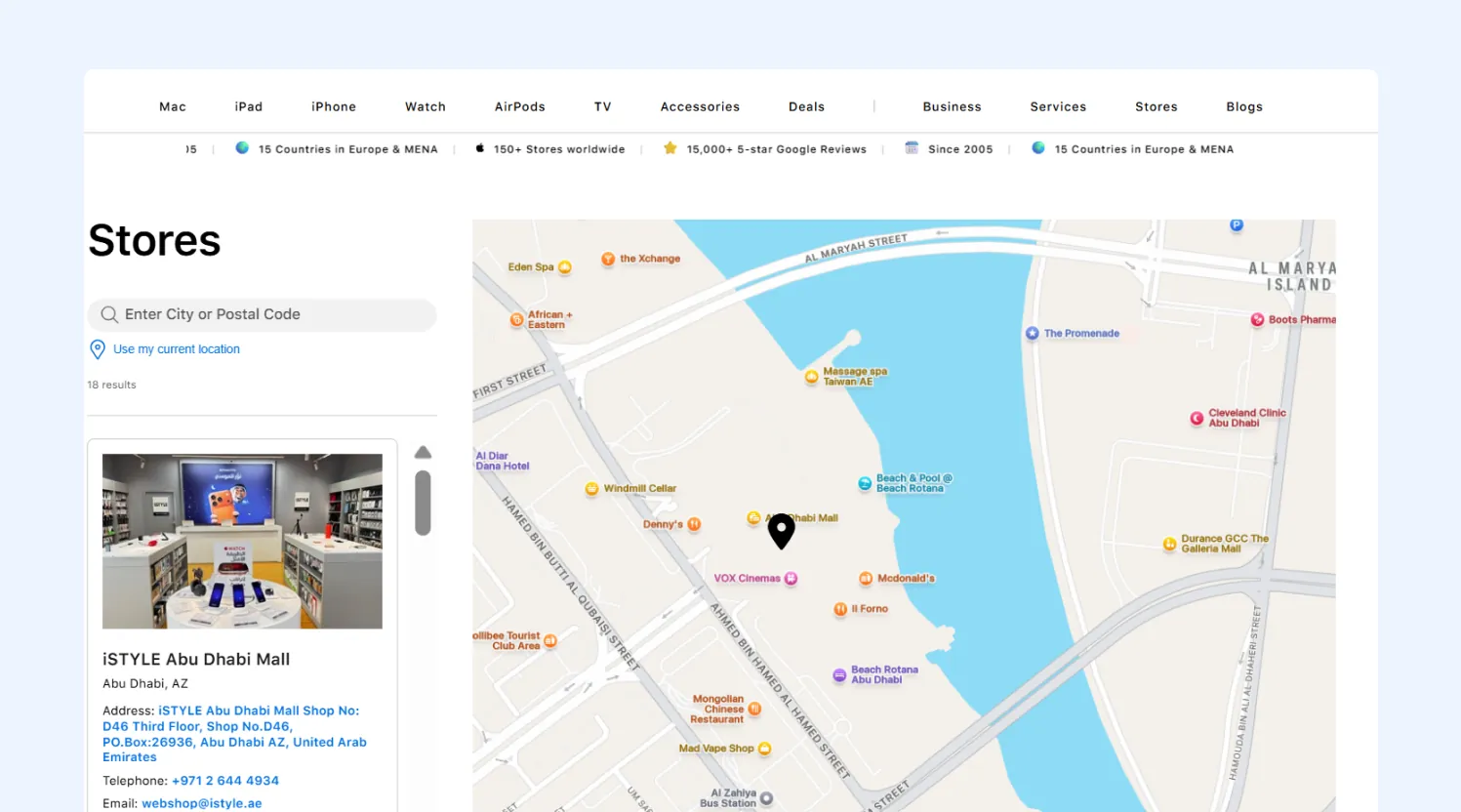
A store locator built for discovery: postal code search, current-location detection and store cards that link straight to individual location pages.
A poorly designed store locator creates friction at exactly the moment a customer is ready to take action. Customers shouldn’t have to navigate multiple pages to find a nearby location, check store hours, verify pickup availability, or get directions.
A strong store locator should allow customers to:
- Search by city, ZIP code, or address
- Filter locations based on services offered
- Access individual location pages
- View opening hours
- Check contact information
- Access directions
- Explore pickup and fulfillment options
From an SEO perspective, store locators also play an important role in site architecture. They create internal links to location pages, help search engines discover store information, and establish clear relationships between locations and the parent brand.
However, one mistake we see repeatedly is retailers treating their store locator as a utility page rather than a discovery page. The highest-performing store locators don’t just help customers find the nearest store. They help customers find the most relevant store.
For example, if a customer searches for a location that offers same-day pickup, curbside collection, bike repairs, or appliance installation, the store locator should make that information immediately visible.
Requiring customers to click into multiple pages to find basic service information creates unnecessary friction and often results in lost conversions.
Another common issue is crawlability. Many store locators are built entirely in JavaScript, making it difficult for search engines to discover and index location information. If Google struggles to access your store data, your local visibility can suffer.
9. Build for answer engines and AI search
Most local SEO strategies are still built around Google rankings. That’s understandable, but it’s becoming limiting. Customers are now discovering businesses through AI Overviews, Gemini, and other AI-powered search experiences that don’t simply display websites; they recommend businesses.
The challenge is that AI systems can’t recommend what they don’t understand. That’s why many of the fundamentals we’ve discussed throughout this guide (structured data, detailed location pages, consistent business information, and high-quality reviews) are becoming even more important.
They help AI systems understand what you sell, where you operate, and why customers should choose you. We’ve seen this firsthand through our work with Ambler Surgical.
By restructuring product data and category information for AI consumption, we helped position the brand as a trusted source in AI-generated recommendations, resulting in an 872% increase in year-on-year ChatGPT referral traffic.
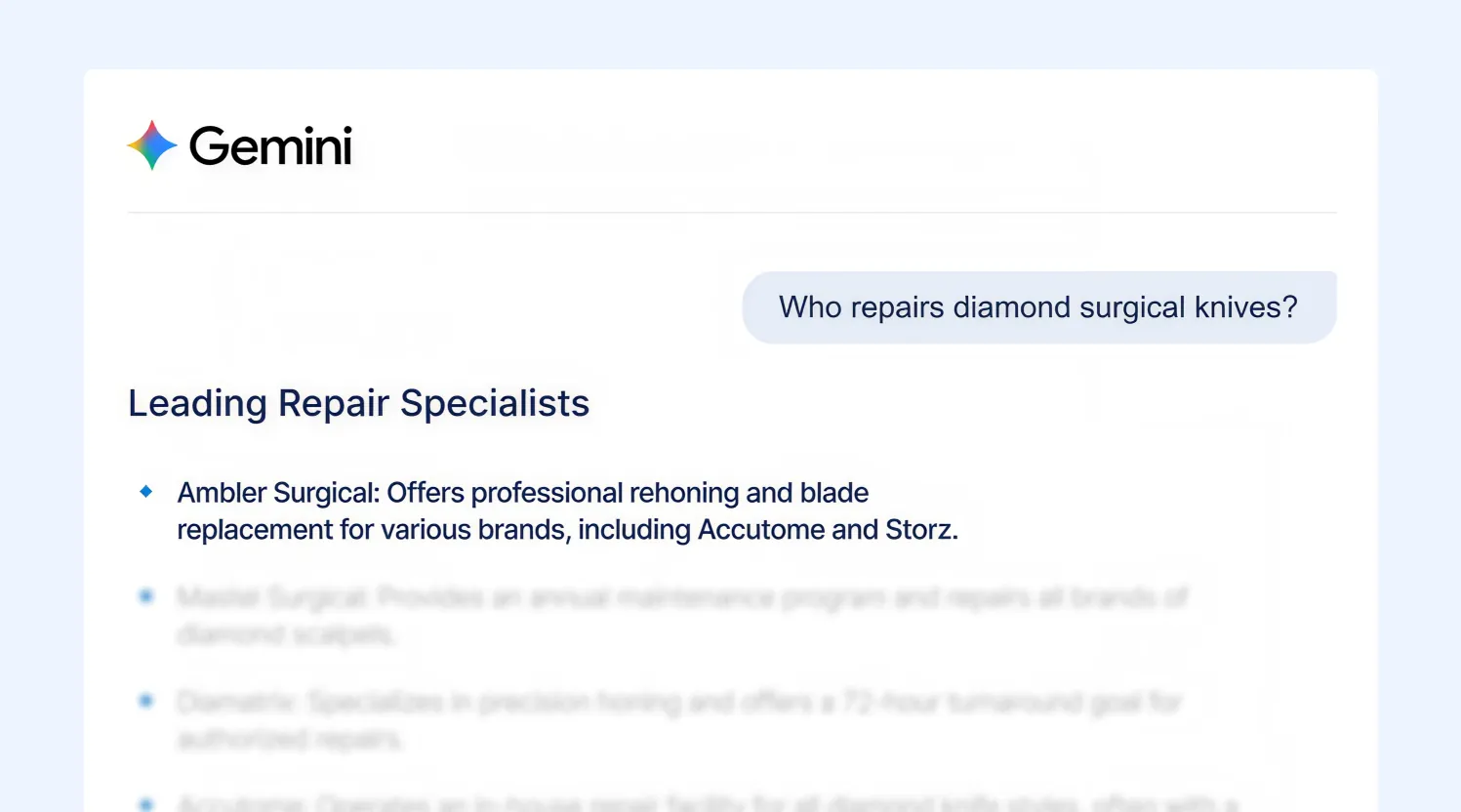
AI assistants recommend brands, not links: structured product and category data is what put Ambler Surgical at the top of this answer.
That result highlights a shift we expect to accelerate over the next few years: retailers won’t just compete for rankings. They’ll compete for recommendations.
Google is already testing what comes next with Business Agent, an AI-powered shopping assistant that can answer product questions directly from a brand’s Google presence using information from Merchant Center and the retailer’s website.
As conversational shopping experiences become more common, accurate product data and well-structured content will play an even bigger role in how businesses are recommended and discovered.
10. Optimize for mobile local searches
Over 57% of local searches are performed using mobile devices. Whether a customer is looking for directions, checking store hours, or searching for a product nearby, they often decide within minutes.
That’s why a poor mobile experience can directly impact local SEO performance and conversions. Your store locator and location pages should also be easy to navigate on smaller screens.
If customers have to pinch, zoom, or click through multiple pages to find basic information, they’re likely to leave. Page speed matters as well. Slow-loading pages create friction and increase the likelihood that customers will choose a competitor instead.
Start with the actions local shoppers care about most:
- Add click-to-call buttons so customers can contact a store directly from search results.
- Make store hours, addresses, and directions visible at the top of location pages.
- Don’t just display store addresses—link directly to the corresponding Google Business Profile.
- Surface pickup availability, delivery options, and estimated collection times without requiring additional clicks.
- Allow customers to filter store locations by services such as curbside pickup, repairs, or same-day collection.
- Use geolocation to automatically suggest the nearest store when appropriate.
- Display inventory availability prominently on mobile product pages so customers can quickly see whether an item is available nearby.
11. Optimize for social search and discovery
Many younger consumers now use platforms like Instagram, TikTok, and YouTube as discovery engines. They search directly within social platforms using keywords, hashtags, locations, and creator recommendations.
Research shows that nearly half of Gen Z users regularly turn to social media search functions instead of traditional search engines, while social platforms have become one of the primary ways younger consumers discover businesses, products, and local recommendations.
This shift doesn’t replace Google. In many cases, customers discover a brand on social media first, then use Google Search, Maps, reviews, or AI tools to validate their decision before purchasing. The businesses that appear across both journeys gain a significant advantage.
To improve visibility in social search:
| Action | Why it matters |
|---|---|
| Use descriptive captions with searchable keywords | Social platforms index and surface content based on search intent |
| Include location names naturally in posts and videos | Helps platforms connect content to local searches |
| Optimize profile bios with products, services, and locations | Makes your business easier to discover through platform search |
| Create content around common customer questions | Aligns with how users search for recommendations |
| Encourage customer-generated content | Expands visibility beyond your owned channels |
| Use relevant hashtags strategically | Helps content appear in topic and category searches |
| Collaborate with local creators and influencers | Increases exposure in local recommendation networks |
Common local SEO mistakes e-commerce brands make
Even retailers that invest heavily in SEO often make mistakes that limit their local visibility. Here are some of the most common ones we see:
| Mistake | Why it’s a problem |
|---|---|
| Treating Google Business Profiles as a one-time setup task | Outdated information can reduce visibility and trust. |
| Creating thin location pages | Pages with only an address and map provide little value to customers or search engines. |
| Ignoring customer reviews | Reviews influence both local rankings and customer decisions. |
| Inconsistent business information across directories | Conflicting information makes it harder for search engines to trust your business data. |
| Neglecting structured data | Search engines and AI platforms rely on structured information to understand your business. |
| Focusing only on rankings | Local SEO should ultimately drive store visits, conversions, and revenue. |
| Overlooking AI-powered search | Customers increasingly discover businesses through AI-generated recommendations. |
| Not connecting inventory and fulfillment information to local search | Customers want to know whether products are available before they buy. |
The biggest mistake, however, is treating local SEO as a standalone marketing activity. The most successful retailers align local SEO with merchandising, customer experience, inventory management, and fulfillment.
When these teams work together, local visibility becomes much easier to achieve and much more valuable to the business.
How to measure local SEO success
One of the biggest mistakes retailers make is measuring local SEO purely by rankings. While rankings can indicate progress, they don’t tell you whether local SEO is driving business results. A top position means little if it doesn’t generate traffic, store visits, leads, or sales.
Instead, focus on metrics that reflect customer actions and revenue impact:
| Metric | What does it tell you |
|---|---|
| Google Business Profile views | How often do customers discover your business in Search and Maps |
| Website clicks from local listings | Whether local searchers are engaging with your brand |
| Calls and direction requests | Local intent and store interest |
| Local keyword rankings | Visibility for important local searches |
| Location page traffic | How effectively your local content is performing |
| Review volume and ratings | Customer trust and reputation |
| Store visits | The impact of local search on foot traffic |
| Buy Online, Pick Up In Store (BOPIS) orders | The connection between online discovery and offline purchases |
| Revenue by location | The business impact of local SEO efforts |
For multi-location retailers, it’s also important to measure performance at the location level. Often, a handful of stores generate most of the local search visibility, while others underperform due to incomplete profiles, weak reviews, or poorly optimized location pages.
At Magebit, we recommend reviewing local SEO performance monthly and focusing on trends rather than individual ranking fluctuations. Search results are increasingly personalized, making customer actions and business outcomes far more valuable indicators of success than rankings alone.
Ultimately, the goal of local SEO isn’t to appear higher in search results. It’s to help more customers discover your business, choose your brand, and complete a purchase.
Need help managing local SEO at scale?
Local SEO has become significantly more complex than it was a few years ago. Retailers now need to manage Google Business Profiles, location pages, structured data, reviews, local inventory visibility, AI search optimization, and social search discovery.
At the same time, search behavior continues to evolve as customers move between Google, Maps, AI assistants, Instagram, TikTok, and other discovery platforms before making a purchase. Keeping up with these changes requires more than occasional SEO updates. It requires ongoing optimization.
Magebit’s SEO retainer services help retailers improve visibility across traditional search, local search, AI-powered discovery, and emerging search channels.
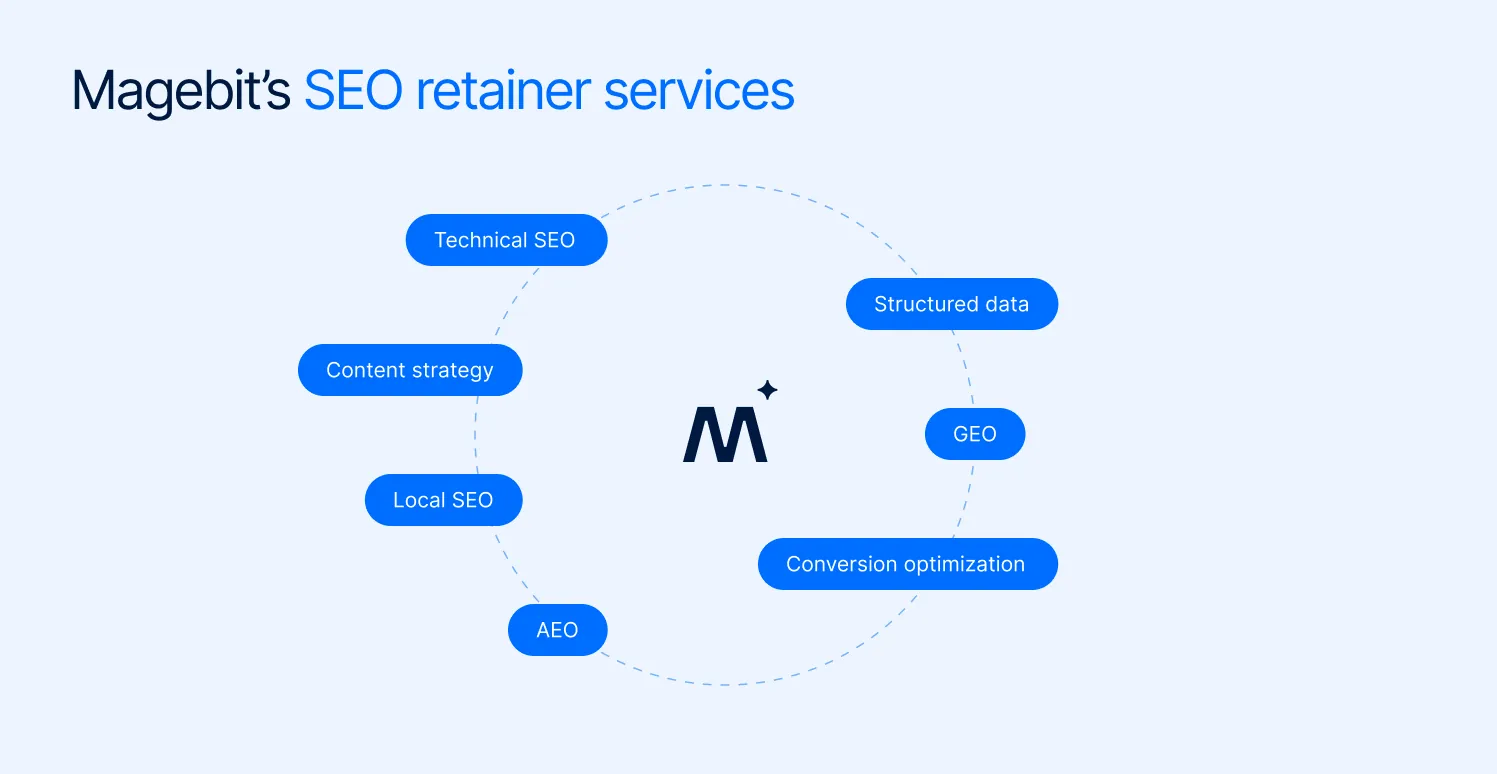
Magebit’s SEO retainer services cover technical SEO, content strategy, local SEO, AEO, GEO, structured data and conversion optimization.
Our team works across technical SEO, content strategy, local SEO, AEO, GEO, structured data, and conversion optimization to help ensure your products and locations are visible wherever customers search.
Final thoughts
Local SEO rewards retailers who consistently make their businesses, products, and locations easier to discover, understand, and trust.
Keep your profiles fresh, build location pages that actually answer buying questions, connect your inventory, and make sure your business information means the same thing everywhere it appears online.
Do that, and you’ll be ahead of most retailers already. Add structured data and an active review strategy, and you’re ahead of nearly all of them.
The brands that treat local search as a revenue channel rather than a background task are the ones quietly picking up customers their competitors don’t even know they’re losing.
If you’re looking to improve local visibility, talk to a Magebit expert about our SEO retainer services and how we help retailers turn visibility into revenue.