AI shopping in the United States is now big enough to matter and small enough to still get ahead of. That combination will not last long.
The traffic is already the best-performing you can get. Adobe Analytics, working from more than a trillion visits to US retail sites, found AI-referred shoppers converting 60% higher than every other channel in July 2026.
The same analysis found that large language models could read, on average, only 61% of a retailer’s website. That gap is the whole story. The channel works, but most stores cannot receive it.
This post covers how popular AI shopping actually is in the US right now, why the published adoption figures disagree so wildly, and the specific things to fix on your store before the traffic arrives in volume.
Quick answer
AI shopping in the US is now mainstream for product research, but most shoppers still complete the purchase on the retailer’s own site. To prepare your e-commerce store for AI traffic, fill the gaps in your product data, make your pages machine-readable, keep structured data accurate, and track AI referrals in GA4.
How popular is AI shopping in the US?
AI shopping is already more common than it might seem. But there’s a big difference between using AI to research a product and letting an AI agent buy it for you.
In fact, the numbers change quite a bit depending on which part of the shopping journey you’re looking at.
| What is being measured | 2026 US figure | What it tells you |
|---|---|---|
| Used AI for product research in the past 90 days | 43% of US online shoppers | The real demand signal. People actively asking questions before they buy. |
| Used AI to inform a purchase decision | ~30% of all US consumers | The commercial floor. Purchases that would look different without AI. |
| Completed a purchase entirely through an AI agent | 8% of AI users | Agentic commerce as it exists today, rather than as it is pitched. |
So, what does this mean for e-commerce brands? Three things stand out:
- AI is already shaping what people buy. If your products aren’t showing up when shoppers use AI to research and compare, you may be losing them before they ever reach your store.
- Your website still has to close the sale. AI may influence the shortlist, but shoppers still visit the retailer’s site to check details, compare options, and make a purchase.
- Agentic commerce isn’t the priority yet. For most e-commerce brands, the bigger opportunity right now is making their existing store easy for AI to understand and recommend, not rebuilding the entire buying experience around AI agents.
Where does AI shopping in the US start?
The bigger change isn’t just that shoppers are using AI. It’s where they start looking for products.
In 2024, 43% of AI users started purchase research on a traditional search engine, while 25% started on a standalone AI platform. By 2026, those figures had nearly flipped: 46% started with a standalone AI platform, compared with 24% who started with traditional search.
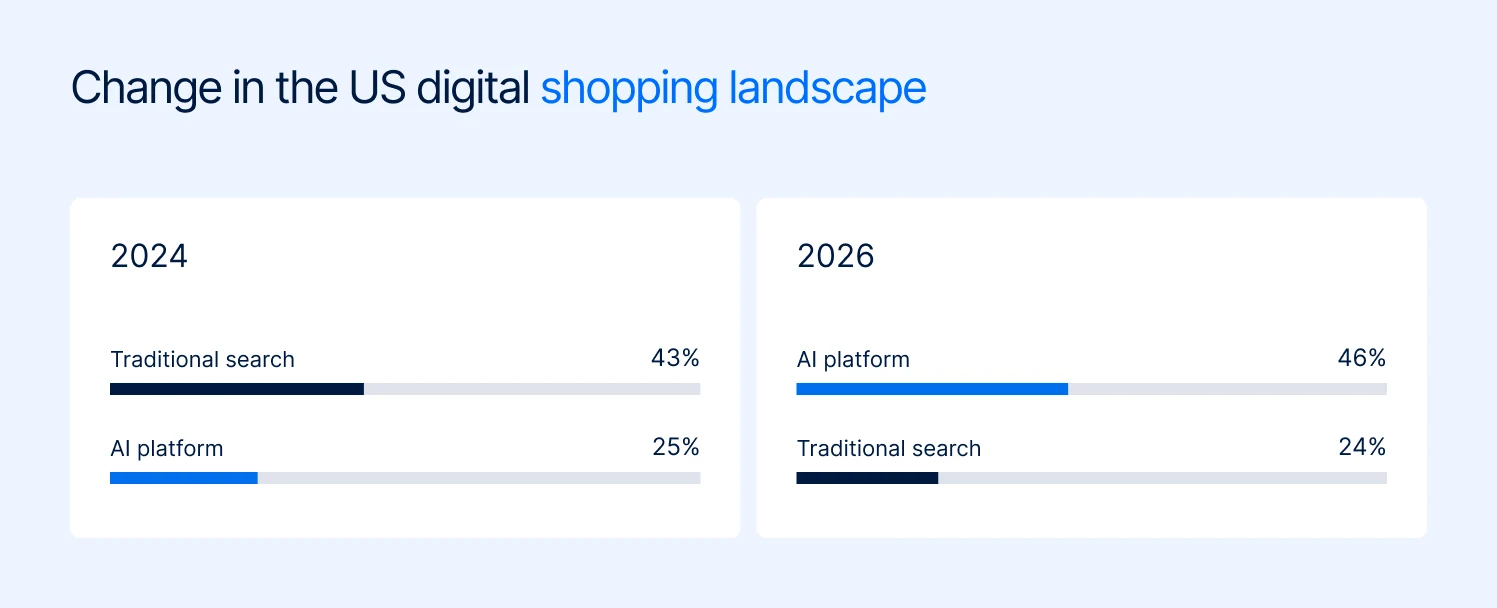
AI platforms overtook search as where US shoppers start, 2024 to 2026
That’s a different visibility problem for e-commerce brands. Google gives shoppers a page of results to work through. AI gives them a recommendation or a shortlist before they visit a retailer.
Are AI systems recommending your products?
That’s the question e-commerce teams now need to ask alongside “Where do we rank?”
A 2026 Recomaze study tested 9,720 e-commerce stores across 58,320 purchase-intent queries. 60% of the stores weren’t recommended for any of the six queries tested. Across the full study, a competitor was recommended 79% of the time when a store wasn’t.
That changes how you think about AI visibility. You aren’t trying to move from position 8 to position 4. You’re trying to get your product into the answer at all.
And unlike traditional search, the answer may contain only a few stores. If yours isn’t one of them, a competitor gets the shopper’s attention instead.
This is where AEO and GEO come in. AEO focuses on getting your content surfaced in AI-generated answers. GEO looks more broadly at how your brand and products appear across generative search and AI recommendations.
For e-commerce, both come down to the same question: can AI understand what you sell, connect your products to the right buying questions, and recommend your store?
What AI shopping changes for your e-commerce store
AI is changing what happens before a shopper reaches your store. They may arrive with products already shortlisted, questions already formed, and information they’ve received from somewhere else.
That puts more pressure on a few parts of the e-commerce experience.
Your store is no longer the first place shoppers learn about your products
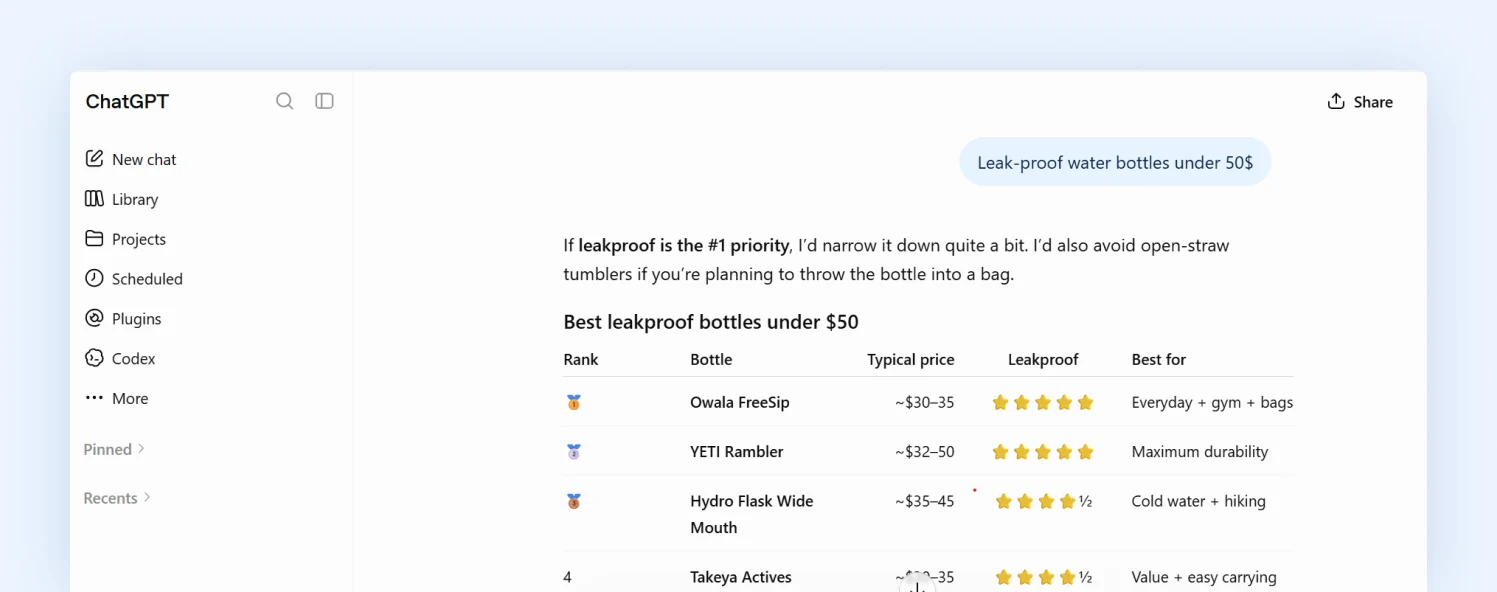
ChatGPT recommending products before the shopper reaches a store
A shopper may first encounter your product through ChatGPT, Gemini, Perplexity, or another AI tool. By the time they reach your site, they may already know the product they want, the alternatives they’re considering, and what they expect it to do.
Your PDP is becoming a verification point
AI can narrow down the options, but shoppers still come to the retailer’s site to check the details. Your PDP needs to make that verification quick, particularly for products with complex specifications, variants, or compatibility requirements.
Your product information now travels beyond your storefront
The information in your catalog can end up in AI recommendations, search results, feeds, structured data, and other systems. If those sources disagree, the shopper can get different answers depending on where they look.
What breaks when AI shoppers reach your store
These changes create some very practical problems when the underlying store isn’t ready.
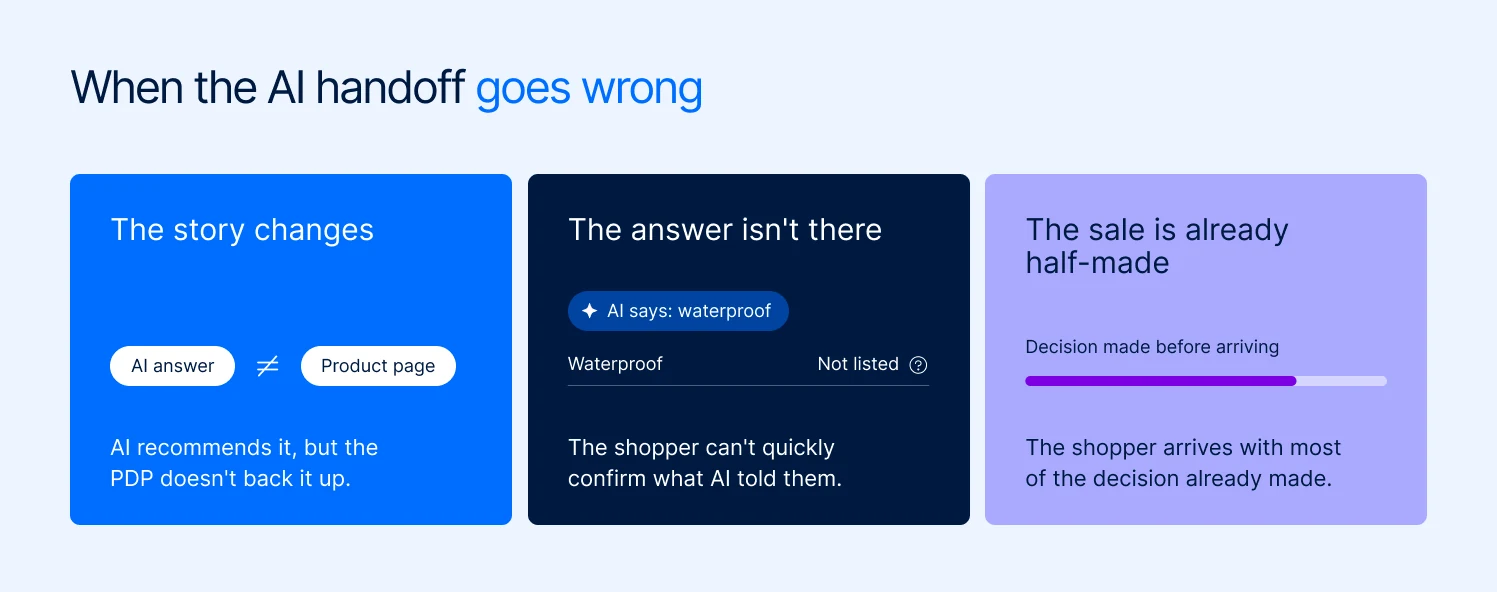
Three ways the AI shopping handoff breaks on the product page
The shopper gets conflicting information
AI recommends a product for a particular use case, but the PDP doesn’t mention that use case. AI says a product is compatible with something, but the site doesn’t confirm it. The shopper is left wondering which information is right.
The shopper can’t find what they came to check
If the answer is buried in a PDF, hidden inside a configurator, or spread across several pages, the shopper has to work too hard to confirm the recommendation.
Your PDP may be meeting the shopper after the decision
That means there’s less time to win them over with generic product copy. The page needs to quickly confirm that the product is right for them.
Small data errors become visible to customers
A wrong price, outdated availability, missing specification, or incorrect variant might start as an internal data problem. Once AI is involved, it can become part of the recommendation a shopper receives.
If the information on your store doesn’t match what they were told, you have a trust problem before they’ve even added the product to their cart.
How to prepare your store for AI traffic
None of this requires a new platform, a new integration, or a new vendor. It is work on the store you already have. Do it roughly in this order.
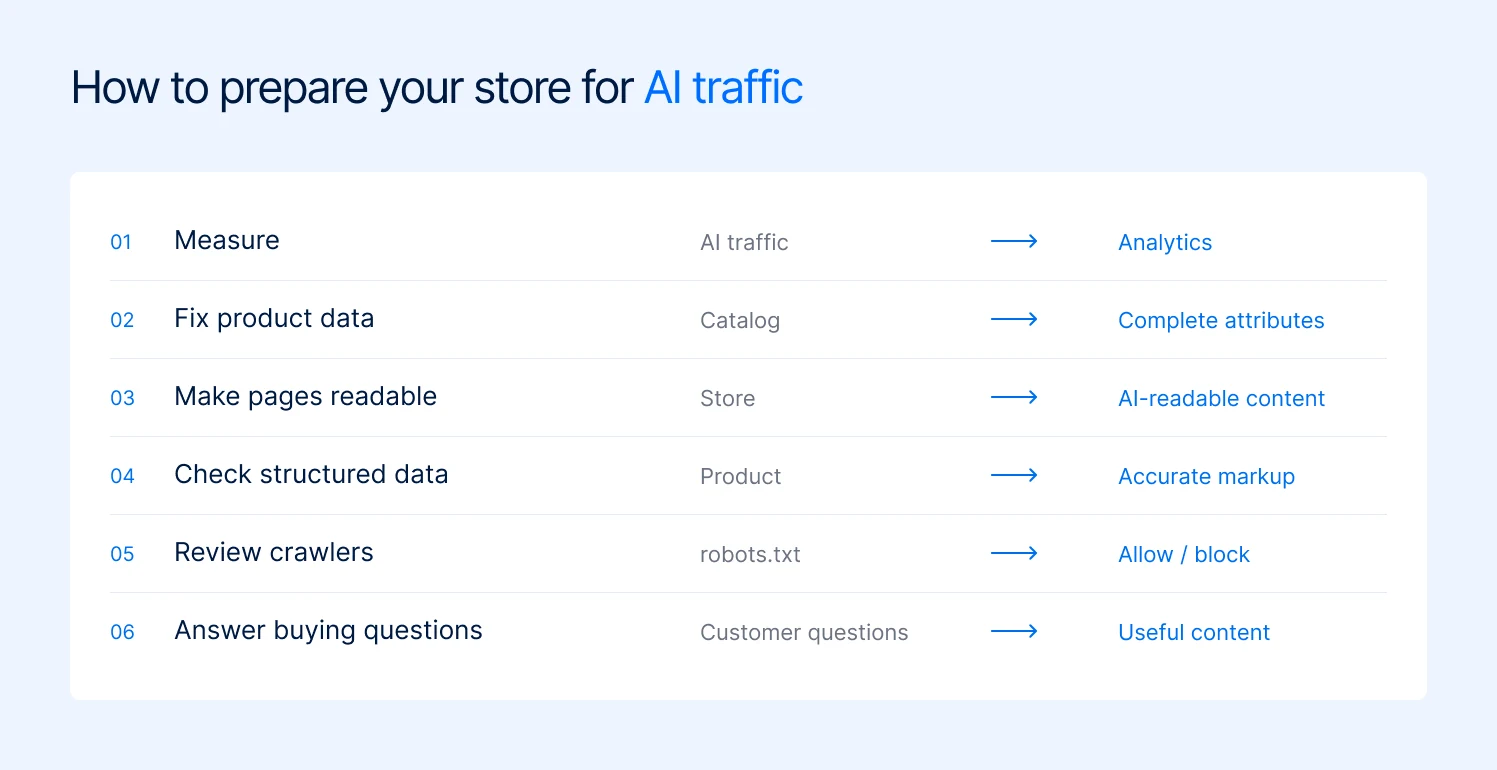
Six steps to prepare your e-commerce store for AI traffic
1. Measure the channel before you plan around it
First, find out whether AI is already sending shoppers to your store and what those visits are worth. Google Analytics 4 added an AI Assistants channel to its default channel group in May 2026.
It separates traffic from services such as ChatGPT, Gemini, and Claude from other referral traffic. You’ll find it under Reports → Acquisition → Traffic acquisition, with the dimension set to Session default channel group.
There are a few gaps to keep in mind:
- Perplexity is still grouped under Referral.
- Clicks from Google’s AI Overviews are counted as Organic Search because they come from a Google referrer.
- Unattributed sessions still appear under Direct.
Google’s platform list can also change, so check the current Google Analytics documentation before using the number in internal reporting.
The useful number isn’t simply AI traffic. Compare revenue per session from AI referrals with your other channels over the same period. That tells you whether the channel is worth investing in for your store.
2. Fill the gaps in your product data
This is where we’d start the actual store work. Look at every product attribute that could affect a buying decision: size, dimensions, materials, compatibility, technical specifications, variants, availability, and category-specific details.
If the size chart exists only as an image, material information is missing from half your SKUs, or the same attribute has three different names across categories, fix it. AI can only work with the information it can access.
This gets harder as catalogs get larger. We saw that with Ambler Surgical, which has more than 20,000 specialist surgical products and a large number of technical attributes.
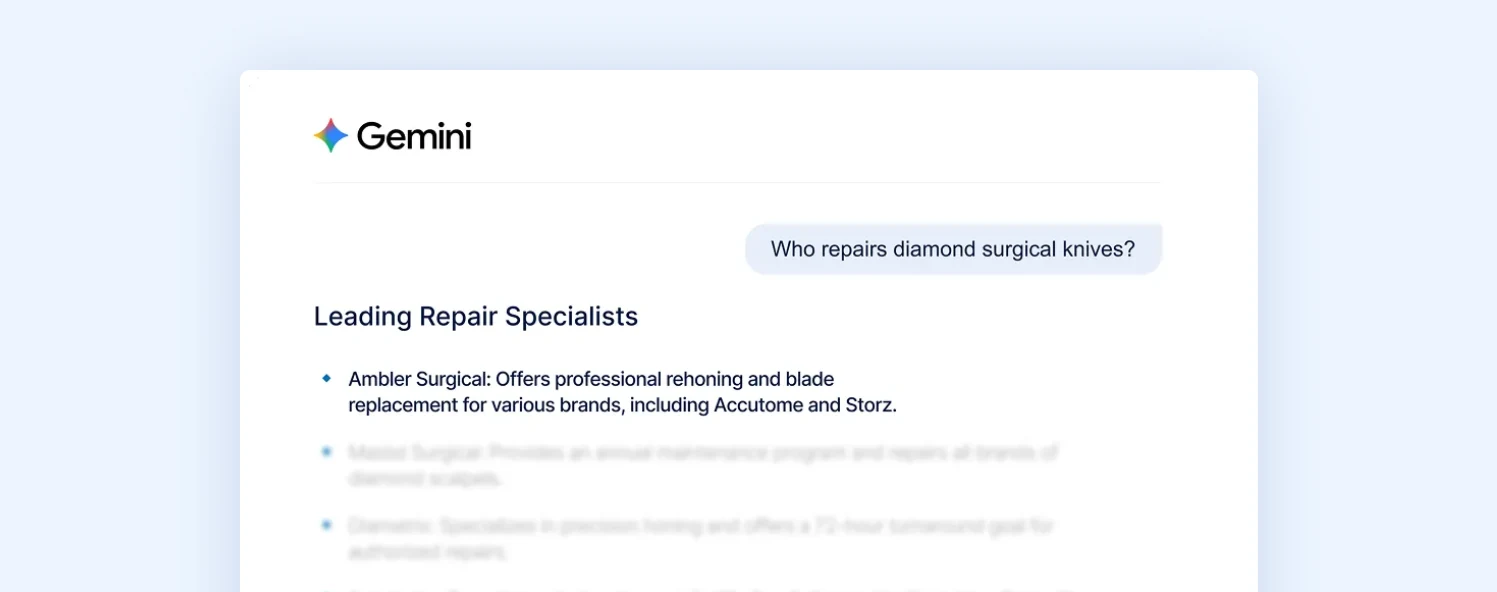
Gemini recommending Ambler Surgical first for a specialist query
Magebit worked on the product and category structure, crawl and indexation issues, and the underlying product data. The work helped Ambler reach #1 positions for priority AI queries, while organic search clicks grew 223% and ChatGPT referral traffic grew 872% year over year.
3. Check that machines can actually read your pages
Having the right information in your catalog doesn’t help if AI systems can’t reach it.
Check your PDPs for important information that only appears after an interaction: tabs, accordions, JavaScript-rendered sections, configurators, images, and PDFs can all contain useful product information that isn’t available in the same way to machines.
Your storefront can still use interactive elements. The important product information just needs to exist somewhere that machines can access without having to behave like a shopper.
4. Keep your structured data accurate
Product, Offer, Review, and other relevant structured data give machines another clear way to understand what’s on a page. The problem we see isn’t always missing markup. It’s wrong markup.
Check that product prices, availability, ratings, variants, identifiers, and other important fields match what’s actually shown on the page. If your inventory or pricing changes regularly, make sure those updates flow through to the structured data too.
5. Decide your crawler rules
Pull up your robots.txt and check which AI crawlers you’re allowing or blocking. There’s a legitimate reason to block some crawlers depending on how you want your content used. But don’t let your theme, platform, or an old SEO implementation make that decision for you.
If you’ve blocked the crawlers you want discovering your products, fix that before doing anything else.
6. Publish content shaped like the questions people ask
Your product catalog tells AI what a product is. It doesn’t always answer the questions shoppers have before buying it.
Look at the questions your sales and customer service teams hear repeatedly. Then turn those into useful pages: product comparisons, sizing and fit guides, compatibility explainers, use-case pages, and buying guides.
For example, “Which of these will fit my kitchen?” needs a different kind of content from a standard product description. So does “Which of these is compatible with my existing system?”
This content helps AI understand which products fit which situations, while giving shoppers something useful to check when they reach your store. It can also support conventional search and on-site search, so you’re not creating it for AI alone.
What to prioritize before investing in AI shopping
There are a lot of new AI commerce features to spend money on. Not all of them need to be on your roadmap yet.
Don’t make AI checkout the first priority
The idea of completing the whole purchase inside an AI platform got a lot of attention in 2025. But the model is still evolving.
In March 2026, OpenAI said it was moving away from its initial Instant Checkout experience and focusing more on product discovery, while giving merchants more control over their own checkout.
Other forms of agentic checkout are still being developed, so this isn’t a reason to ignore the space. It is a reason to be careful about building your e-commerce roadmap around one particular AI checkout experience.
For most stores, the immediate opportunity is simpler: make sure the store itself works when AI sends a shopper there. Publicis Commerce and EMARKETER found that 69% of AI-assisted shoppers usually finish their purchase on a retailer’s website or app, while only 10% usually complete it on the AI platform.
An on-site assistant can wait too
Retailer-owned AI assistants have a stronger case. EMARKETER forecasts that retailer-native AI assistants will account for 54.1% of US AI-driven retail e-commerce sales in 2026 and remain ahead of general-purpose AI platforms through 2030.
But an assistant is only as useful as the commerce data behind it. If your catalog has missing attributes, your inventory is unreliable, or your product information contradicts itself, an assistant can turn those problems into customer-facing answers.
Fix the catalog and the underlying store first. Then decide where an AI assistant can save your customers time or help them choose the right product.
How Magebit can help US e-commerce brands prepare for AI shopping
The shift to AI shopping sits across marketing and technology. SEO and AEO/GEO determine whether your brand gets discovered and cited.
Your e-commerce platform, product data, integrations, and infrastructure determine whether the information behind those recommendations is actually accurate. Magebit brings those two sides together.
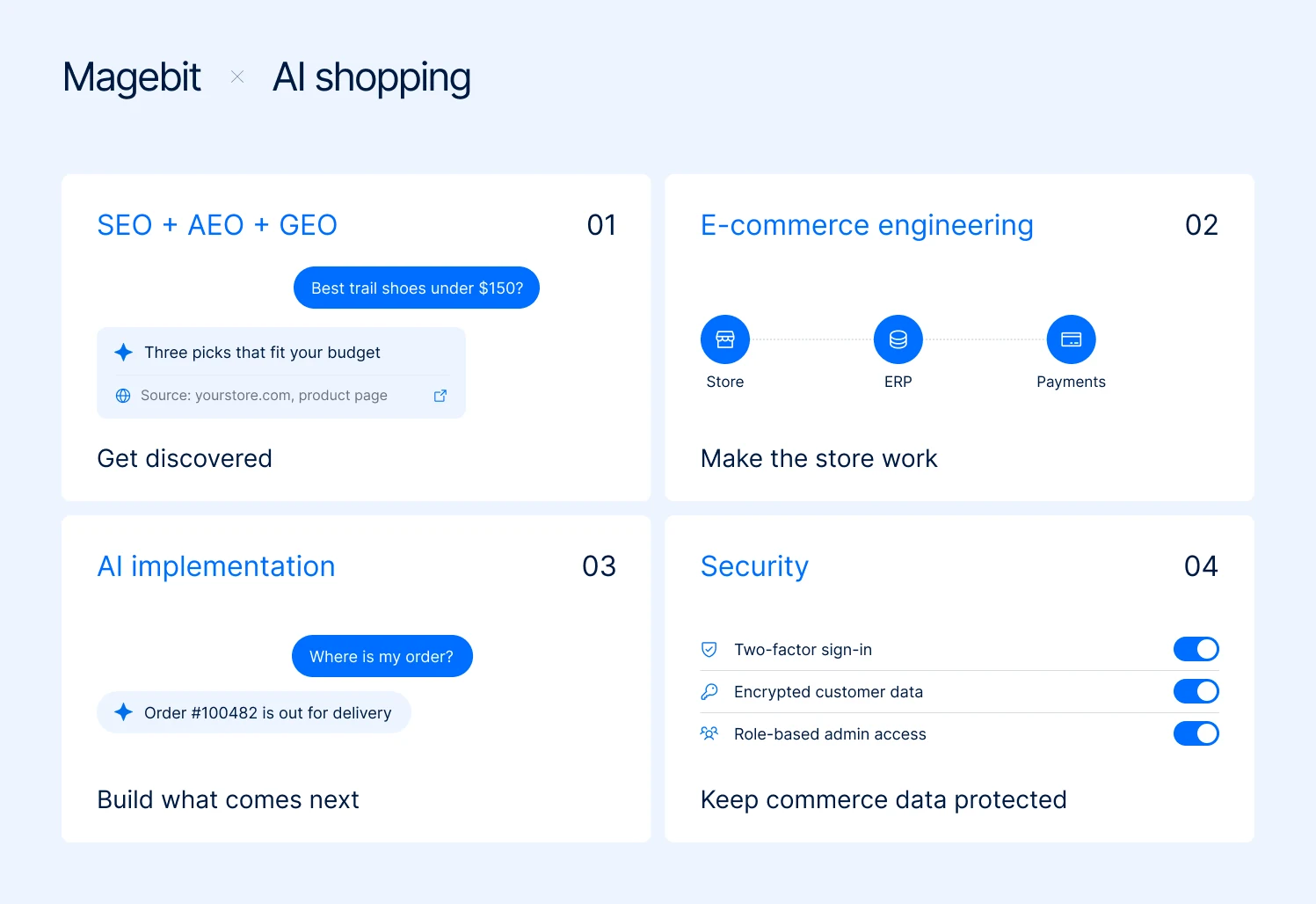
How Magebit prepares e-commerce stores for AI shopping
SEO, AEO, and GEO: We can track how your brand and products appear across Google, ChatGPT, Gemini, Perplexity, and other AI search experiences, then use that data to identify where you’re being missed and what competitors are winning visibility.
E-commerce engineering: For complex Shopify Plus, Magento, and Adobe Commerce stores, the changes often need to happen deeper in the stack. Magebit’s developers can work on the commerce architecture, integrations, product data, and custom functionality behind the storefront rather than stopping at recommendations.
AI implementation: Once the foundation is ready, we can help with the next layer, from AI-assisted shopping experiences to agentic commerce and AI integrations. Magebit’s open-source MCP module, for example, connects AI systems with Magento and Adobe Commerce through role-based permissions and audit logging.
Security: AI commerce can touch product data, customer information, orders, and other sensitive systems. Magebit is ISO 9001 and ISO 27001:2022 certified, giving security and data handling a defined place in the implementation process.
A 90-day starting point
| Timeframe | Focus / Key Objectives |
|---|---|
| Days 1–30 | AI visibility and e-commerce assessment |
| Days 31–60 | Priority SEO/AEO/GEO and engineering work |
| Days 61–90 | Measure results and identify the next AI commerce opportunities |
For US e-commerce brands, the work isn’t about picking one AI platform and betting everything on it. It’s about having the marketing, commerce, and engineering teams ready as the channel develops.
Final thought
AI shopping may change where customers discover products, but the basics of e-commerce haven’t changed. Your products still need accurate information, your site still needs to work, and shoppers still need to trust what they see.
The difference is that some of that decision-making now happens before the shopper reaches your store.
So if you’re already seeing AI referrals in your analytics, don’t wait for the channel to become a major source of traffic. Find out what’s working, fix the gaps, and make sure your store is ready for more of it. Talk to Magebit about a free SEO & AEO audit.