AI adoption is no longer a differentiator. Most companies have already crossed that line. The problem is what happens next?
88% of organizations now use AI in some capacity, but most are still operating in fragments. Tools are being tested, prompts are being written, and isolated gains are easy to find. What is missing is integration.
Back in 2024, Magebit approached AI differently. We made a call to treat AI as a baseline expectation across the organization and not as a tool. That decision changed everything.
Today, everyone on the team (developers, designers, finance, HR, and admin staff) is AI native. And if they’re not, they learn it, get better at it, and leverage it to do work that matters. Here’s how this strategy helped us gain a competitive advantage.
Being early AI adopters, we went all in
The biggest mistake companies made with AI was not timing. It was caution. Most teams kept AI at the edges. They used it for small tasks, avoided putting it into core workflows, and waited for it to become reliable enough. Although that approach was safe, it also guaranteed limited impact.
We saw early that the value of AI does not come from isolated use cases; it comes from changing how work flows. So we tested it where the stakes were higher. Development was the starting point. Cursor was one of the first tools we used for Magento workflows. It was not perfect at that point, but it was already reducing repetitive work and making iteration faster in a way that was hard to ignore.
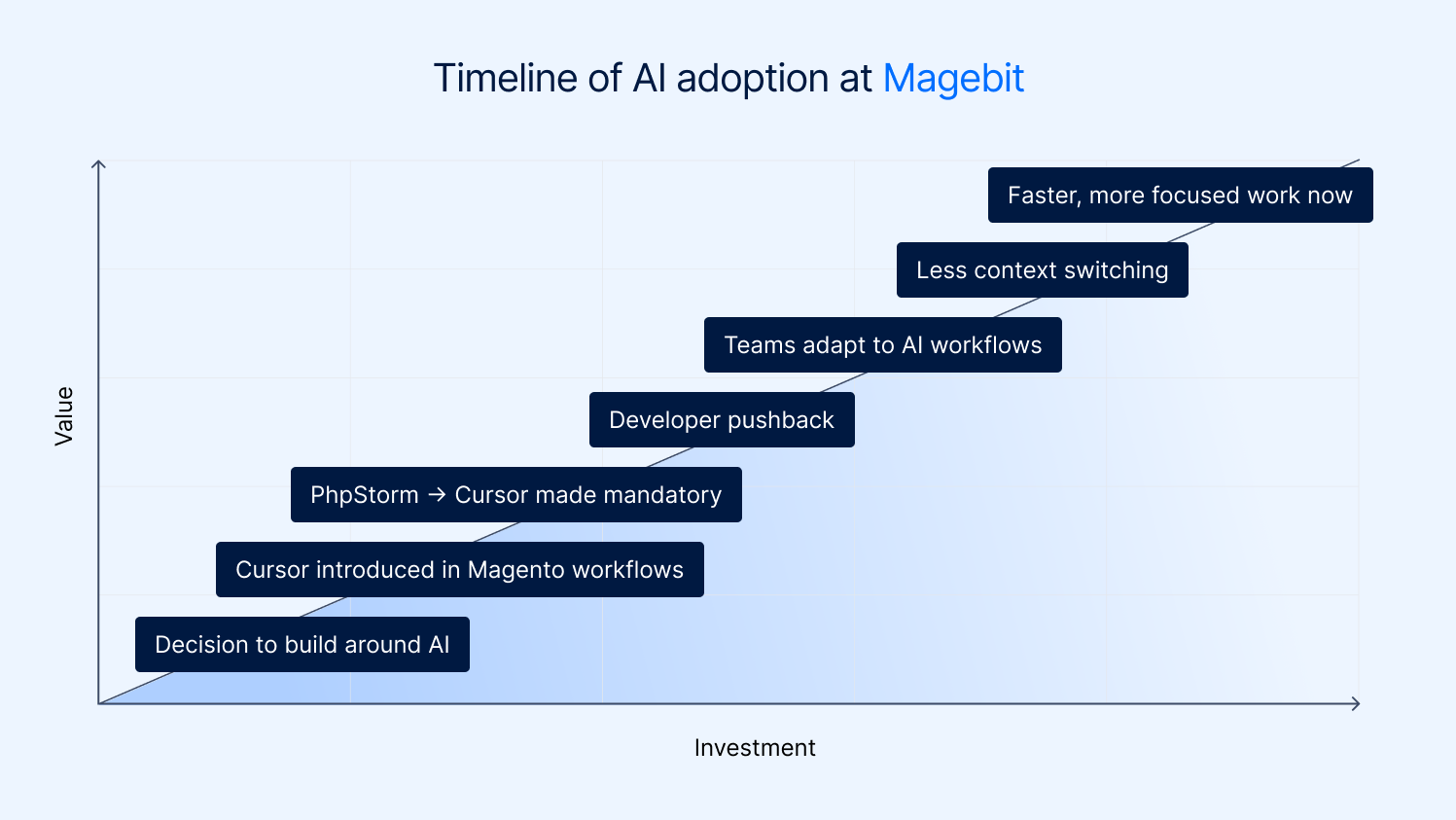
Visual timeline of Magebit’s AI journey
At that point, the decision became clear. Either treat AI as a helper, or build around it. We chose to build around it. The transition was not smooth. When we made the switch from PhpStorm to Cursor mandatory, the pushback was immediate. Developers had workflows they trusted, and AI still felt unpredictable.
But as teams adapted, the benefits became consistent. Work became faster, but more importantly, it became less fragmented. Developers spent less time switching contexts and more time solving actual problems.
Then came the behavioral shift. The same people who were most skeptical at the start are now the ones who rely on it the most. Not because they were convinced early, but because the improvement became impossible to ignore.
AI across every team
When companies limit AI to technical teams, it creates a new bottleneck. If only parts of the organization evolve, the gains stay local. Work still slows down when it moves across teams.
We made a different decision. AI had to be relevant to how each function operates, not just where it is easiest to implement, so we applied it consistently across all teams.
| Team | How AI is Used | What it Improves |
|---|---|---|
| HR | AI-assisted candidate screening, resume parsing, and onboarding workflow automation | Reduces manual effort, speeds up hiring cycles, and improves consistency in evaluation |
| Finance | Scenario modelling, financial forecasting, and what-if analysis using real-time data | Faster decision-making, better risk assessment, and more accurate projections |
| Design | Rapid asset generation, concept exploration, and variation testing | Shorter design cycles, more creative exploration, and quicker iteration on ideas |
The table above is just an example of some teams using AI at Magebit. The goal here is not adoption; it is alignment. When every team operates with the same baseline capabilities, handoffs become faster, decisions become clearer, and execution becomes more predictable.
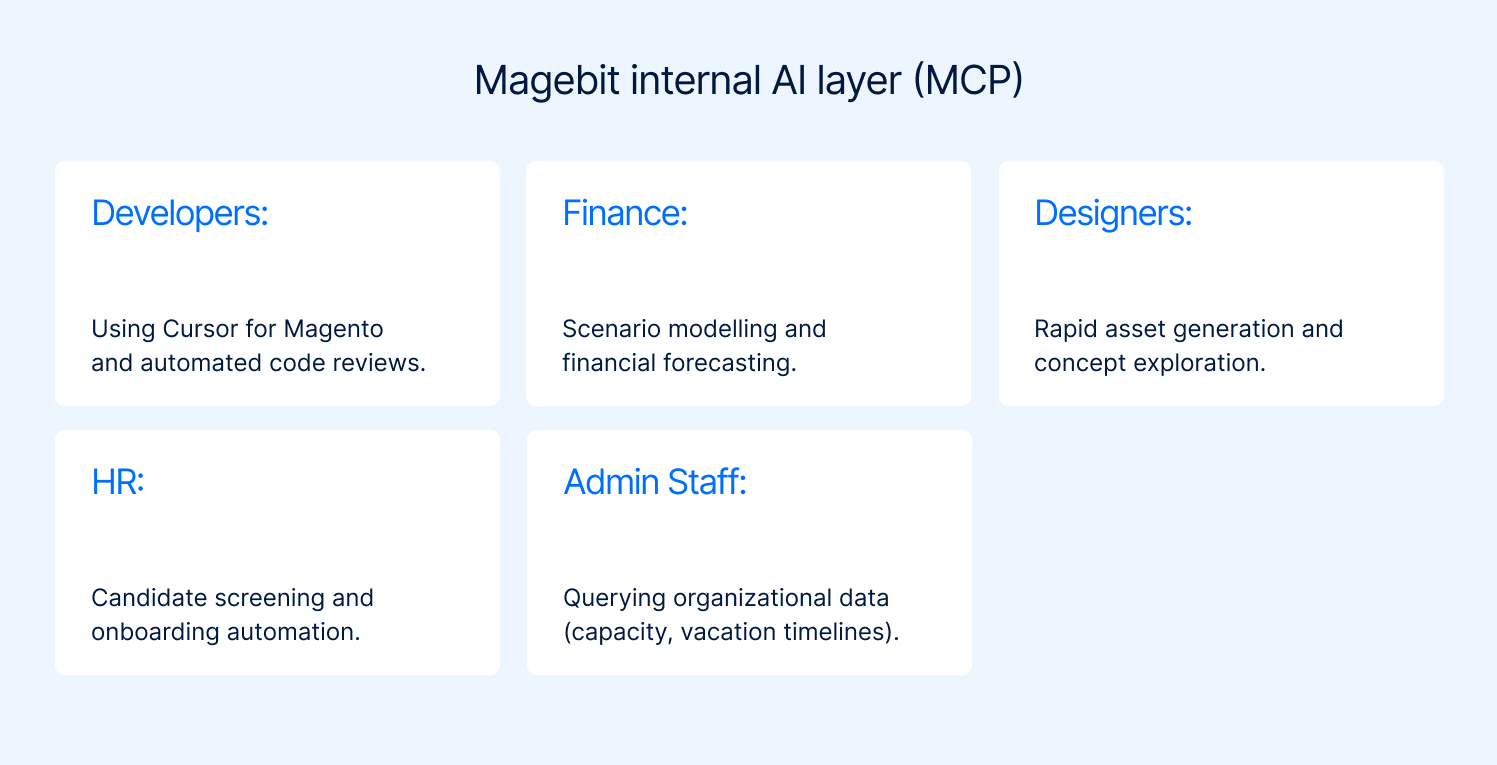
Conceptual visual of organization-wide AI usage at Magebit
That is where the compounding effect shows up. However, that shift did not happen automatically. It required training, patience, and a willingness to rethink existing workflows rather than simply layering AI on top of them. We run regular sessions tailored to different roles:
- Team-specific AI workshops
- Mob programming sessions with AI
- Mandatory internal AI courses
- AI fundamentals for non-developers
The result is a company where AI fluency is universal, not siloed.
How Magebit uses AI tools
AI is deeply embedded in how we work, but we do not use it blindly. Every output is treated as a starting point, not a final answer. Teams are expected to validate, refine, and apply judgment based on context. This matters because AI is only as effective as the inputs it receives and the way it is used. Without that layer of oversight, speed comes at the cost of accuracy.
So while AI helps us move faster, the standard of work is still defined by people.
Our internal AI brain
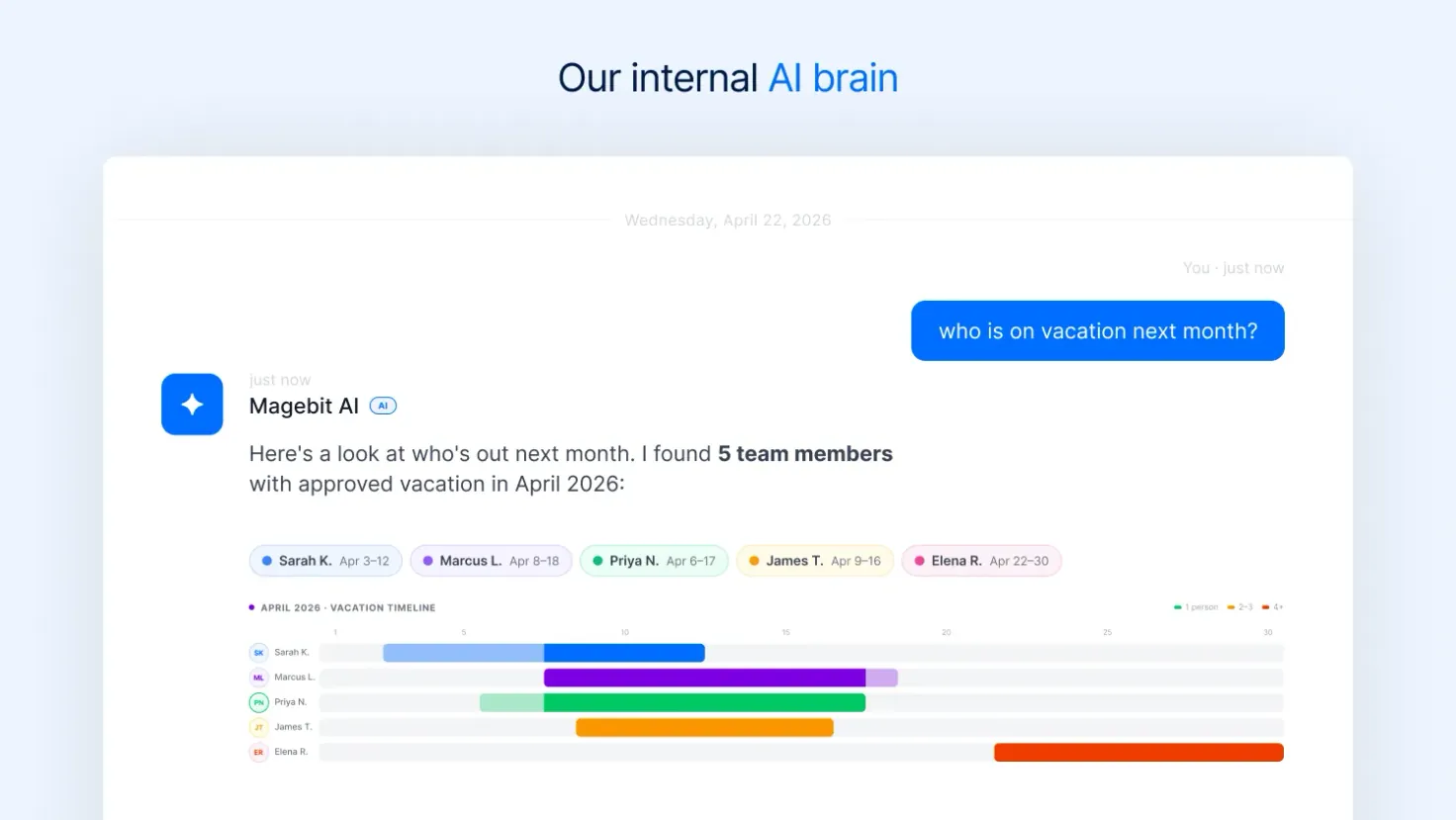
Magebit’s internal AI tool
Most AI tools have one limitation. They do not understand your business. They generate outputs, but they lack context. That is why most implementations plateau. We hit that limit early.
So instead of relying only on external tools, we built an internal AI layer that understands how our company actually works. It’s similar to Palantir Foundry. This system connects projects, financials, timelines, team structures, and client history into a single context layer.
That changes how teams interact with data. Instead of searching across systems, teams can query the organization directly and get answers that are relevant to how we operate. This removes a category of inefficiency that most companies accept as normal: time spent searching, time spent asking, time spent waiting.
How it works
Our internal AI layer connects company data and structures it so the system understands relationships, not just inputs. That intelligence layer is exposed as an internal MCP (Model Context Protocol). Now, anyone using Cursor, Claude, or our internal Slack bots can ask questions in plain language and get highly accurate answers instantly.
What this means in practice:
- Context-aware responses, not generic outputs
The system understands how our organization works, so answers reflect real workflows, not assumptions. Want a financial projection for Q3? Ask. - No dependency on tribal knowledge
Information is no longer locked in specific places. Anyone can access what they need, when they need it (unless confidential). Need insight into team capacity for a new project? Ask. - Fewer tools, fewer interruptions
Teams do not need to jump between dashboards, spreadsheets, and chats. They ask once and get a usable answer. - Decisions happen earlier, not later
Whether it is project capacity, financial projections, or client context, teams can act immediately instead of waiting for inputs. Interested in knowing when an account manager for a specific client will be back from vacation? Ask.
Here is a simple example of the shift:
- Before: Check multiple systems → ask someone → validate → decide
- Now: Ask AI once → get context-aware answer → act
What this means for our clients
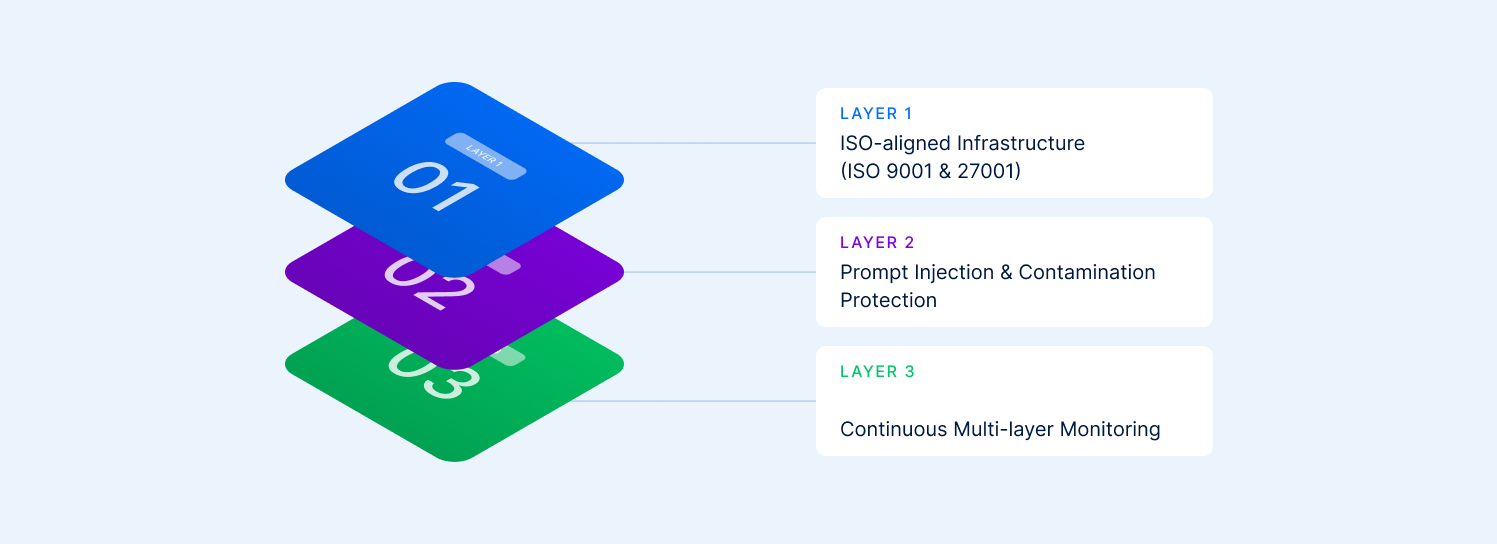
Conceptual graphic showing how Magebit’s AI enhances client outcomes
- Security is never compromised
You might wonder about risks. We handle them head-on. All our AI services run on secure, ISO-aligned infrastructure (with ISO 9001 and 27001 certification in progress). We’ve brought key functions in-house to reduce reliance on third-party systems, and everything we build internally is locked down and monitored.
Our security posture accounts for traditional threats and emerging ones, like prompt injection attacks and AI-driven contamination attempts. We monitor at multiple layers, continuously.
In our view, this is where AI adds the most value, not by replacing standards, but by reinforcing them while improving speed.
- AI-powered quality control adds additional safeguards
We have embedded AI directly into our software development lifecycle so that quality checks happen continuously, not just at the end. Instead of relying only on manual reviews, we use automated systems at key stages of development:
- Code review bots analyze pull requests for logic issues, security risks, and inconsistencies in structure and style.
- Pre-commit checks catch potential bugs before they enter the codebase.
- Post-deployment monitoring helps identify unusual behavior in real time, so issues can be addressed early.
The role of these systems is not to replace developers, but to support them. By reducing the time spent on repetitive checks and obvious errors, developers can focus more on solving complex problems and improving the overall architecture. This also creates a more consistent standard across the codebase, since every change is evaluated against the same criteria.
In practice, this leads to fewer production issues, faster release cycles, and a level of quality that is easier to maintain as projects scale.
- Faster execution is part of our process
One of the most immediate benefits of AI is speed, but the real gain is better decision-making capabilities:
- Teams can now prototype and iterate far more quickly than before, which means ideas are tested earlier and refined faster
- Instead of long feedback cycles, clients see progress in shorter loops and can make decisions with more clarity
- Issues are identified much earlier in the development cycle. This reduces the cost of fixing them later and avoids the kind of delays that typically impact timelines
- With better access to data and context, recommendations are no longer based on assumptions alone. Whether it is prioritizing features, evaluating trade-offs, or planning next steps, decisions are grounded in real inputs rather than guesswork
It is important to note that this is not about replacing people. The role of AI is to remove friction, surface insights, and support better execution. The outcome is that skilled teams can operate at a higher level, delivering work that is not only faster but also more considered and reliable.
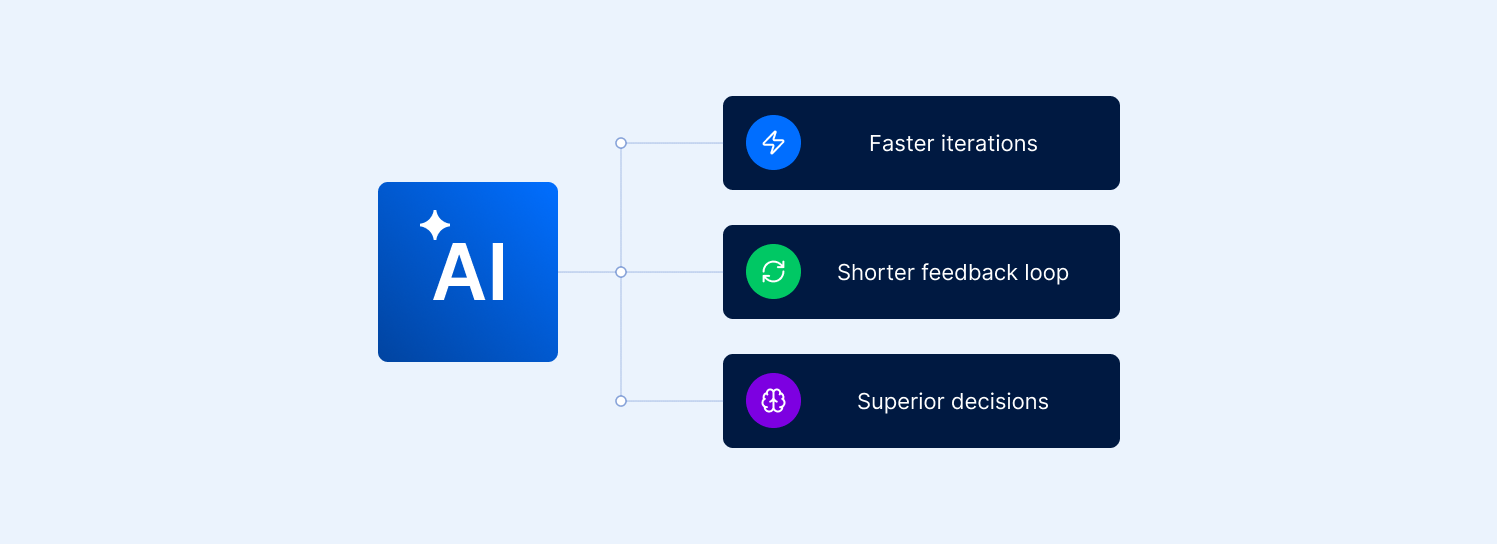
AI-driven benefits that Magebit offers to clients
Why Magebit is uniquely positioned
Most companies are now trying to retrofit AI into existing systems. We built workflows around it early. That difference compounds over time and creates a structural advantage.
AI is only as effective as the systems it sits on. Without strong engineering foundations, it remains a layer on top. With the right foundation, it becomes part of how work is executed. Our background in Shopify and Magento development plays a key role here, because it allows us to integrate AI into complex, real-world environments rather than isolated use cases.
That is also why our approach has been practical, not experimental. We have applied AI across different types of problems, from improving development workflows to building custom solutions such as deal evaluation models for venture capital firms and AI-driven content personalization.
We have also engaged early with emerging directions like agentic commerce. This includes contributing to open-source Magento modules that enable AI-driven interactions, and working with evolving standards such as ACP and UCP.
At the same time, being part of organizations like the MILA AI Association keeps us close to ongoing research, as well as current and upcoming legislation shaping this field. That perspective helps us separate short-term trends from long-term shifts worth investing in.
Ready to lead?
AI won’t replace companies. But companies that master AI will replace those that don’t. The gap between the ‘experimenters’ and the ‘integrators’ is widening every day. If you’re thinking, “We should be using AI now,” the data’s clear: 92% of businesses are already betting on AI. The question is, how do you win among them?
This is where it helps to work with implementers like Magebit who have already built around it. We aren’t waiting for the future of commerce; we’re the ones building the infrastructure for it. We’re still pushing the frontier – experimenting with new LLMs, refining our AI pipelines, and training every team member to think in data flows and model prompts.
If you want to zoom past your competition with smarter, faster development, let’s chat. We can show you the tools and processes behind our success, or even run a pilot to prove the concept.