Most online stores run an automated email that fires the moment someone adds items to their cart. It works well on consumers, because a consumer who stalls is usually just distracted or comparing prices.
A hospital procurement team stalls for a completely different reason: the purchase order needs three signatures, and the budget owner is out until Thursday. No reminder email fixes that, because the holdup was never indecision in the first place.
That mismatch is why B2B healthcare email results generally run well below the B2C numbers that get quoted everywhere. Klaviyo’s widely cited 83.6% welcome-email and 50.5% abandoned-cart open rates come from a dataset that’s overwhelmingly B2C, not a realistic floor for what a hospital or clinic buyer will do.
Growing average order value (AOV) and lifetime value (LTV) in B2B healthcare doesn’t come from copying the consumer playbook.
It comes from building email flows, automated sequences triggered by what an account actually does, around how procurement, reordering, and contract renewals really work.
Quick answer
The five email flows that increase AOV and LTV for B2B healthcare and medical supply sellers are contract onboarding, usage-based replenishment, approval-stalled order recovery, volume-tier upsells, and compliance reminders.
Each one is triggered by how an account actually buys, such as its reorder cycle or approval window, not by a fixed consumer-style schedule.
The problem: consumer flows sent to institutional buyers
Most medical supply and equipment sellers use the same core email flows as DTC brands: a welcome series, abandoned-cart reminders, and discount-led win-back campaigns. The problem isn’t the flows themselves. It’s the assumptions behind them.
Most e-commerce flows assume one person discovers a product, decides to buy it, and checks out. B2B healthcare purchasing rarely works that way. A single order may pass through a requester, procurement, and a budget approver before it’s approved.
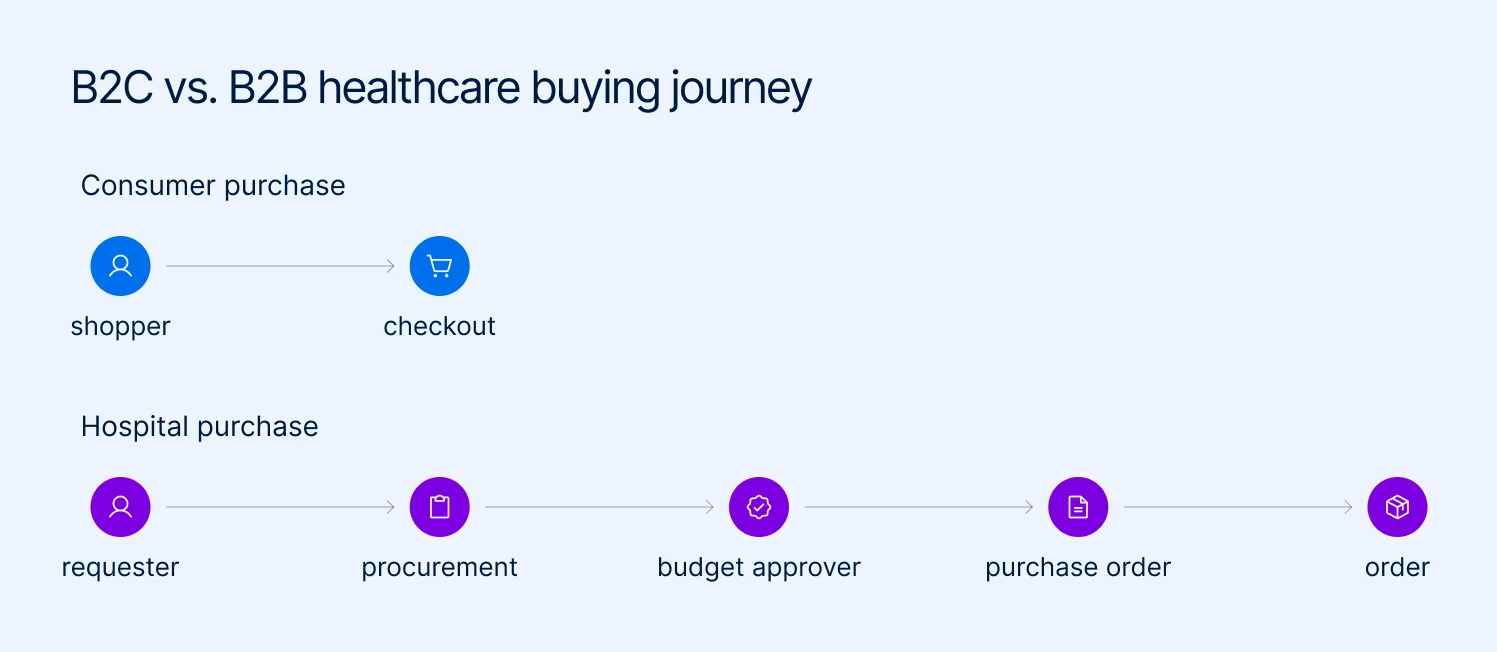
B2C vs B2B healthcare buying journey
So when an order stalls, it’s usually waiting for sign-off, not because the buyer has changed their mind. An abandoned-cart email sent an hour later solves the wrong problem.
Reordering works differently too. Hospitals and clinics regularly restock products like gloves, wound care supplies, and sterilization products.
These buyers don’t need persuading to place another order; they need a reminder before they run out. Waiting until an account looks inactive misses the buying cycle entirely.
That’s why generic email flows underperform in B2B healthcare. The issue is sending the right email at the wrong time. The best-performing flows are built around how each account actually buys, its approval process, reorder cadence, and purchasing behavior.
Who is actually buying from you?
Before building any email flow, segment accounts by how they buy, not how much they spend. A hospital and a small dental practice might generate similar revenue but need completely different email triggers.
| Facility type | Typical buyer | Purchase pattern | Flow that fits |
|---|---|---|---|
| Hospital/health system | Procurement team, multiple approvers | Large, contract-priced, multi-signature orders | Onboarding to contract terms, approval-stalled order recovery |
| Clinic/private practice | Office manager or single buyer | Frequent, smaller consumable orders | Usage-based reorder reminders |
| Dental office | Practice owner or office admin | Predictable monthly restock | Replenishment flow tied to typical cycle |
| Diagnostic lab | Lab manager | Reagent and consumable restocking, tight timing | Stock-out alerts, backorder updates |
| Long-term care facility | Facilities or care coordinator | Steady, recurring, compliance-sensitive | Recertification and renewal reminders |
Pro tip: Let order history guide your segmentation. The facility type in your CRM or commerce platform won’t always reflect real buying behavior.
The 5 email flows that drive AOV and LTV in B2B healthcare
Once you’ve segmented your accounts, these five email flows will do most of the heavy lifting. Each one is triggered by how an account actually buys, not by a fixed email schedule.
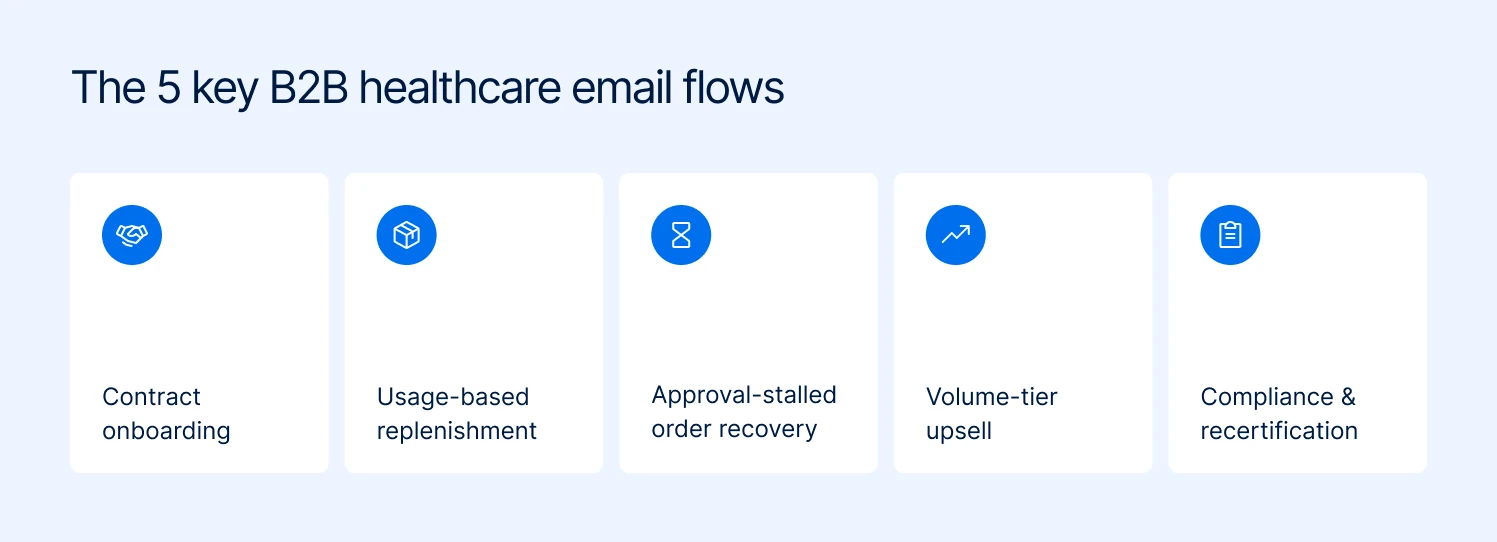
Five B2B healthcare email flows
| No. | Flow | Trigger | What it does | Metric it drives |
|---|---|---|---|---|
| 1 | Contract onboarding | New account activated or contract signed | Confirms negotiated pricing, sets up requisition lists, shows how to reorder fast | Time to first repeat order |
| 2 | Usage-based replenishment | Predicted reorder date based on past consumption | Reminds the buyer before stock runs out, with the exact SKUs and quantities they usually order | Purchase frequency (core LTV lever) |
| 3 | Approval-stalled order recovery | Cart or quote sitting idle past the account’s typical approval window | Sends the approver a direct link and the documentation they need to sign off, not a discount | Order completion rate |
| 4 | Volume-tier upsell | Account nearing its next contract pricing tier or kit threshold | Shows the exact quantity needed to get better per-unit pricing on products they already buy | AOV |
| 5 | Compliance and recertification nudge | Product requiring periodic documentation, recalibration, or renewal | Reminds the buyer before a lapse creates a compliance gap | Retention/LTV |
Back-in-stock notifications can also capture demand for products that regularly go out of stock. When a requested product becomes available again, automatically notify the buyer with a direct link to the product or reorder page.
Replenishment is the highest-leverage flow on this list. Buyers already know they need the product; the only job of the email is showing up before they have to think about it.
Here’s how those five flows would work for a hospital that typically reorders surgical gloves every 28 days.
- Contract onboarding: As soon as the contract is signed, the buyer receives negotiated pricing, approved product lists, and simple reorder instructions. The goal is to make the first repeat order as easy as possible.
- Replenishment reminder: About a week before the hospital is expected to run low on gloves, it receives an email with the same products and quantities it usually orders, making it quick to reorder before stock runs out.
- Approval follow-up: If the order remains unapproved longer than that account’s usual approval timeline, a follow-up email is sent to the person responsible for approving purchases, along with the information they need to move the order forward. The goal is to remove approval delays, not offer a discount.
- Volume-tier upsell: If the hospital is close to qualifying for better contract pricing, the email shows exactly how many more boxes of gloves it needs to add to get the lower price. Instead of pushing unrelated products, it encourages a larger order on items the hospital already buys regularly.
- Compliance reminder: If the hospital needs to renew documentation or recalibrate equipment to stay compliant, the reminder arrives before the deadline to help avoid interruptions to future orders.
Where these programs actually break
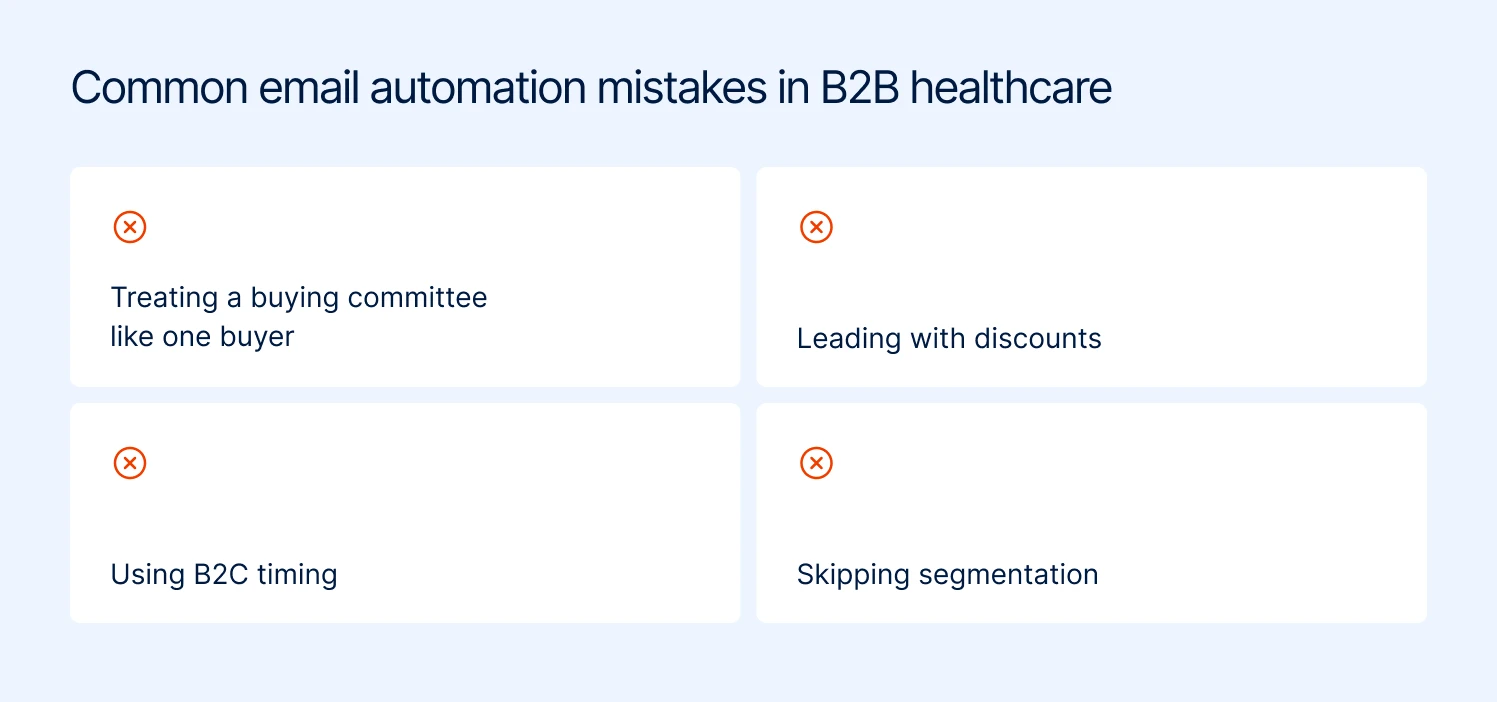
B2B healthcare email automation mistakes
Mistake 1: Treating a buying committee like a single buyer
A hospital order is rarely approved by the same person who creates it. If every follow-up email goes only to the person who placed the order, it can sit in someone’s inbox waiting to be forwarded to the budget approver.
Instead, send approval-related emails to the person who can actually sign off on the purchase.
Mistake 2: Leading recovery emails with a discount
A hospital or lab account that gets trained to expect a percentage off every time an order stalls will start stalling orders on purpose.
Discount-led AOV tactics can actively erode long-term value. A discount might make this order bigger, but it can also teach buyers to wait for the next deal. For institutional buyers, removing approval delays is usually more effective than offering a coupon.
Mistake 3: Sending on B2C timing
A one-hour abandoned-cart email assumes the buyer can check out immediately. A hospital’s approval window runs several days, so an email sent an hour after the cart stalls just lands in an inbox nobody with signing authority has opened yet.
Time the send to the account’s real approval cycle, not a countdown built for consumer carts.
Mistake 4: Skipping segmentation entirely
A single “one email fits all accounts” program misses that a dental office and a hospital network buy on completely different rhythms, even when their annual spend looks similar on paper.
Growing AOV without training buyers to wait for a discount
Institutional buyers care more about relevance than discounts. In B2B healthcare, the best ways to increase AOV are kit-based bundling and tier-threshold nudges.
Kit-based bundling groups products that are often ordered together, such as gloves, masks, and sterilization supplies, into a single reorder. Buyers spend less time placing multiple orders, and your average order value increases naturally.
Tier-threshold nudges work just as well. If an account is close to reaching better contract pricing, the email should show exactly how many more boxes of gloves or other regularly purchased products they need to add to qualify.
Instead of pushing unrelated products or offering a coupon, you’re helping buyers get better value on items they already planned to purchase.
Both approaches increase order value by making the purchase more useful, not by training buyers to wait for the next promotion.
Turning your email data into a real LTV number
Most sellers know their average order value (AOV). Fewer know their customer lifetime value (LTV), making it difficult to measure the true impact of email flows like replenishment reminders or approval follow-ups. A simple starting point is:
LTV = Average Order Value × Purchase Frequency × Customer Lifespan
For example, a hospital placing four $2,000 orders a year over five years has a much higher LTV than a dental practice placing six $300 orders a year for two years, even if both generate similar revenue in their first year.
Don’t calculate LTV across your entire customer base. Calculate it for each facility type, such as hospitals, clinics, dental practices, and labs. That shows which accounts are worth investing more in with onboarding, replenishment, and retention flows, and which need a different strategy.
How Magebit helps build these email flows for global B2B healthcare brands
The email is rarely the hard part. The hard part is getting the right data into your email platform.
We’ve seen healthcare brands where contract pricing lives in Adobe Commerce, reorder history lives in the ERP, approval roles sit somewhere else, and the email platform only knows when someone last opened a campaign. In that setup, every flow becomes a guess.
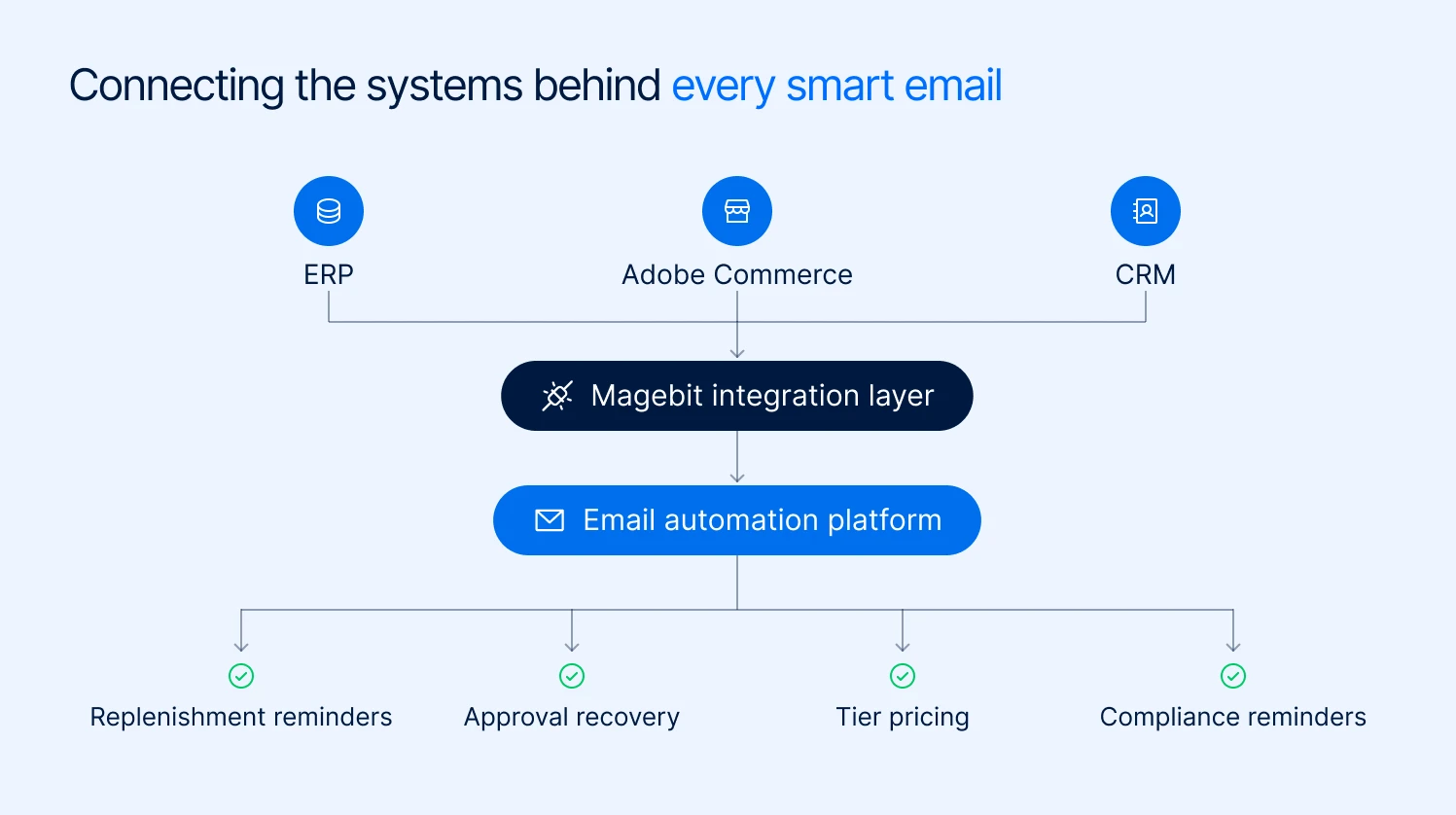
Magebit integration layer for B2B healthcare email automation
We fix that by connecting those systems. Once your commerce platform, ERP, and email platform are talking to each other, the emails become much smarter. Replenishment reminders go out when an account is actually due to reorder, not because 30 days have passed.
Approval follow-ups reach the person who can approve the purchase, not just the one who started it. Tier-pricing emails appear when an account is genuinely close to the next pricing threshold.
That’s the difference between automating emails and automating the buying journey.
For healthcare brands, there’s another layer to consider: the data itself. When you’re syncing customer, order, and contract information across systems, security can’t be an afterthought.
That’s why we build these integrations using processes backed by our ISO 27001:2022 and ISO 9001 certifications.
We’ve done this work for some of the biggest names in healthcare distribution. For Henry Schein, the Fortune 500 distributor serving dental, medical, and veterinary professionals, Magebit handled the full engineering of a new dental store, from integrations to launch, in just a few months.
Final thought
Healthcare buyers don’t purchase the way consumers do, so their email flows shouldn’t look the same either.
When reminders match reorder cycles, approval emails reach the right people, and upsells are tied to contract pricing instead of discounts, email becomes part of the buying process instead of another marketing channel.
If your current flows weren’t built around how your customers actually buy, there’s a good chance they’re leaving revenue behind. Talk to a Magebit B2B commerce expert.