Meet Magento Czech 2026 in Prague was a different kind of conference for us at Magebit. We joined as a Silver Partner, and this time there was no booth, just the two of us, Val and Rihards, a packed one-day agenda, and more good conversations per square meter than at events three times the size.
The format is deliberately smaller and more personal, and it works. Sessions ran back to back, but the breaks were long enough to actually talk to the people whose talks you had just heard.
By the afternoon it felt less like a conference and more like a university class working on a group project: everyone mixing, no pressure, no sales-badge scanning. The setting helped too: Spojka Events, a beautifully repurposed industrial space in Prague’s Karlín district.
Rihards on stage: real stores, real numbers
Magebit had its own spot on the agenda. Rihards Ratke took the stage with “The Already Done List: How Venta Streamlines Hyvä Development”, an argument that a new theme is not a design task, it is a coordination task.
Instead of theory, he told the stories of real stores we work with across Europe, including stores running our Venta theme, and what changed for them after the work was done.
In France, orders coming from Google search grew by over 40% and noticeably more visitors now turn into buyers. In Switzerland, customers spend more per order and come back more often. In the UK, returning customers grew by almost half, and revenue followed.
The point was simple: good e-commerce work shows up in the numbers a business owner actually watches: orders, loyalty, and revenue. It also made a fitting warm-up for the more technical sessions that followed.
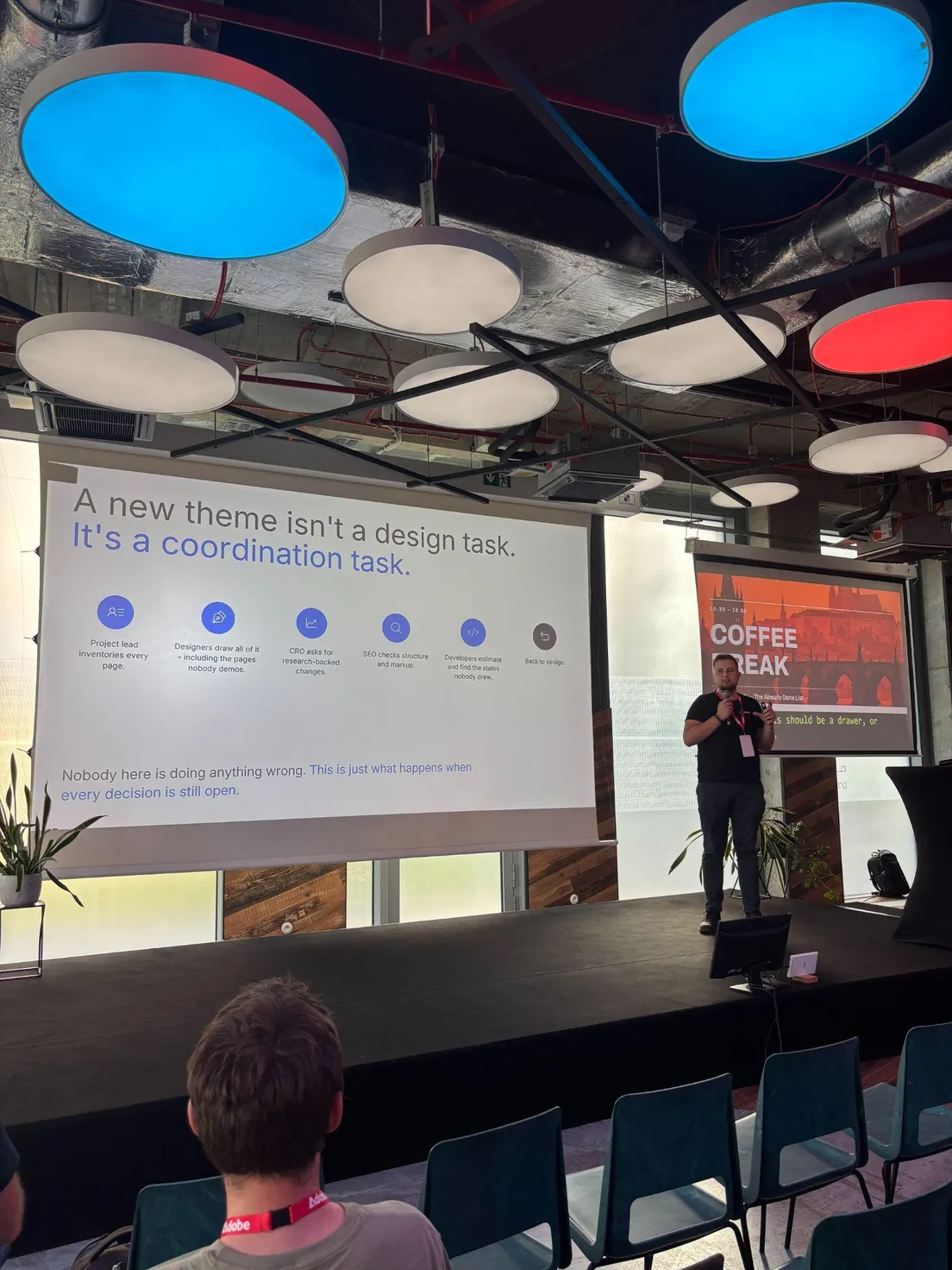
Rihards Ratke on the Meet Magento Czech 2026 stage: a new theme is a coordination task
Shopify came up in the hallways too, and more partners are adding it to their roadmaps than ever. But the stage in Prague was firmly about something else: a community actively investing in making Magento faster, safer, and nicer to run. That is where the day’s real substance was.
The sessions we took notes from
Loading Magento below 100ms (Jakub Winkler, qoliber)
For us, the talk of the day. Jakub, of qoliber, compressed two years of performance work into 25 minutes, and we quickly nicknamed him the Need for Speed addict of the Magento world.
His message is one every store owner should hear. The speed that really matters is how fast your store responds when the usual shortcuts do not apply: a shopper’s first visit, a rarely opened page, or the growing wave of AI bots now crawling stores at volumes rivaling human traffic. That is exactly where most Magento stores are slowest, and that is what Jakub set out to fix.
The results speak plainly. Pages that used to take close to a second now answer in a fraction of one, and catalog updates that used to run overnight now fit into a coffee break. He even proved it live, with a store of 150,000 products responding in the blink of an eye, on a deliberately slowed-down server.
He was just as honest about the limits. This is real for browsing today, not yet for checkout. And his closing line doubles as the reason merchants should care: “Faster Magento means more business for everyone.”
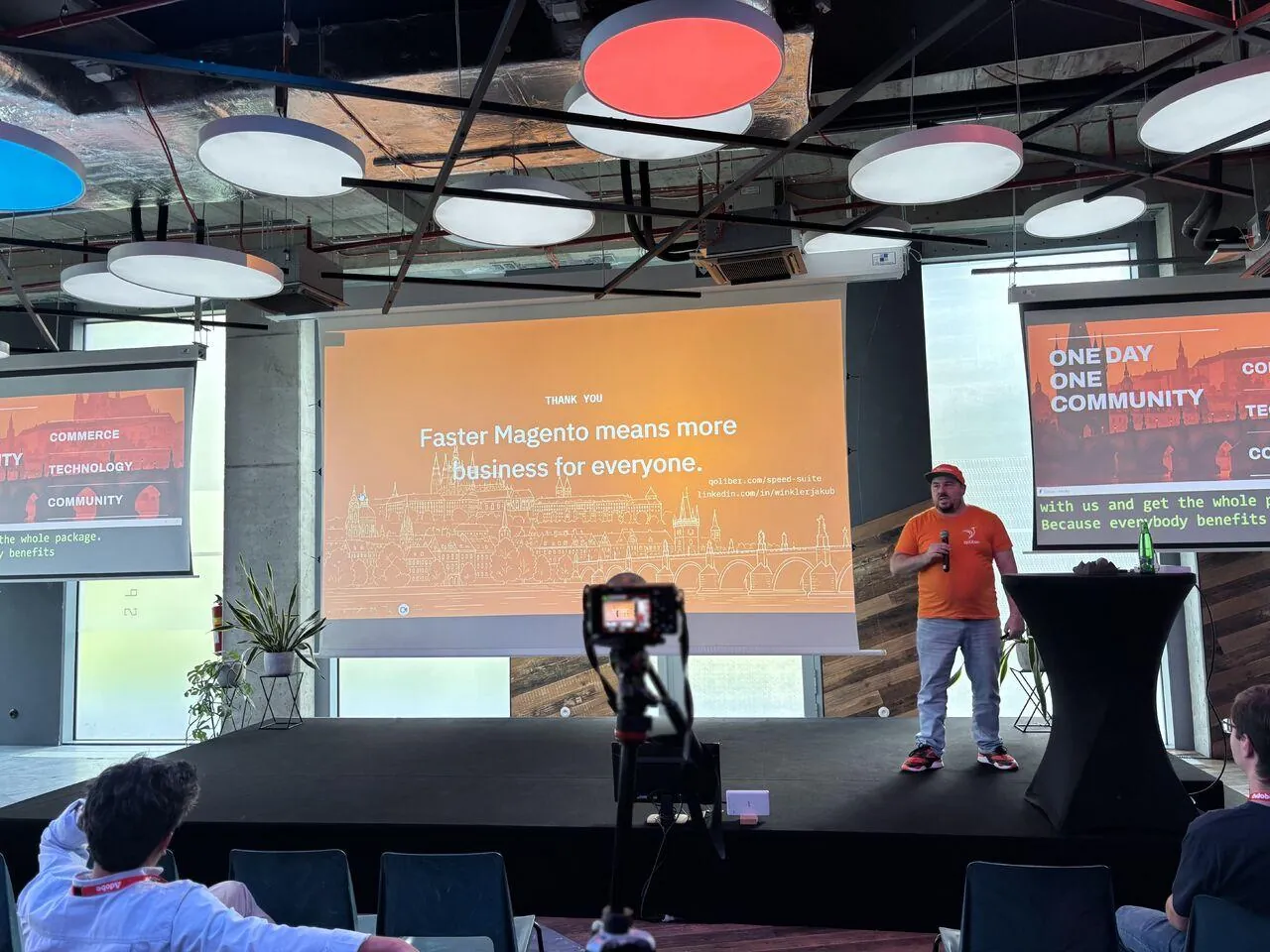
Jakub Winkler of qoliber closing on sub-100ms Magento: faster Magento means more business for everyone
AI agents in your Magento agency (Peter Jaap Blaakmeer, elgentos)
Most AI talks at commerce events are about the storefront: search, recommendations, chatbots. The session from elgentos looked inward instead, at AI working inside the agency itself.
It also produced the craziest thing we heard all day. Imagine a full Magento upgrade, end-to-end testing included, running overnight and waiting for a developer’s review by morning coffee. Add an AI agent that picks up a task ticket and implements it on its own, plus an honest answer to how juniors keep learning when AI writes the code, and you can see why this talk stuck with us.
The rule underneath it all: let AI prepare the work, never let it ship the work. A person stays responsible for everything that goes live, which is close to how we use AI at Magebit, and the thinking behind our open-source MCP module for Magento.
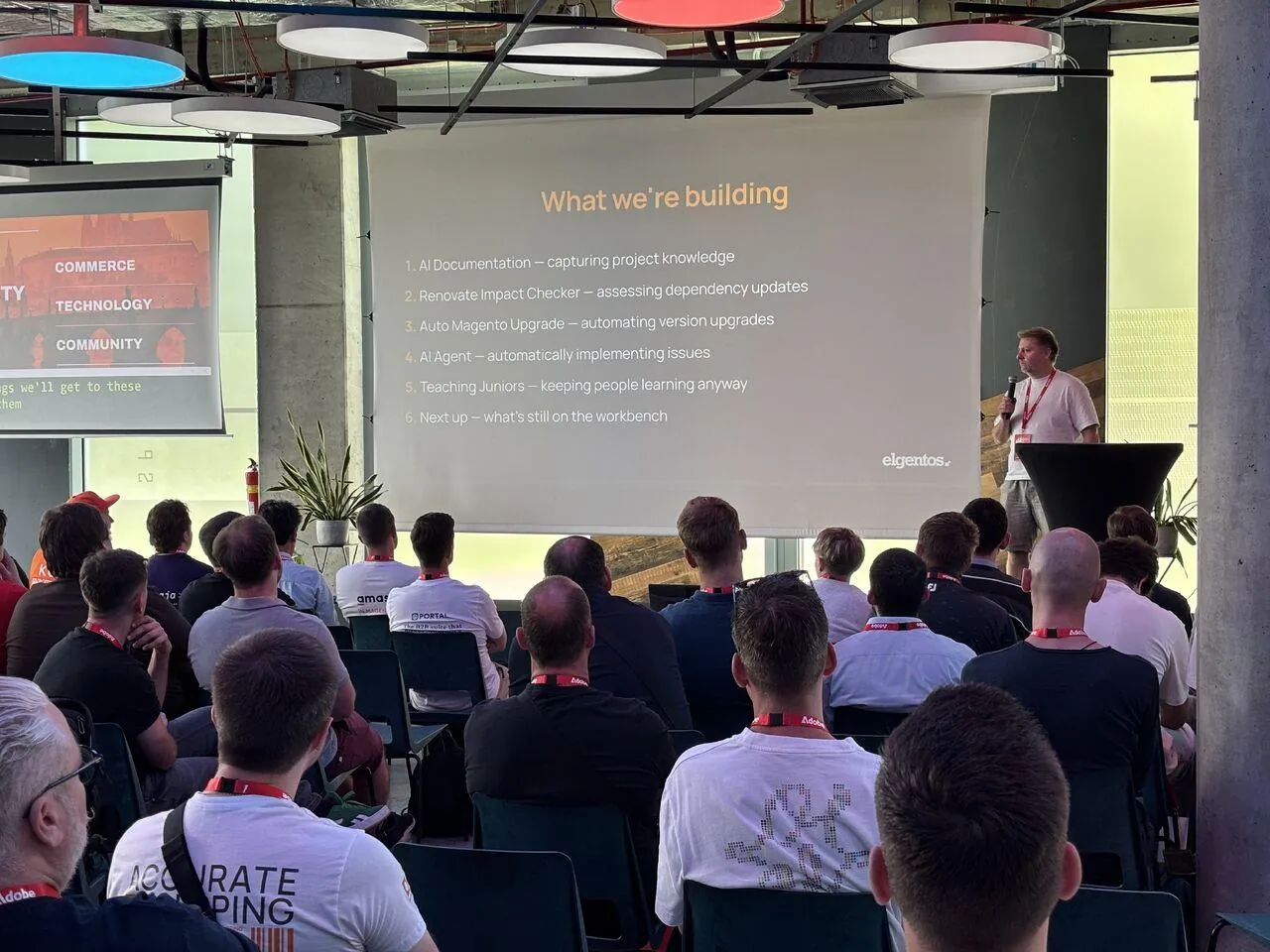
A full room for elgentos on AI agents working inside the agency
The database people showed up (MariaDB Foundation)
Having the creator of MySQL and MariaDB in the room was a moment in itself. The news the MariaDB Foundation brought to the stage is something every Magento merchant should have on their roadmap: Adobe has made MariaDB the default and recommended database platform for Adobe Commerce and Magento Open Source.
The dates matter here. MySQL 8.0 reached end of support on April 30, 2026, versions 2.4.8 and 2.4.9 are the last to support MySQL at all, and MySQL 8.4 is the final MySQL version Adobe will certify.
In practice, that means a MySQL-to-MariaDB migration is in almost every Magento store’s future. The advice from the stage matched our own: fold it into your next upgrade cycle rather than treating it as a separate project.
The move also unlocks capabilities the older setup simply does not have, including smarter, faster search, where shoppers can find products by meaning rather than exact keywords.
And yes, we asked. MySQL and MariaDB really are named after Monty Widenius’ daughters, My and Maria.
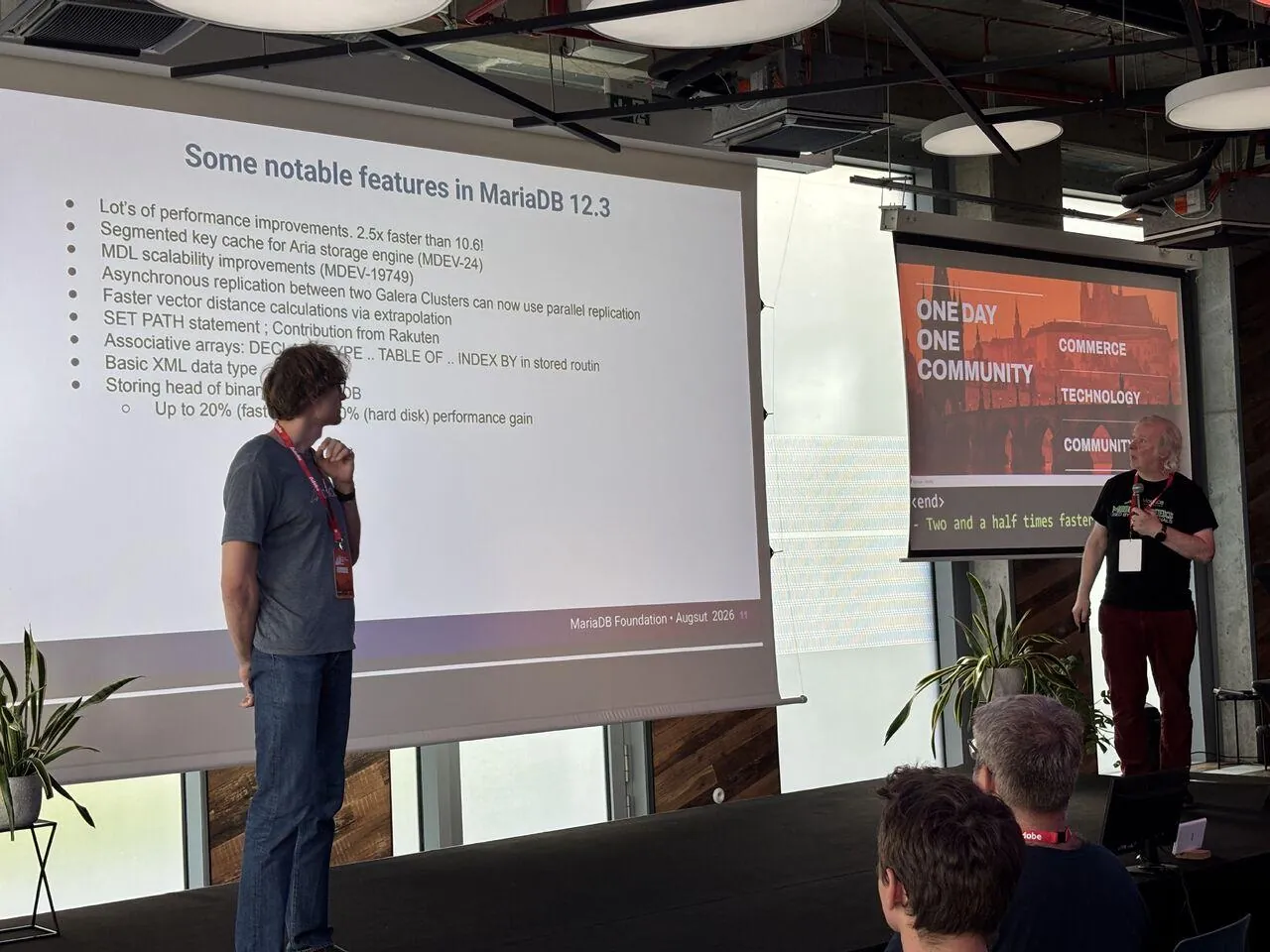
The MariaDB Foundation on stage, walking through what is new in MariaDB 12.3
The priority we’re getting wrong: security (Jiří Brada, PushON)
Jiří brought original research from tens of thousands of real Magento stores, and the message was uncomfortable in a useful way: the same AI that helps agencies ship faster helps attackers find vulnerabilities and automate exploits at scale.
The window between a vulnerability being disclosed and being actively exploited keeps shrinking, which means “we patch quarterly” may no longer be good enough. No store is impossible to breach. Security is layers, and every layer cuts the odds.
That framing is exactly why we run our own work against ISO 9001 and ISO 27001 certified processes.
Nebula: a new admin for Magento (Ruud van Zuidam, Siteation)
The Magento admin panel has looked and felt the same for a decade, and Nebula is the community’s answer: a modern replacement built by qoliber and Siteation together, with a faster interface, dark mode, cleaner workflows, and a fully modern foundation under the hood.
Under that hood, native ES modules replace RequireJS, vanilla JavaScript replaces jQuery, and Alpine.js 3 replaces KnockoutJS. The talk itself was as much about the design journey as the code, which made it accessible well beyond the developer crowd.
The code is already public on GitHub, feedback is openly invited, and the release date was announced on stage: September 15. For merchants, a better admin is not cosmetic. It is hours saved every single day by the people running your store.
And two more worth mentioning
AI at Your Service. Sergej Derzap of Amasty covered the other half of the AI story: practical, measurable AI adoption across development, catalog work, support, and marketing, without sacrificing site performance or conversion.
Did It Sync, or Did It Just Not Error? Abigail Green of JH tackled a problem every integrated store knows too well: data pipelines to ERP and PIM systems that report “success” while silently dropping or corrupting data. Her point: monitoring for errors is not the same as knowing your data is right.
A quick thanks to the organizer
A special shoutout to Marek Kubacak and his team. This was the first Meet Magento he has organized in the Czech Republic, and you would never have guessed it.
First editions are usually rough around the edges. This one had a speaker lineup strong enough for an event three times its age, a venue that fit the community like a glove, genuinely great food, and after-event drinks where the best conversations of the day kept going long past the official agenda.
Add Prague itself as the backdrop, and you get an event we would sign up for again before tickets even go on sale. Marek, if you are reading this, count us in for the next one.
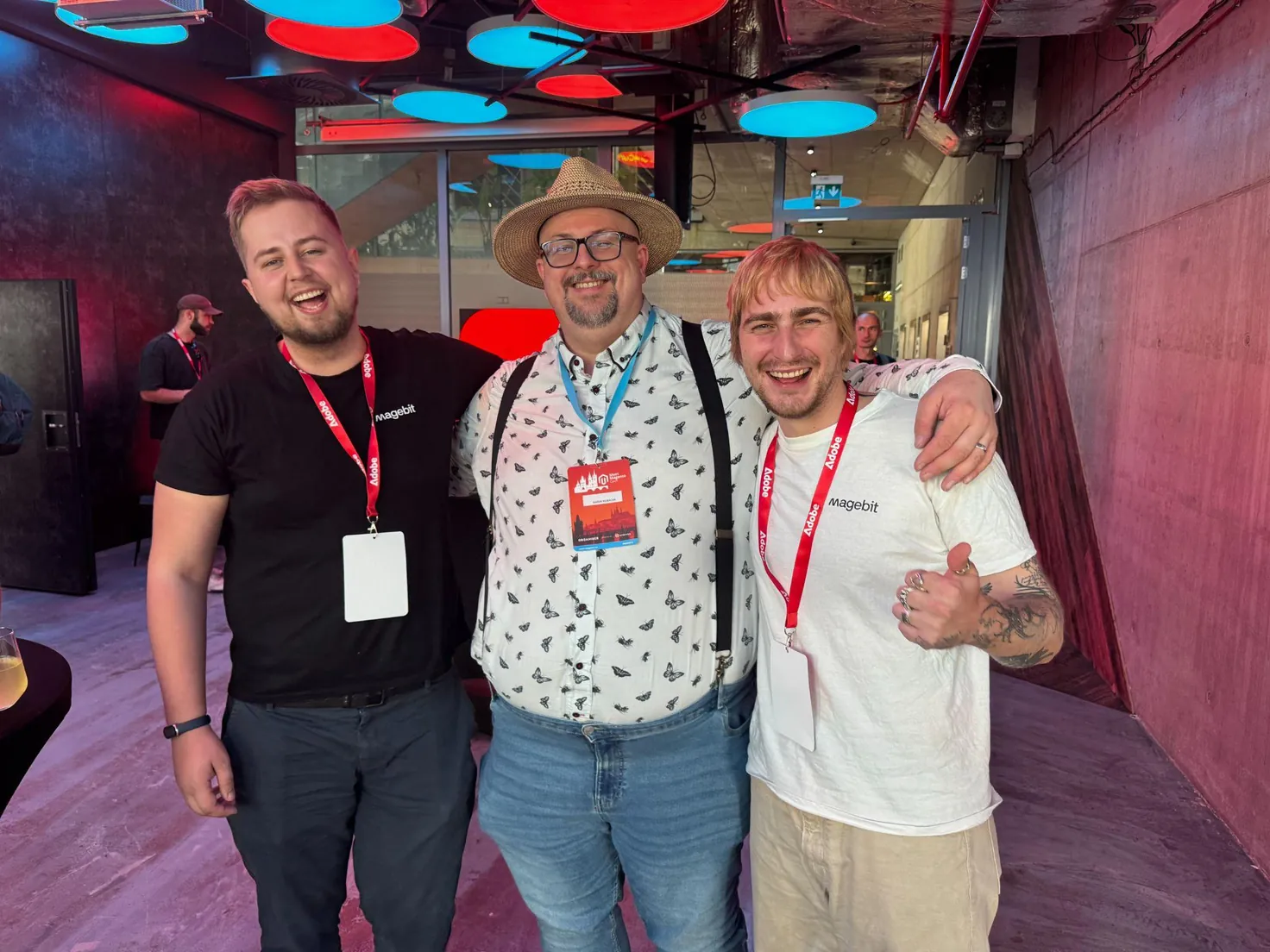
Val and Rihards with Marek Kubacak, the organizer behind Meet Magento Czech 2026
Key takeaways for merchants
What this means if you run an e-commerce store:
- Raw store speed is back on the agenda. AI bot traffic now hits the pages regular caching never covers, so how fast your store itself responds affects both customer experience and hosting costs. Worth asking where your store really stands.
- Put the MariaDB migration on your roadmap now. MySQL support on Magento is ending; the smart move is folding the migration into your next planned upgrade instead of paying for it twice as a standalone project.
- Review your patching cadence. AI has shortened the time from disclosed vulnerability to active exploit. Ask your agency how fast fixes actually reach production, and what layers exist beyond patching.
- Sub-100ms Magento is real, with caveats. The storefront can get there today with disciplined engineering; checkout and heavily customized stores cannot yet. Anyone promising otherwise is selling.
- Silent integration failures cost real money. If your store syncs with other systems (inventory, orders, product data), ask how you would know when a sync quietly goes wrong, not just whether the site is up.
- A modern admin is a productivity feature. Keep an eye on Nebula, because back-office efficiency is part of your platform’s total cost of ownership.
Planning a Magento upgrade, a MariaDB migration, or a Hyvä storefront build? You can see the work we have shipped or get in touch and we will look at your current setup and suggest concrete next steps.