Within just two to three months, they resolved issues that previously seemed unresolvable.

Tim Johnson
CTO
Your stack meets the requirements. That tells you it will run, not that it's right. We audit how your server, cache, database and search are actually configured.

Adobe Commerce gold partner
#1 Adobe Commerce partner worldwide

Hyvä Platinum Partner
40+ projects delivered


ISO certification
9001 & 27001

Most certified Hyvä agency worldwide

200+ Adobe Commerce Certifications

Magento Association
Platinum Partner










Every host publishes the same list. Match it and Magento runs. It can't tell you whether a 4 GB buffer pool suits a 31 GB database, or whether you have headroom for Black Friday.
None of these produce an error. They produce a slower store, a bigger bill, or a worse Black Friday.
Traffic doubled, the catalog tripled, the configuration never changed. Sizing is a decision with a shelf life.
Varnish is running, Redis is connected, and the hit rate is 60% because the VCL is stock or the cache never warms after deploy.
PHP-FPM sized for peak, a buffer pool sized for the dataset and a search heap, on a box that can't give all three what it promised.
Cache, sessions and full-page cache in one instance, so a flush logs your customers out and an eviction storm takes sessions with it.
Cron groups, indexers and queue consumers overlapping, so reindexing runs during your busiest European morning.
Over-provisioned steady state, no autoscaling for the peaks that matter. Paying for capacity you don't use, and lacking it when you do.
Twelve layers, each measured against your catalog, traffic and roadmap, not a vendor's minimum.
Version and support status, OPcache sizing and eviction rate, realpath cache, memory limits, and PHP-FPM sized against your real concurrency.
Version, InnoDB buffer pool against actual dataset size, log sizing, connection limits, temp table behaviour, and the slow query log's contents.
Varnish version and VCL, hit rate measured rather than assumed, grace mode, purge and warming. Redis or Valkey instance separation, eviction policy and sizing.
OpenSearch or Elasticsearch version against your Magento version, heap sizing, shard and replica configuration, cluster health and network exposure.
Nginx against Magento's own reference, worker and keepalive tuning, compression, HTTP/2 and 3, static asset handling and CDN rules.
Cron group configuration and overlap, indexer mode and reindex duration, queue consumers, and whether anything has been failing silently for months.
Media storage strategy, shared storage performance across nodes, session storage, and whether the setup can scale horizontally or only vertically.
Headroom against measured peaks, autoscaling or its absence, instance right-sizing, and on Adobe Commerce Cloud, environment sizing and Fastly configuration.
Staging parity with production, the deployment pipeline, rollback capability, and whether cache warming and static content deployment are handled or hoped for.
What's protected, retention, whether backups sit somewhere an attacker on your server can reach, geographic redundancy, and whether a restore has ever been performed.
Application performance monitoring, infrastructure metrics, log retention adequate for investigation, alert thresholds, and who is actually paged at 3 AM.
Spend against utilisation, reserved capacity opportunities, and the over-provisioning that quietly funds itself.
Half of what we find is a stack that was current when it was built. The requirements move, and security support moves with them.
An unsupported PHP or database means you stop receiving security fixes entirely. The audit says which upgrades are urgent, and what each one requires.

Valkey, the Linux Foundation fork of Redis, is now recommended for new setups. Existing Redis installations keep working, and we'll tell you if moving is worth it.
Every service can be individually correct and the stack still slow. Magento's performance lives in how the layers interact, which is what a checklist misses.
When Magento purges and Varnish misses it, stale prices stay live.
Fine until an eviction storm logs customers out mid-checkout.
Reindexing during your peak is a setting, not a fact of life.
A deploy that empties every cache serves cold pages to real traffic.
More PHP workers than database connections means peak errors.
New nodes that arrive cold under peak load make a surge worse.
The audit's core question is fit. Three answers, and we'll tell you which one you are.
Quiet, and usually worth more in savings than the audit costs.
Load behaviour tells us before Black Friday does.
Memory where you need IO, or vertical scaling on a stack that can't scale out.
Hundreds of settings across a dozen services is machine work. Judging what a change is worth against the risk of making it isn't.

Not the four someone remembered, across a dozen services.
Against reference values and your workload, not a template.
Slow query logs and months of metrics, rather than a sample.
Where your infrastructure-as-code and the servers disagree.

Non-standard is often deliberate. Someone has to know which.
Against the risk of making it, and the outage window it needs.
Rather than handing you ten that don't matter.
AI reads and compares. Engineers own the verdict.
Read-only exports and history pulled from every service in the stack
Every setting compared to Magento's reference, your workload and traffic
Configuration cross-checked with hit rates, query times, memory pressure
Is this actually limiting you, and what would changing it be worth
No finding without a captured configuration export or metric behind it
Your configuration and data stay inside our ISO 27001 practice
and are never used to train a model.
Findings separated into performance, resilience and cost, each with the number behind it.
A walkthrough with the engineer who ran it
Not an account manager reading notes.
Which many merchants have never seen, because nobody drew it.
What limits performance, what's a risk, what costs, what can wait.
The number, calculated against your dataset, with the reasoning.
Whether you survive your peak as configured, and what changes.
Right-sizing, because these audits frequently pay for themselves.
Sequenced by dependency and risk, with outage risks flagged.
Recorded explicitly, so no area is presented as healthy by omission.
Hosting providers check whether the server is up, not whether Magento uses what you pay for.
Everything is read-only. No changes are made to your live environment.
 Access revoked when the audit endsRestricted access, scoped and recordedHandled inside our ISO 27001 practice
 Hosting consoleAccess
 0 changes made to your environmentOnly configuration reads, metric queries and log reviews.
Configuration inspection, service versions, resource usage
Topology, instance sizing, scaling and cost data

Cache, indexer and cron configuration

Traffic profile, response times, historical behaviour, where available

Slow query log, dataset size, connection behaviour

Drift between declared and running configuration, if you have one
You don't need to know what's wrong with the stack. You need a reason to want it measured.
We build and operate AWS and Adobe Commerce Cloud infrastructure for production Magento stores, so "is it the code or the server" stops being a debate between two suppliers.
Scoped after the report, with the approved estimate as the final price.
Priced from the report, not a guess
The approved estimate is the final price
Sequenced by outage risk first
Hosting, monitoring and capacity management run by the team that also knows the codebase.
24/7 monitoring and emergency response
Capacity managed against your roadmap
One team for the application and the stack
Your host will tell you the servers are healthy. That is a different question from whether the stack fits the store.
Configuration checked against Adobe guidance
Varies
Capacity modelled on your real traffic
Cost mapped against utilisation
Backups verified by restore, not by existing
Sometimes
Peak-season verdict with headroom stated
Varies
Vendor-neutral, no hosting to sell you
Read-only, no changes to production

Kevin Hughes
European Technical Director

Within just two to three months, they resolved issues that previously seemed unresolvable.
Tim Johnson
CTO

There is no challenge for which they can't find a solution.

Will Aubuchon
CEO

What I value most is consistency. Magebit knows our store inside out, responds fast, and keeps it running smoothly year after year.
Marian Gaidoš
CEO

The top-ranked Adobe Commerce agency on the planet by Adobe themselves.





The most certified Hyvä agency in the world. Confirmed by Hyvä themselves, twice.
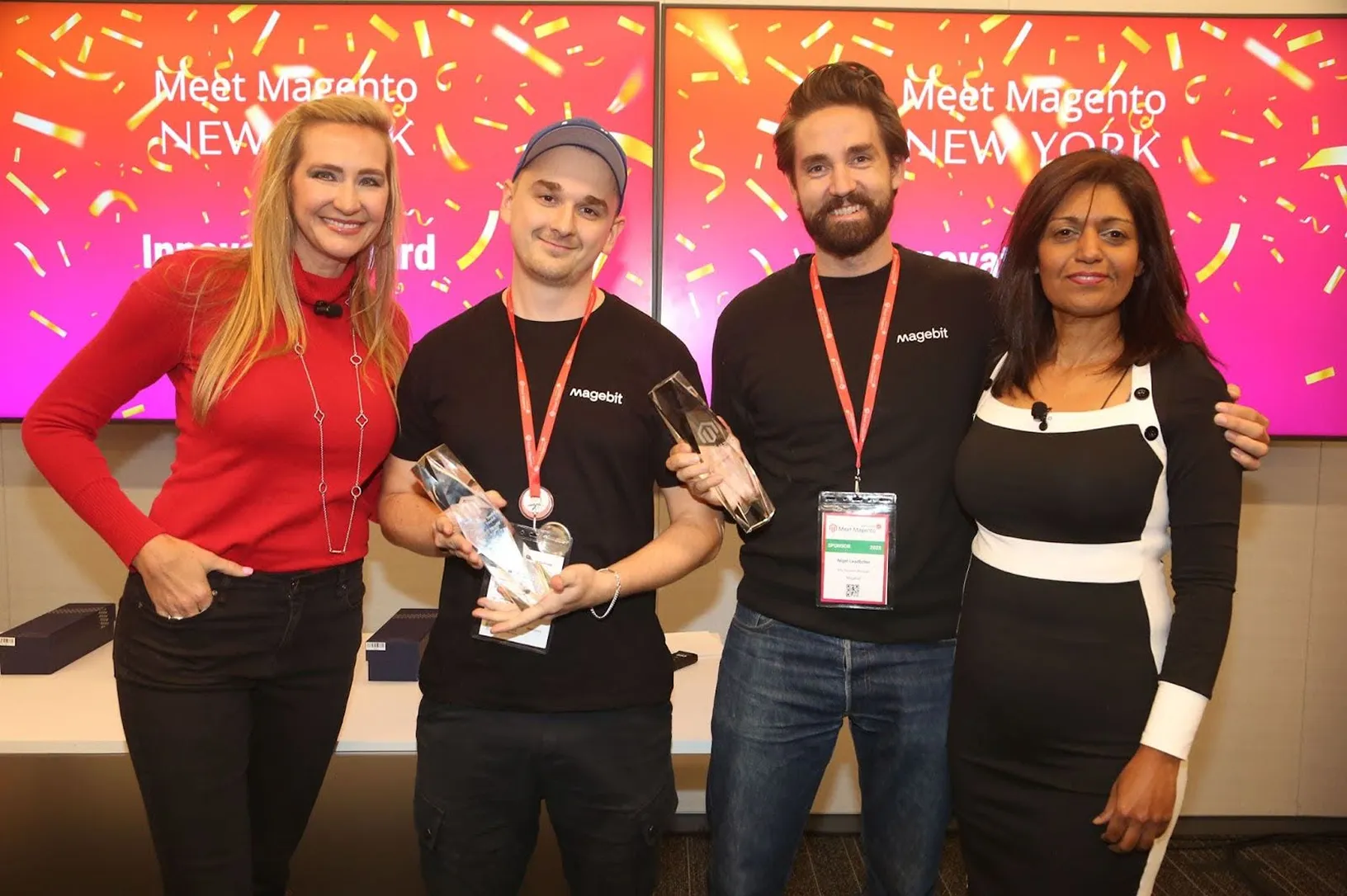
Innovator, World Traveler, and eCommerce Excellence awards across Meet Magento NYC and HIVE London, and more.

The most-certified Hyvä agency worldwide and the first Hyvä Platinum Partner in the USA. 55+ certified developers and 40+ projects delivered.

ISO 9001 & 27001 for quality and security.

Truly agile team that moves and adapts faster than your typical agency.

UX grounded in large-scale ecommerce research.
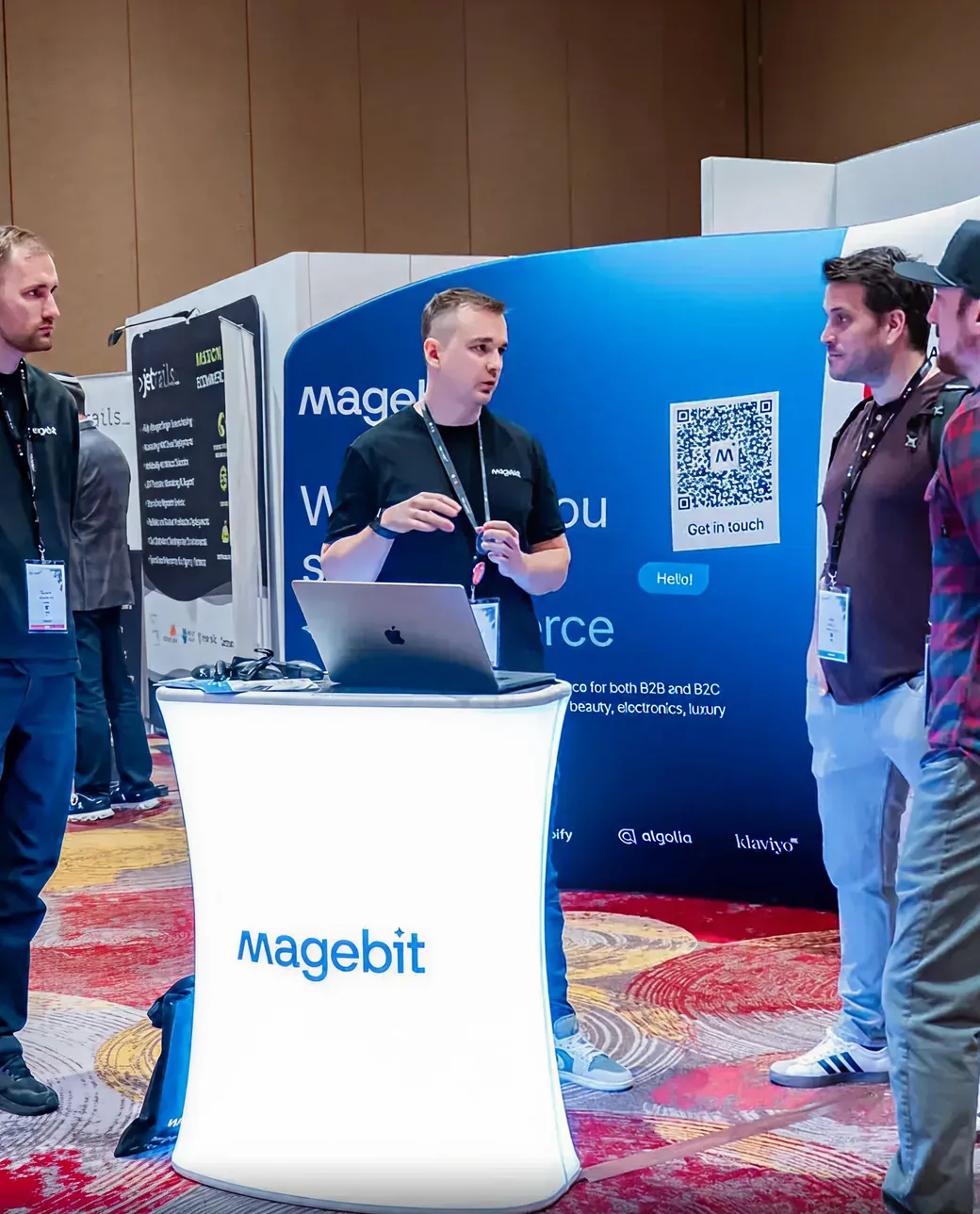
Magebit team at Meet Magento, #1 Adobe Commerce agency worldwide.
By certified developers, Magebit holds the number-one spot among Adobe Commerce agencies worldwide, and we’re the most certified Hyvä agency on the planet. Proof that the depth is real, not a logo on a page.

#1 Adobe agency worldwide

200+ Adobe certifications
#1 Most certified Hyvä agency

Adobe Subject Matter Expert
Most stores we look at are running a stack that was correct the day it was built, and has been quietly wrong since the catalog doubled. Tell me what you're running and we'll tell you what it should be, with the numbers behind it.
Reviewed by Kristaps Rjabovs
Co-founder of Magebit, Forbes 30 Under 30

If you can't find the answer you're looking for, feel free to reach out to us. We're here to help.
They overlap at the edges, deliberately. The security audit asks whether the estate is exposed or already compromised. This one asks whether it's configured well: sized correctly, caching properly, scaling when it needs to, and costing what it should. Access control and patch currency appear in both, from different angles. If you're doing both, we sequence them so nothing is checked twice.
Yes, most audits we run are on someone else's hosting. The findings go to you regardless of who ends up implementing them, and we'll say plainly when your provider is doing a good job.
No. Plenty of audits end with a configuration change list for the current provider. Where a move is genuinely the answer, you'll get the reasoning and the numbers, and the findings are yours to take to any provider.
Where peak capacity is the question, yes. It's the only honest way to answer it, because steady-state metrics don't predict Black Friday.
None. Every check is a read-only configuration read, metric query or log review. Remediation only happens if you commission it separately.
Scoped on the first call against your topology, environments and hosting model, then quoted as a fixed price under our Fixed Cost Estimate Guarantee. Cost findings alone often exceed the price of the audit.
Your stack, your traffic, your bill. You'll get a diagram, findings ranked by impact, configuration values with reasoning, and a verdict on whether it carries your next peak.
Not a sales script.
Performance, resilience and cost, separated.
The findings are yours to keep.
We use cookies.
Some help us see how the site is used and measure our ads. You choose — until you do, no cookies are set and Google receives only cookieless signals that don't identify you. Privacy Policy