Personalization has become one of the most overused terms in e-commerce. Every enterprise platform promises AI-powered recommendations, real-time experiences, and higher conversions.
Yet Deloitte found that while 80% of brands believe they deliver a great customer experience, fewer than half of consumers agree. So where’s the disconnect?
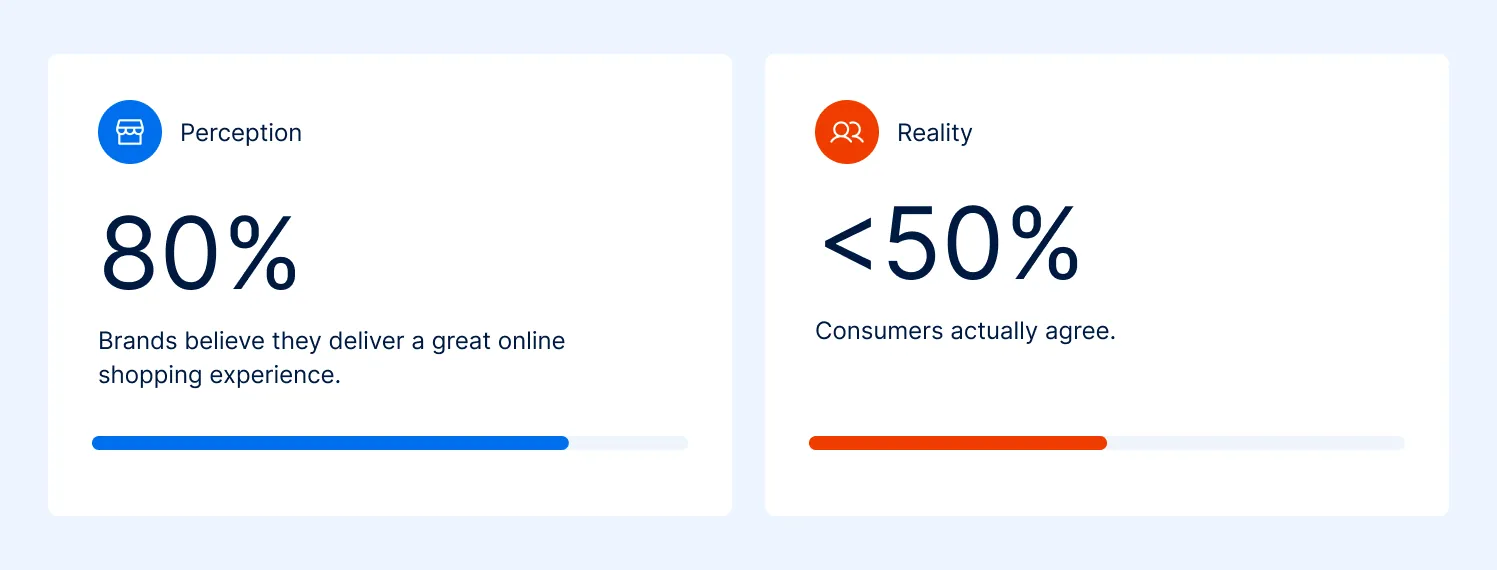
Brands and consumers differ on online shopping experience perception
After working with merchants across Adobe Commerce and Shopify, we’ve found that the platform merchants choose often has a bigger impact than they expect. The best personalization strategy can still fall short if the platform doesn’t fit the business, the team, or the existing tech stack.
That’s why we’re comparing two of the leading enterprise personalization platforms: Optimizely and Dynamic Yield. On the surface, they solve many of the same problems. In practice, they’re built for different priorities, and choosing the right fit can make all the difference.
Who are Optimizely and Dynamic Yield for?
Not every e-commerce business needs an enterprise personalization platform.
One misconception we often see is merchants investing in enterprise personalization before they’ve established a consistent experimentation or merchandising process. The result? Powerful software that ends up being underused.
Optimizely and Dynamic Yield are designed for retailers that have grown beyond basic personalization and are looking to improve customer experiences at scale. They’re typically a good fit for businesses that:
- Generate significant online revenue and traffic.
- Have dedicated e-commerce, marketing, merchandising, or CRO teams.
- Want to use customer data to improve conversions and engagement.
- Are investing in AI-powered personalization, experimentation, or both.
- Need a platform that integrates with an enterprise e-commerce ecosystem.
If you’re a smaller retailer or just starting your personalization journey, these platforms may be more than you need. Simpler personalization or A/B testing tools can often deliver better ROI until your business reaches the scale where enterprise capabilities become valuable.
Why do Optimizely and Dynamic Yield look so similar?
On paper, Optimizely and Dynamic Yield look remarkably similar because both offer AI-powered personalization, A/B testing, experimentation, and omnichannel capabilities.
At the same time, both are recognized as Leaders by Gartner’s Magic Quadrant for Personalization Engines and by Forrester’s Wave for Experience Optimization Solutions. So, if you’re looking at analyst reports alone, it’s easy to conclude there’s no wrong choice.
The differences become clearer once you think beyond the feature list. Optimizely puts experimentation first, helping teams validate ideas before they go live. Dynamic Yield puts personalization first, adapting experiences to individual shoppers in real time.
That distinction influences everything else, from implementation and day-to-day use to the type of e-commerce team each platform is best suited for.
Optimizely: Best for experimentation-first teams

Optimizely website for AI-powered experimentation and digital experience optimization
If your team regularly debates homepage redesigns, promotional banners, or checkout changes without enough data to settle the discussion, Optimizely is built for exactly that.
Instead of relying on assumptions, teams can compare different layouts, messaging, promotions, or checkout experiences, measure the results, and launch the version that performs best.
That’s what sets Optimizely apart. While it offers personalization features, its biggest strength is helping businesses reduce risk by validating ideas before they go live. If your team regularly asks, “How do we know this will improve conversions?” Optimizely is built to answer that question.
Independent reviews reflect that focus. Optimizely scores higher than Dynamic Yield for ease of setup, challenging the common assumption that it’s the more technical platform. It also ranks highly in Forrester’s latest Experience Optimization evaluation, particularly for strategy and experimentation capabilities.
Who is Optimizely best for?
Optimizely is a strong fit for retailers that:
- want to build a culture of experimentation
- frequently run A/B and multivariate tests
- want data to guide design and merchandising decisions
- prefer validating changes before rolling them out at scale
Key benefits of Optimizely
Beyond experimentation, Optimizely helps teams:
- Reduce risk before launch by validating ideas with real customer data instead of assumptions.
- Make data-driven decisions with built-in A/B and multivariate testing across pages, campaigns, and user journeys.
- Optimize continuously by testing incremental improvements rather than waiting for major redesigns.
- Scale experimentation across marketing, merchandising, and product teams using a single platform.
What are the trade-offs?
If your primary goal is deep, always-on personalization, Optimizely isn’t as strong as Dynamic Yield. Its personalization and recommendation capabilities score lower in independent reviews, making it a better experimentation platform than a dedicated personalization engine.
Optimizely pricing
Optimizely doesn’t publish its pricing publicly. Enterprise plans are quote-based and typically start in the mid-five figures per year, with costs increasing based on traffic, products purchased, and implementation requirements.
For most retailers, implementation and ongoing optimization services add to the overall investment, so it’s important to evaluate the total cost, not just the software license.
Dynamic Yield: Best for personalization-first teams

Dynamic Yield website for AI-powered personalization and product recommendations
If your store shows every customer the same homepage, product recommendations, and promotions regardless of who they are, Dynamic Yield is designed to change that.
Instead of testing whether one experience performs better than another, it focuses on automatically showing the most relevant products, offers, content, and recommendations based on each shopper’s behavior.
That’s what sets Dynamic Yield apart. Its biggest strength is delivering personalized experiences at scale. If your goal is to make every shopper feel like the store was built just for them, Dynamic Yield is designed for exactly that.
Dynamic Yield consistently scores higher than Optimizely for personalization and product recommendations, and Gartner has recognized it as a Leader in Personalization Engines for multiple consecutive years.
Who is Dynamic Yield best for?
Dynamic Yield is a strong fit for retailers that:
- want to deliver personalized experiences across the customer journey
- rely heavily on product recommendations to increase average order value
- serve large customer segments with different shopping behaviors
- want AI to automatically optimize content, offers, and merchandising
Key benefits of Dynamic Yield
Beyond personalization, Dynamic Yield helps retailers:
- Increase relevance by adapting content, recommendations, and promotions to individual shoppers.
- Improve product discovery with AI-powered recommendations based on browsing behavior, purchase history, and customer intent.
- Deliver consistent experiences across web, mobile, email, and other customer touchpoints.
- Reduce manual merchandising by automating much of the decision-making behind product recommendations and personalized campaigns.
What are the trade-offs?
Unlike Optimizely, implementation typically requires deeper integration with your e-commerce platform and product catalog. Verified customer reviews frequently mention integration as the most time-consuming part of deployment, particularly for businesses with complex catalogs or legacy e-commerce systems.
That doesn’t make Dynamic Yield the wrong choice. It simply means implementation timelines depend far more on the quality of your existing data and integrations than the product demo might suggest.
Dynamic Yield pricing
Like Optimizely, Dynamic Yield doesn’t publish public pricing. Enterprise plans are quote-based and generally start around $50,000 per year, with total costs depending on traffic, modules, implementation complexity, and ongoing support.
Optimizely and Dynamic Yield comparison table
| Feature / Category | Optimizely | Dynamic Yield |
|---|---|---|
| Core strength | Structured testing before launch | Always-on, automated personalization |
| Ease of setup (G2 score) | 8.1 | 7.6 |
| A/B testing (G2 score) | 8.8 | 9.1 |
| Personalization/recommendations (G2 score) | 7.6 | 9.4 |
| Typical team fit | Wants to validate before committing | Wants personalization running with less daily management |
| Integration risk | Lower reported friction in reviews | Multiple reviews cite longer integration timelines with legacy stacks |
| Checkout-page tracking | Known gap on Shopify (checkout runs on a separate domain) | Handled via product feed sync, not page snippet |
| Pricing | Quote-based, mid-five to six figures/year | Quote-based, reports of $50K+/yr starting point |
| Compliance | GDPR/CCPA-ready, TLS in transit, encryption at rest | GDPR/CCPA-ready, dedicated DPO and CISO |
Which platform should you choose?
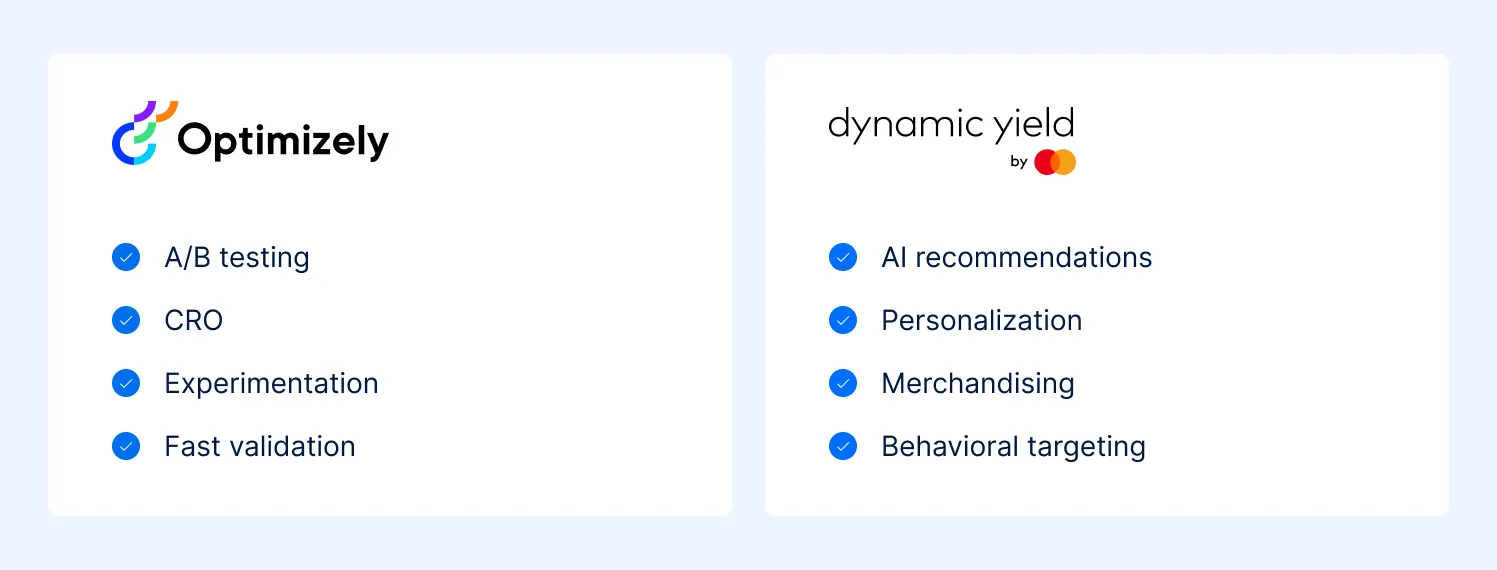
Optimizely and Dynamic Yield feature comparison
Choose Optimizely if you:
- Want to validate ideas before rolling them out site-wide.
- Regularly run A/B or multivariate tests on landing pages, product pages, or checkout flows.
- Have a dedicated CRO, product, or optimization team.
- Prefer making decisions based on data rather than assumptions.
- Want a platform that’s generally quicker to get up and running for experimentation.
Choose Dynamic Yield if you:
- Want to deliver personalized shopping experiences at scale.
- Rely on AI-powered product recommendations to increase conversions or average order value.
- Have a large catalog or diverse customer segments that benefit from tailored experiences.
- Want to automate merchandising, promotions, and content based on customer behavior.
- Have the technical resources to support a more involved implementation.
Look elsewhere if you:
- You’re a small or mid-sized retailer without the traffic or resources to justify an enterprise personalization platform.
- Your product data isn’t well organized. Both platforms rely on clean, structured data to deliver meaningful results.
- You don’t have a clear optimization strategy. Technology alone won’t improve conversions without ongoing testing, analysis, and iteration.
- You’re looking for a plug-and-play solution. Both platforms require planning, implementation, and continuous optimization to deliver ROI.
When neither platform is the right fit
Optimizely and Dynamic Yield dominate this conversation because they’re the two names everyone cites, but they aren’t the only options, and for some merchants, they aren’t the right fit at all.
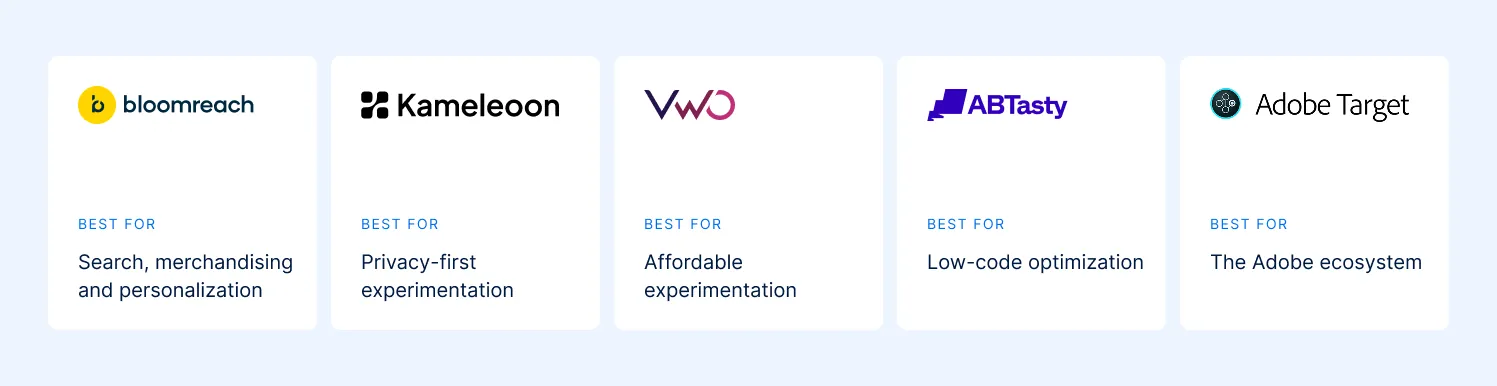
Top alternatives to Optimizely and Dynamic Yield for e-commerce personalization and experimentation
| Alternative | Best for |
|---|---|
| Bloomreach | Commerce-first teams who want search, merchandising, and personalization unified in one stack |
| Kameleoon | Regulated industries (healthcare, finance, EU-based) needing HIPAA/GDPR baked into the architecture |
| VWO | Teams wanting a broad experimentation suite at a lower price point than enterprise tools |
| AB Tasty | Teams new to conversion optimization who want a simple, low-code starting point |
| Adobe Target | Existing Adobe Marketing Cloud users who want testing folded into a broader suite they already pay for |
Final thoughts
Optimizely and Dynamic Yield are both capable enterprise platforms, but they’re built with different priorities in mind.
If experimentation and continuous optimization are central to your strategy, Optimizely is likely the stronger fit. If your focus is delivering personalized shopping experiences at scale, Dynamic Yield has the edge.
The right choice ultimately depends on your business goals, your team’s capabilities, and how well the platform fits your existing e-commerce ecosystem, not just the number of features it offers.
If you’re still unsure which platform is the right fit, talk to a Magebit expert. We’ll assess your e-commerce strategy, technology stack, and business objectives to help you choose the solution that delivers the most value for your business.