AI has officially moved from a buzzword to a must-have for e-commerce, but “AI implementation agency” now covers two very different jobs.
One is installing a smarter search bar. The other is wiring an AI agent into your ERP, PIM, and order management so it can actually act on your business, not just talk about it. Most 2026 rankings blur the two together, and merchants end up hiring a search-app reseller for a job that needed real engineering, or the reverse.
This list only ranks agencies capable of the second kind of work: connecting AI to live commerce systems, not just adding a chat widget.
I’ve ranked them on integration depth, verifiable delivery proof, and the part almost no 2026 guide covers: actual readiness for agentic commerce, where AI agents complete purchases on a shopper’s behalf rather than just recommending products.
If you only need a packaged search or merchandising tool, skip to the shorter list near the bottom; you don’t need an agency for that.
Who is this guide for?
This guide is for mid-market and enterprise e-commerce brands generating more than $20 million in annual revenue that are evaluating AI implementation partners, not just AI software.
Formula for ranking the best AI implementation agencies
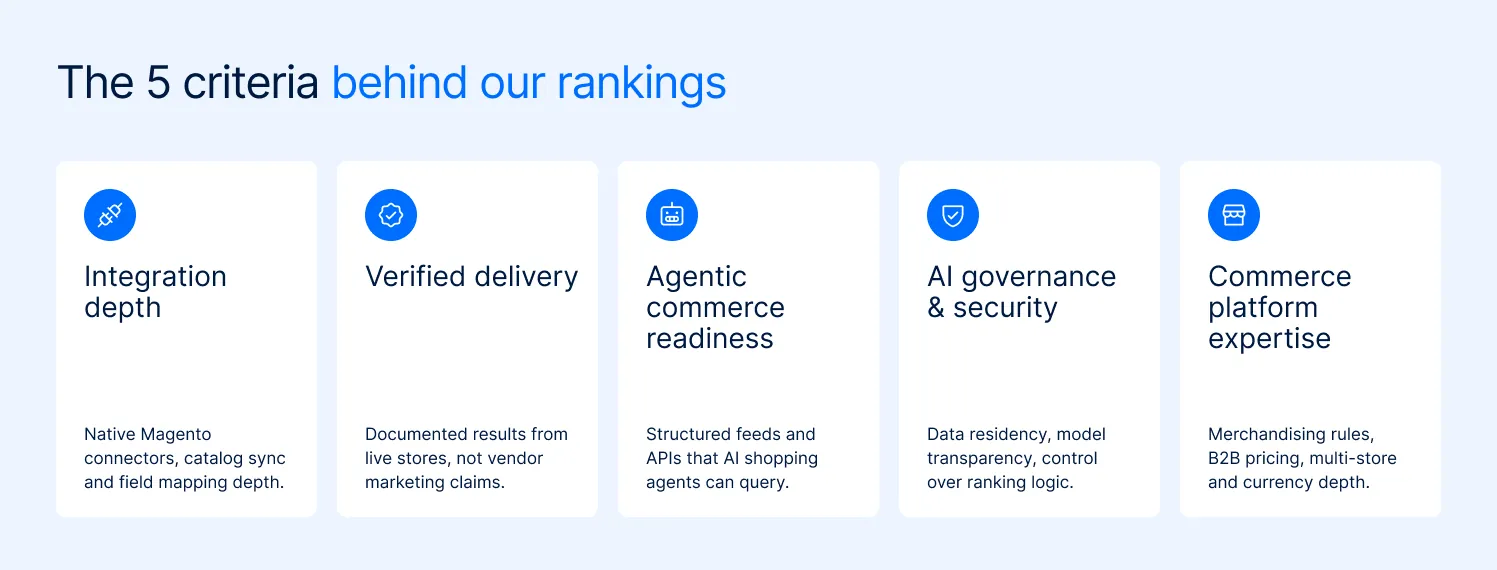
Five criteria used to rank AI implementation agencies
To keep this list credible, the evaluation leans on evidence you can check yourself, not agency-authored claims:
- Integration depth: does the agency connect AI to ERP, PIM, OMS, and CRM systems, or does it stop at a chatbot layered on top of the storefront?
- Verifiable delivery proof: open-source repositories, named enterprise clients, third-party case studies, and official partner directories, not self-reported percentages with no source.
- Agentic commerce readiness: real, shipped work on standards like Model Context Protocol (MCP), Agentic Commerce Protocol (ACP), Universal Commerce Protocol (UCP), not a slide about “the future of AI shopping.”
- Governance maturity: whether AI access to the store data is permission-scoped and auditable, which matters more every month as EU AI Act transparency rules approach.
- Platform depth: genuine expertise in the commerce platform itself, not just AI layered on top of a template.
A note on bias: I work at Magebit, so take the #1 spot with the grain of salt it deserves. To keep this as objective as I can, I weighted the criteria above and checked every claim against something public (a GitHub repo, an official partner page, a press release) rather than an agency’s own pitch deck.
The 2026 top 10 AI implementation agencies for e-commerce
1. Magebit

Magebit Logo
Magebit is the only Adobe Commerce agency I could verify publicly offering a shipped, open-source Model Context Protocol module for Magento and Adobe Commerce. This is a connector layer that lets AI systems like Claude and ChatGPT read and act on real store data (orders, inventory, promotions) through the same role-based permissions your admin panel already enforces, with a full audit log.
It’s paired with an open-source Agentic Commerce module that makes a store compatible with Instant Checkout in ChatGPT and similar agentic surfaces, while the merchant stays the merchant of record.
What sets Magebit apart isn’t just the tooling; it has adopted AI as a company-wide operating model rather than treating it as another service offering.
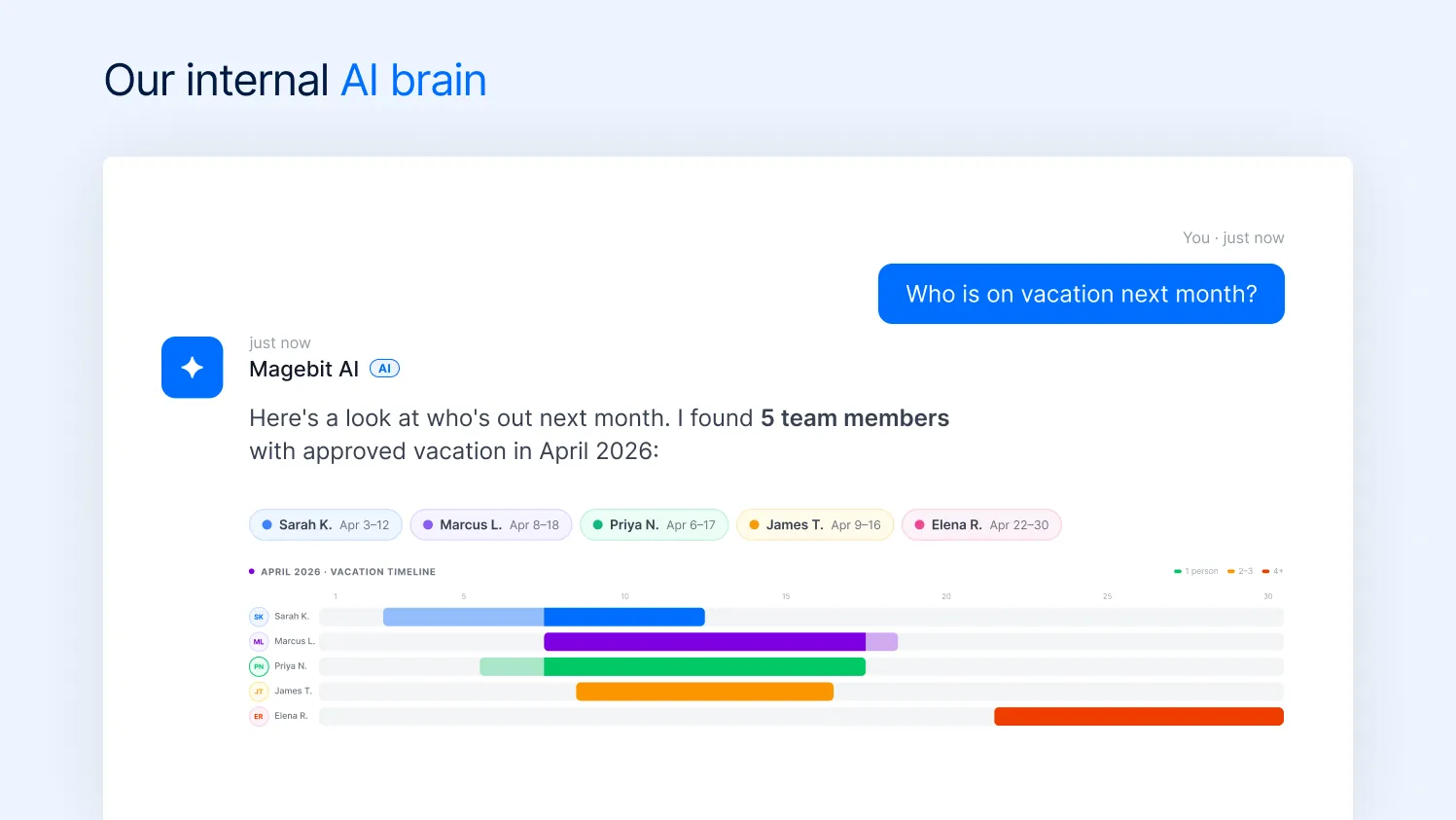
Internal AI assistant interface showing Magebit AI answering a question
AI is embedded across engineering, project delivery, finance, HR, and internal operations through standardized workflows, role-specific training, and an internal AI context layer that connects company knowledge, documentation, projects, and business data through MCP.
As Magebit’s CEO, I’ve been closely involved in the AI ecosystem from the beginning, and I consider myself to be at the forefront of how AI is being applied to business and commerce.
I’m a Cursor Ambassador for Riga, participate in various early-access programs across the AI space, and regularly work with emerging AI tools, platforms, and protocols.
This gives me firsthand exposure to new developments as they emerge, allowing us to experiment early and identify what can translate into real value for our teams and clients.
It also enables the team to retrieve context-aware information directly from tools such as Claude, Cursor, and Slack while maintaining security and governance.
Magebit has also built custom AI solutions beyond e-commerce, including an AI-powered deal evaluation platform for a venture capital client, RunwayFBU, and Answer Engine Optimization (AEO) for Ambler Surgical, helping improve the company’s visibility in AI-powered search experiences.
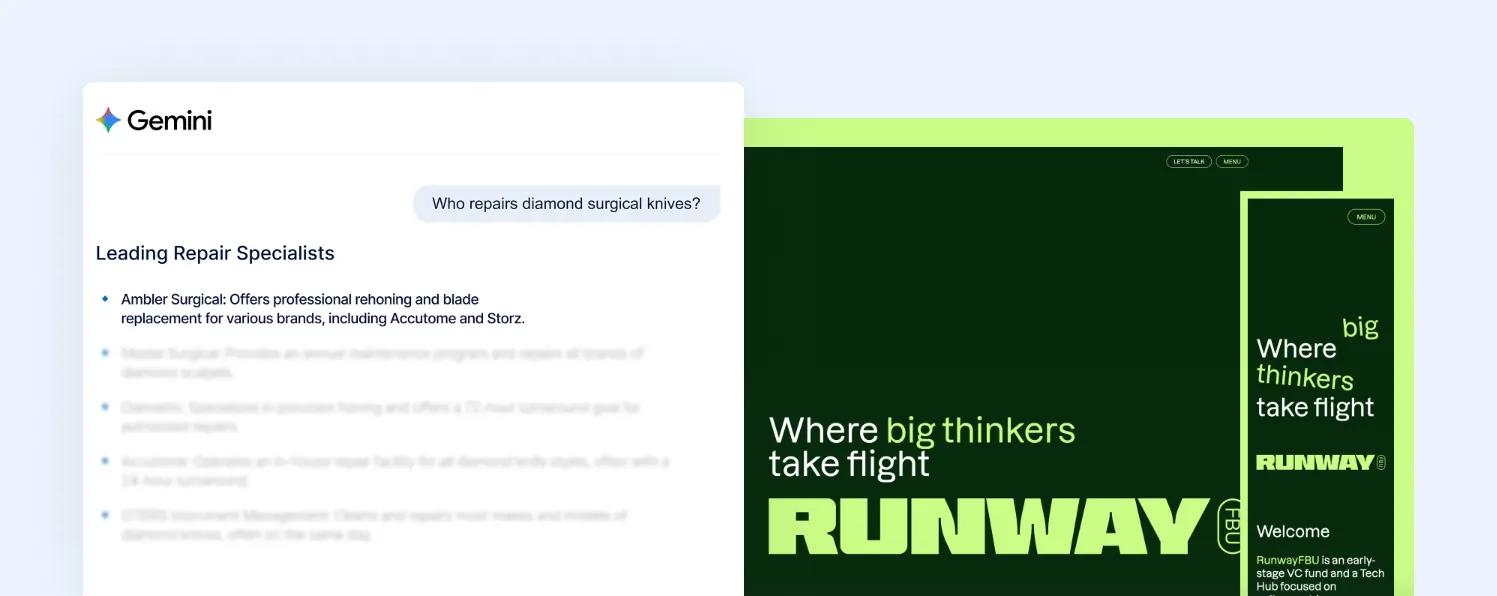
Magebit AI solutions: Ambler Surgical AEO results and RunwayFBU deal evaluation platform
Founded in 2014, the agency now has 150+ digital commerce specialists and has delivered complex commerce solutions for global Fortune 500 brands. It was also ranked the #1 Commerce-specialized partner globally in Adobe’s Solution Partner Directory for the second consecutive year.
Combined with its open-source contributions, membership in the MILA AI association, and ISO 27001:2022 and ISO 9001 certifications, Magebit demonstrates AI expertise that extends well beyond adding chatbots or third-party integrations.
- Headquarters: Riga, Latvia.
- AI Experience: Open-source MCP and Agentic Commerce modules for Magento/Adobe Commerce; custom AI solutions; early adopter of ACP and UCP standards.
- Best for: Magento/Adobe Commerce merchants who need AI wired into real operations, not a chatbot skin, and want to be agent-ready for AI shopping surfaces.
- Notable Clients: Dunkin’, Hydro Flask, Henry Schein, Aubuchon Ace Hardware, The Body Shop, Dynamic Yield by Mastercard, and more.
2. Elogic Commerce
Elogic Commerce Logo
Elogic Commerce is a commerce engineering and systems integration partner founded in 2009, with over 200 specialists across Adobe Commerce, Shopify Plus, Salesforce Commerce Cloud, BigCommerce, and commercetools.
Its core strength is building integration-heavy commerce platforms where AI can work with enterprise systems such as ERP, CRM, and PIM, rather than operating as a standalone feature.
Elogic also places a strong emphasis on enterprise governance, holding ISO/IEC 27001:2022, ISO 9001, and SOC 2 Type II certifications.
Elogic is genuinely platform-agnostic, which is valuable if you’re not committed to one commerce stack. Still, it also means they’re a generalist rather than a specialist in any one ecosystem’s AI tooling.
While its AI capabilities focus primarily on applying existing AI technologies within these environments, its broader expertise lies in commerce architecture and systems integration rather than in developing proprietary AI infrastructure.
- Headquarters: Tallinn, Estonia.
- AI Experience: AI-powered search and merchandising, catalog enrichment, support automation, and operational workflow intelligence connected to ERP/CRM/PIM.
- Best for: Multi-platform B2B and B2B2C sellers who need AI integrated into complex backend systems more than a single-platform specialist.
- Notable Clients: ABBYY, Aramex, KIA, L’Oréal, GS1
3. Object Edge

Object Edge Logo
Object Edge is a Salesforce-certified enterprise AI delivery consultancy operating since 1994, with a specific focus on Palantir Foundry and AIP deployments alongside Salesforce Commerce, MuleSoft, and Oracle.
Their generative AI consulting practice for Salesforce launched in 2023 and now covers Einstein GPT strategy, predictive lead scoring, and AI-driven promotions tied to production data pipelines, not pilots.
Their model is explicitly enterprise: named Fortune 100 clients, an 8-to-12-week implementation window for commerce platform work, and a joint-venture pricing model for AI engagements with manufacturers and distributors. That scale and pricing put them out of reach for anything under an enterprise budget.
Its enterprise-first delivery model is a strength for large organizations, but it also means fewer publicly available AI assets, open-source contributions, or reusable implementation frameworks. For merchants looking to adopt emerging AI commerce standards through proven, community-supported tooling, other agencies may offer a more accessible starting point.
- Headquarters: Walnut Creek, USA.
- AI Experience: Palantir Foundry/AIP deployments, Salesforce Einstein generative AI, AI-driven demand planning and dynamic pricing.
- Best for: Large Salesforce Commerce enterprises with the budget and data maturity for a full AI transformation program, not a first AI pilot.
- Notable Clients: Bosch, Bridgestone, Siemens, Sealed Air, Ericsson
4. Bounteous

Bounteous Logo
Bounteous is a digital transformation consultancy with a mature AI practice spanning data, analytics, customer experience, and commerce.
As an Adobe Platinum Solution Partner, it helps enterprises connect platforms such as Adobe Experience Cloud, Salesforce, and custom technology stacks to deliver AI-powered personalization, customer journey orchestration, and intelligent commerce experiences.
Its client portfolio includes global brands such as Coca-Cola, Mars, Chase, Caesars Entertainment, and Wawa. Bounteous complements its AI practice with ISO/IEC 27001, SOC 2 Type II, and HITRUST certifications.
Rather than building standalone AI products, Bounteous focuses on helping enterprises operationalize AI through unified customer data, predictive analytics, personalization engines, and intelligent digital experiences.
The trade-off is that Bounteous is optimized for large-scale digital transformation rather than focused commerce AI implementations.
AI is one capability within a much broader consulting portfolio, so merchants looking for open-source AI infrastructure, platform-specific agentic commerce expertise, or faster implementation cycles may find more specialized partners elsewhere.
- Headquarters: Chicago, USA.
- AI Experience: Bounteous ARC proprietary AI platform for designing, deploying, and operating intelligent agents at enterprise scale; AI-powered analytics and customer experience, personalization engine implementation.
- Best for: Enterprises running AI as one piece of a wider digital transformation, with the internal stakeholders and budget to match.
- Notable Clients: Coca-Cola, Mars, Chase, Caesars Entertainment, Wawa.
5. Brainvire

Brainvire Logo
Brainvire is an AI-focused digital transformation agency and Adobe Gold Partner whose core strength is backend integration, connecting Magento and Adobe Commerce to ERP and CRM systems for manufacturers and retailers needing a unified, omnichannel setup.
Their notable portfolio includes Walt Disney and FOX Sports, and their 2025–26 work has expanded into cloud-native, AI-enhanced solutions. Brainvire also holds ISO/IEC 27001:2013 certification, reflecting a structured approach to governance.
Brainvire is headquartered in the US, and pricing reflects that. Expect a premium versus offshore-heavy competitors. Their AI experience leans on integrating third-party AI tools (generative AI, conversational AI, predictive analytics) rather than shipping proprietary open-source AI infrastructure.
- Headquarters: Irving, USA.
- AI Experience: Generative AI, machine learning, conversational AI, and predictive analytics for e-commerce, mostly via third-party tool integration.
- Best for: Manufacturers and retailers needing deep ERP/CRM integration work alongside AI, with a budget for US-based delivery.
- Notable Clients: Disney, FOX Sports, KFC, Southwest Airlines, Land Rover.
6. Valtech
Valtech Logo
Valtech is a global digital transformation consultancy that has made AI a core part of its commerce strategy rather than a standalone service.
As one of the launch partners for commercetools Agentic Jumpstart, the company helps enterprise retailers move AI from experimentation into production through conversational commerce, AI-powered personalization, intelligent search, and enterprise automation.
Valtech is the agency to call when AI is one piece of a much larger modernization effort. It excels at global rollouts, complex technology ecosystems, and multi-market transformations where commerce, marketing, customer data, and AI need to evolve together.
That also makes it less appealing for merchants looking for a focused AI implementation or a fast-moving commerce specialist. Most projects sit within broader transformation programs rather than standalone AI engagements.
- Headquarters: Paris, France.
- AI Experience: Generative AI, conversational commerce, AI-powered personalization, intelligent search, customer service automation, enterprise AI strategy.
- Best for: Global enterprise retailers adopting AI as part of large-scale digital transformation and commerce modernization.
- Notable Clients: L’Oréal, Mars, Mercedes-Benz, Toyota, Volkswagen, Dolby, P&G.
7. E2M Solutions

E2M Solutions Logo
E2M Solutions positions itself specifically as a white-label AI development partner for e-commerce agencies, meaning if you’re an agency yourself, not a merchant, they’ll build and run the AI infrastructure behind your brand while you keep the client relationship.
Their pitch is speed: production-grade agents deployed in 8–12 weeks rather than the 3–6 months and $150K+ a typical in-house build requires.
This is a genuinely different business model from the rest of this list. It’s a strong fit if you’re an agency wanting to resell AI retainers without hiring AI engineers, but a direct merchant hiring E2M is effectively hiring a subcontractor’s subcontractor; worth asking who’s actually accountable when something breaks.
- Headquarters: Ahmedabad, India (global delivery).
- AI Experience: White-label AI agents, customer support automation, order management, review management, cart recovery, workflow automation, and Shopify/WooCommerce AI integrations.
- Best for: Agencies wanting to sell AI retainers without building an in-house AI engineering team, not merchants hiring directly.
- Notable Clients: Digital Silk, Coalition Technologies.
8. Absolute Web

Absolute Web Logo
Absolute Web is a commerce agency with a hands-on, technical approach to AI search visibility, helping stores get parsed and trusted by AI engines through structured content, schema, and site architecture, rather than chasing every new AI feature.
They’re a Shopify Plus partner with a growing AI personalization and automation practice, positioned by several third-party guides as a more accessible price point than the enterprise names above.
Their AI focus is narrower than most agencies on this list, strong on AI-search visibility and structured data, less positioned as a full custom-agent-build partner. That’s a feature if that’s specifically your problem, and a limitation if it isn’t.
- Headquarters: Miami, USA.
- AI Experience: Structured data and schema work for AI search visibility, Shopify Plus AI personalization and automation.
- Best for: Shopify and Adobe Commerce merchants looking to improve AI search visibility, personalization, and digital marketing without undertaking a complex custom AI implementation.
- Notable Clients: Capezio, Hollywood Feed, Oribe, Nutrition Kitchen.
9. Underwaterpistol

Underwaterpistol Logo
Underwaterpistol is a Shopify Plus agency with a dedicated AI consultancy built specifically for e-commerce, combining AI with customer experience: automated support flows, content generation, and fully custom GPT-powered chatbots for Shopify storefronts.
Their positioning is creative-first, with automation and brand storytelling, rather than pure backend engineering. That creative lean is a genuine differentiator for DTC brands, but it also means less depth on the ERP/PIM integration work that dominates the top of this list.
If your AI need is customer-facing and brand-voice-sensitive, this is a better fit than a systems integrator; if it’s backend automation, it isn’t.
- Headquarters: London, UK.
- AI Experience: Custom GPT-powered chatbots, automated support flows, and AI content generation for Shopify storefronts.
- Best for: DTC brands on Shopify wanting an AI-driven customer experience with a strong creative/brand voice, not deep backend integration.
- Notable Clients: Hotel Chocolat, Huel, Wild Cosmetics, Fussy.
10. Addepto
Addepto Logo
Addepto specializes in AI consulting and generative AI implementation for commerce, with a strong lean toward personalization and automation built on customer and transaction data: recommendation engines, dynamic pricing tools, and RPA for inventory, supply chain, and marketing workflows.
Their delivery includes monitoring and fine-tuning support after launch, not just a handoff. Their background is more data-analytics-led than merchant-first, which is a real strength for the technical parts of a build but can mean more onboarding time to align with retail-specific standards and language than a commerce-native agency would need.
- Headquarters: Warsaw, Poland.
- AI Experience: Recommendation engines, dynamic pricing, RPA-driven inventory and supply chain automation, end-to-end model monitoring.
- Best for: Merchants whose priority is data-science-grade personalization and pricing models, with in-house teams comfortable partnering with an analytics-led vendor.
- Notable Clients: ABB, JLL, Deloitte, BNP Paribas.
Other agencies worth knowing
Several other agencies appeared frequently during research but didn’t make the top 10 because they specialize in a narrower part of the AI implementation landscape or lack publicly verifiable evidence for the criteria used in this ranking.
- Vaimo – Strong Adobe Commerce and composable commerce partner with AI-powered shopping assistants and personalization capabilities, but its publicly documented AI work focuses more on customer experience than on proprietary AI infrastructure or agentic commerce.
- Charle Agency – Specializes in Shopify AI implementations, automation, and customer experience. A good option for Shopify brands, though its AI portfolio is more implementation-led than infrastructure-focused.
- Netguru – Well-known AI and software development consultancy with extensive generative AI expertise. While it has delivered AI projects for commerce businesses, e-commerce represents only one part of a much broader AI consulting practice.
- Dept® – Global digital agency with significant investments in AI, marketing automation, and customer experience. Most publicly documented work centers on enterprise digital transformation rather than commerce-specific AI implementation.
- Dinarys – A respected commerce engineering agency with Magento, Shopify Plus, and headless expertise that has begun expanding its AI offerings, although public case studies remain more limited than those of the agencies ranked above.
None of these agencies is a poor choice. In fact, several are excellent partners depending on your platform and requirements.
They simply didn’t score as highly against this article’s criteria, which prioritize verifiable AI implementation experience, integration depth, open-source or public contributions, governance, and readiness for emerging agentic commerce standards.
As with any AI partner, ask for live implementations, customer references, or public case studies rather than relying solely on marketing claims.
If you just need an app, not an agency
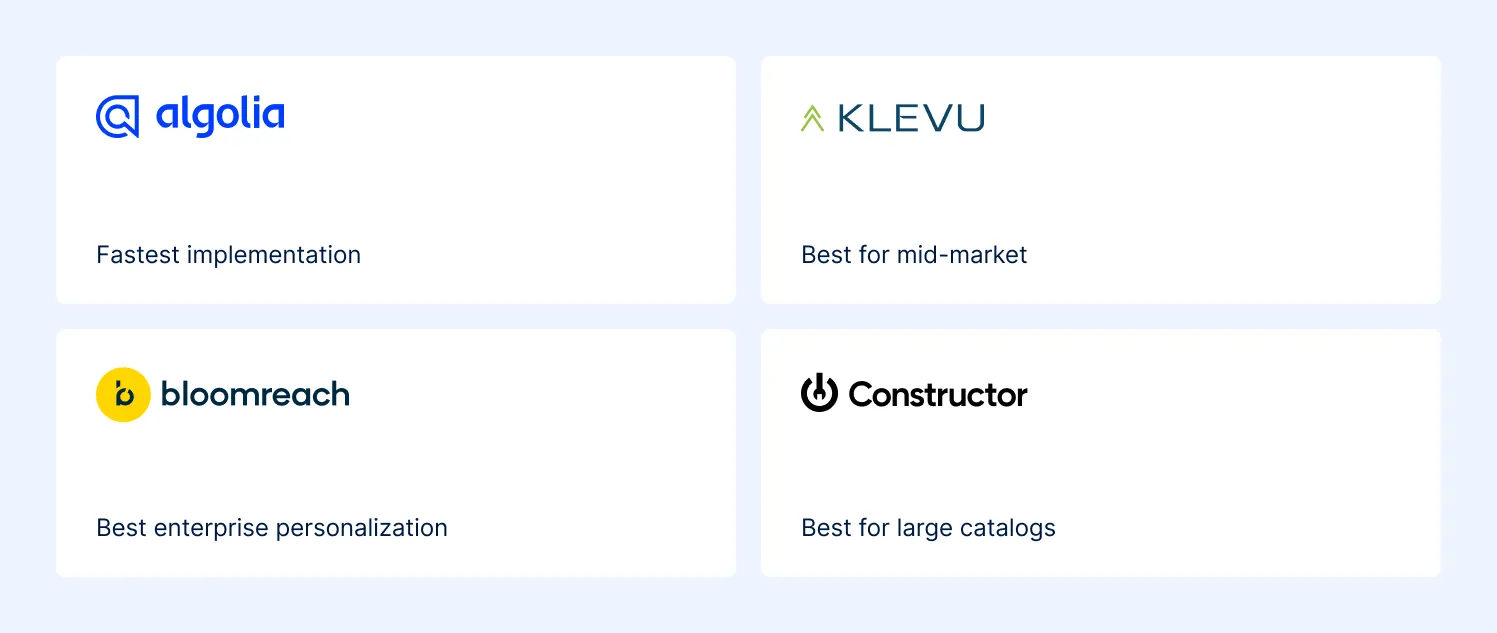
Top AI apps for e-commerce search & merchandising
Not every AI problem needs a custom build. If your issue is search or merchandising, buying a packaged tool is faster and cheaper than hiring anyone above:
- Algolia - fastest implementation, developer-friendly, but costs climb on high-traffic, high-SKU catalogs.
- Klevu - strong mid-market fit with native multi-language semantic search; acquired by Searchspring (now Athos Commerce) in January 2025, worth asking about product direction.
- Bloomreach - the most capable option, going beyond search into full personalization and content, at enterprise complexity and price.
- Constructor - learns from purchase data rather than clicks and is built for catalogs over 100K SKUs; enterprise-only pricing.
Search users convert 2–3x more often than shoppers who only browse, so this category earns its budget on its own. The decision is which tool fits your catalog, not whether to invest.
At a glance: AI implementation agency location
AI implementation agencies are spread across major technology and business hubs worldwide. The map below shows where the leading agencies are headquartered, giving you a quick view of their geographic reach.
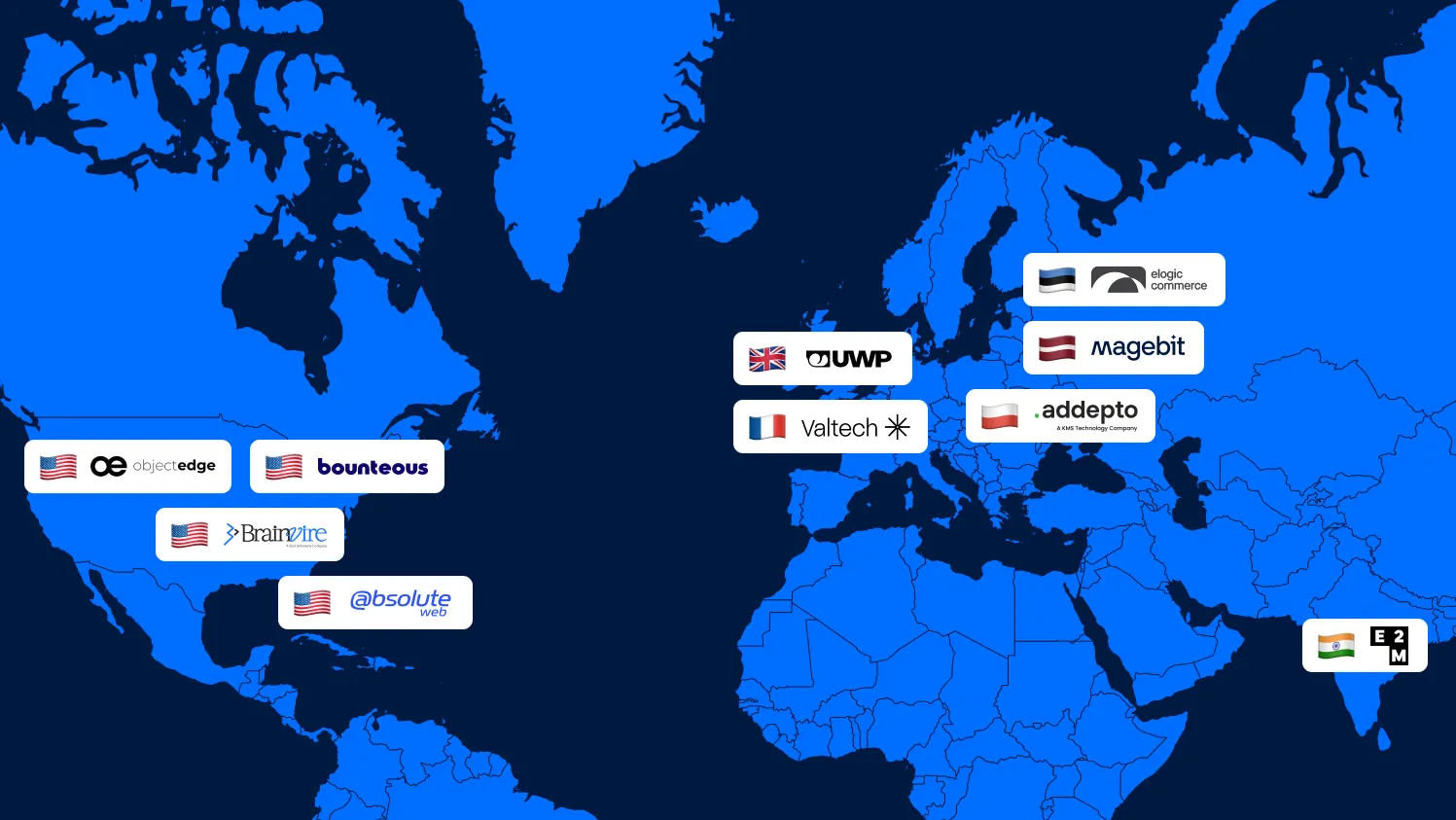
World map showing the locations of 10 top AI implementation agencies
Note: An agency’s headquarters or geographic location doesn’t determine where it can work. Many AI implementation agencies serve clients globally, so an agency being based in another country doesn’t mean it can’t be a good fit for your business.
At a glance: AI implementation agency scorecard
| Agency | HQ | AI focus | Best for |
|---|---|---|---|
| Magebit | Riga, Latvia | Enterprise AI implementation, agentic AI enablement & digital transformation | Enterprise Adobe Commerce, Magento, and Shopify merchants adopting AI across commerce operations |
| Elogic Commerce | Tallinn, Estonia | ERP/CRM/PIM-connected AI | Multi-platform B2B/B2B2C |
| Object Edge | Walnut Creek, USA | Enterprise AI + Palantir | Large Salesforce enterprises |
| Bounteous | Chicago, USA | Data-driven personalization | Broad digital transformation |
| Brainvire | Irving, USA | ERP/CRM integration + AI | Manufacturer/retailer integration |
| Valtech | Paris, France | Enterprise AI transformation & commerce modernization | Global enterprise retailers embedding AI into large-scale digital transformation programs |
| E2M Solutions | Ahmedabad, India | White-label agent infra | Agencies reselling AI retainers |
| Absolute Web | Miami, USA | AI search visibility | AI-search-visibility problems |
| Underwaterpistol | London, UK | Custom GPT chatbots | DTC brand-voice AI experiences |
| Addepto | Warsaw, Poland | Data-science personalization | Analytics-led personalization builds |
How AI implementation pricing actually works
Unlike traditional website projects, AI implementation costs are driven far more by integration complexity, governance requirements, and ongoing maintenance than by the AI model itself.
- Pilot/MVP builds: advisory estimates put a basic custom AI MVP at $50,000–$100,000. However, leading AI implementation agencies like Magebit can deliver pilot projects for less, thanks to advanced internal AI adoption, reusable implementation frameworks, and open-source AI infrastructure that reduce development time.
- Full multi-agent systems: $250,000–$400,000+, plus 20–40% annual overhead for monitoring, prompt tuning, and model updates. But agencies that already operate with AI-first delivery models, such as Magebit, can reduce engineering effort and implementation costs.
- Dedicated developers or AI teams: Fixed monthly retainers typically range from $8,000–$30,000+, depending on team size, seniority, and location. This model suits businesses with continuous AI development. For a single implementation, it usually costs more than a fixed-scope project because you’re paying for dedicated capacity rather than defined deliverables.
Treat all of these as planning ranges, not quotes. They come from advisory-firm estimates rather than audited research, and your actual number depends far more on integration depth than on which vendor you pick.
10 questions to ask any AI implementation agency
-
What systems does the AI actually connect to?
“AI-powered” means nothing if it can’t see your live inventory, promotions, or order history. Get the exact system list.
-
Can you show a shipped agentic commerce integration, not a slide?
Ask for a GitHub repo, a live implementation, or a named client reference, not a roadmap.
-
Who owns the guardrails on actions the agent can take?
A refund or pricing agent acting without a human checkpoint is a liability. Ask where approval is required and who defines that line.
-
What happens when the underlying model changes or is deprecated?
Your agent depends on an LLM you don’t control. Ask how they handle drift without a full rebuild.
-
Can you audit what the agent did after the fact?
If an AI agent changes prices or issues refunds, can you see exactly what it did, when it did it, and why? An audit trail is essential for troubleshooting, compliance, and meeting transparency requirements under regulations such as the EU AI Act.
-
Is this agency building or reselling a framework with a markup?
Ask which parts are proprietary versus an open-source orchestration layer they’re wrapping.
-
What’s your experience with our specific commerce platform, not just AI in general?
AI implementation that ignores platform-specific data models tends to break in production.
-
What does ongoing maintenance actually include?
Prompts and edge cases keep shifting after launch. Ask what year two costs, not just year one.
-
Can you walk me through a project that didn’t go as planned?
An agency with only success stories either hasn’t shipped enough or isn’t being straight with you.
-
Are you ready for agentic commerce standards like MCP and ACP?
If they haven’t heard of these, they’re building for a version of e-commerce that’s already behind 2026.
Final thoughts
AI is quickly becoming part of the commerce stack, but successful implementation depends far more on integration than on the model you choose.
Look for agencies that can connect AI to your existing systems, demonstrate real production deployments, and support your business as AI continues to evolve.
If you’re exploring AI for Adobe Commerce, Magento, or Shopify Plus, talk to a Magebit AI expert to assess your store’s AI readiness and build a roadmap tailored to your business.