Product customization sounds simple in theory: let users choose what they need, reflect the changes in real time, and guide them to checkout. In reality, every additional option increases complexity.
A material change may affect lead time. A voltage selection may restrict compatible components. A regional variant may introduce compliance constraints. What appears as a smooth UX layer on the surface is supported by pricing logic, compatibility rules, inventory dependencies, and manufacturing feasibility underneath.
That is the tension at the heart of modern product builders. The user experience must feel flexible and intuitive. The underlying system must remain structured and enforceable. When that balance fails, configurators either overwhelm users with complexity or allow combinations that create operational friction later.
Therefore, designing product builders that scale and convert is not just a UX challenge. It is a systems challenge. At Magebit, we have seen this firsthand when building configurators for brands like Dunkin’, Selfnamed, MerchHouse, and My 1st Years, where the challenge was not only designing the interface, but structuring the rules that power it.
Where do product builders actually sit today
At a surface level, a product builder allows customers to configure a product step by step. They select features, components, or specifications and see the result update in real time.
But at enterprise scale, a product builder is not just a design tool anymore. It is a governed decision system. It determines:
- Which combinations are allowed
- How pricing is calculated
- Whether components are compatible
- Whether the final configuration is manufacturable
- Whether it can be fulfilled with the available inventory
- How the configured product will look in the final preview and whether that appearance will align with shopper expectations
Every option a customer selects creates a variable, and every variable needs rules behind it. The interface shows the choices, but the system has to check that those choices are compatible, priced correctly, and actually possible to deliver. As products become more complex and supply chains remain unpredictable, that validation step is no longer optional.
Why product builders matter more today
Four forces make product builders strategically critical today.
- Enterprise catalogs are expanding. Modular products, region-specific compliance, and B2B specification requirements all increase combinatorial complexity.
- Operational tolerance for error is shrinking. Margins are tighter, and fulfillment expectations are faster. A configuration error that once caused inconvenience now causes a measurable financial impact.
- Buyer behavior has changed. People want to see exactly what they’re getting, so a realistic 3D view of the customized product before they buy is almost a necessity now.
- Customization is getting more precise. Many products now have specific areas where text, logos, or designs can be printed or engraved. Engraving builders, such as the one used by Hydro Flask, demonstrate how clearly defined personalization zones and live previews help customers understand exactly how their customization will appear on the final product.
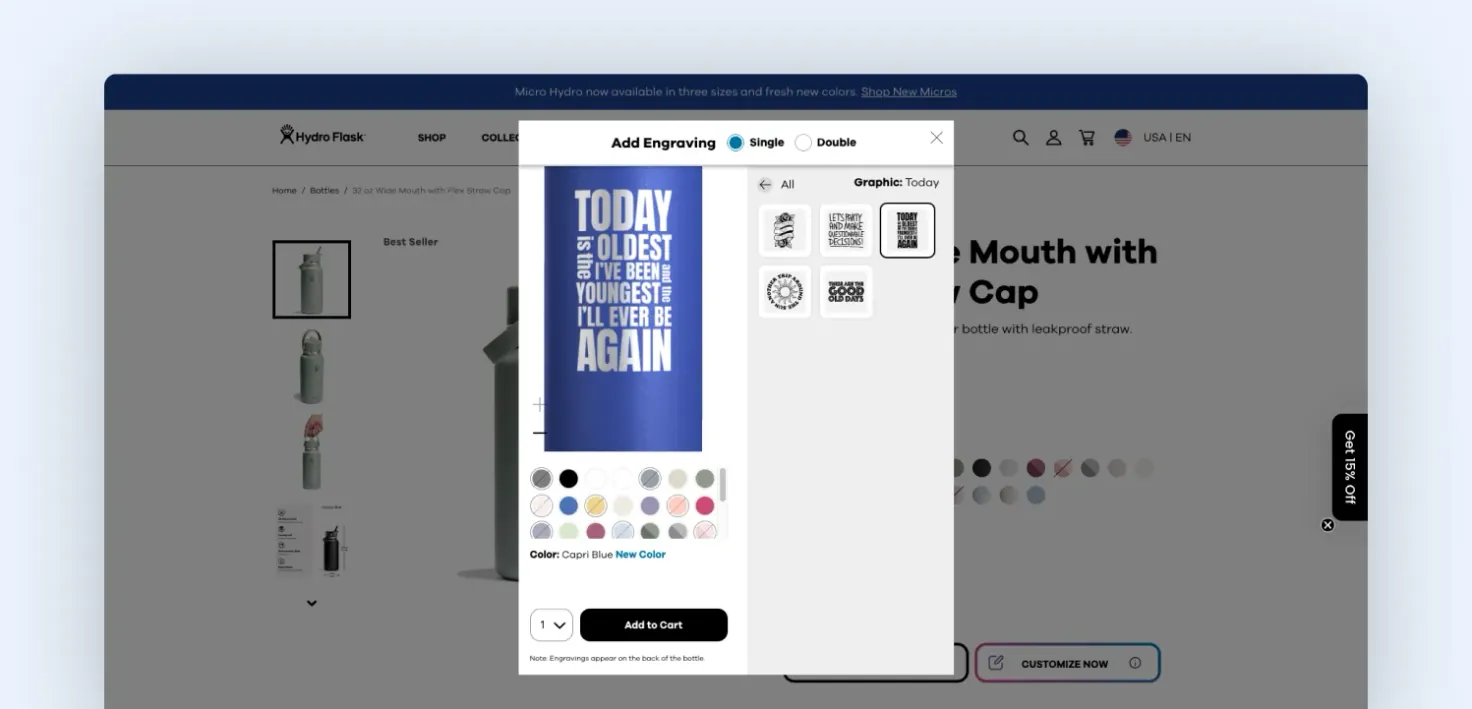
Example of an engraving builder from Hydro Flask
Without the right product builder logic, these factors create real risk. Customers may configure something that cannot be manufactured, or expect one result and receive another, especially with large or expensive personalized products. That is why we need clear principles to follow while creating product builders.
Five principles of product builders: Explained through real examples
Rather than defining these principles abstractly, it is easier to understand them through examples.
1. Decision mapping before interface design
Custom product builders begin with logic, not visuals. Before designing UI, teams must define the decision structure:
- Which choices are mandatory?
- Which are conditional?
- Which are mutually exclusive?
- How does pricing change with each dependency?
- What experience should the builder create for the customer (e.g., premium, technical, guided)?
- Should the product be visible throughout the configuration process, or only revealed once the configuration is complete?
A good example is the bike configurator from Larry vs Harry for the Bullitt cargo bike. It guides users through frame color, drivetrain, accessories, and cargo options, revealing only compatible choices at each step.
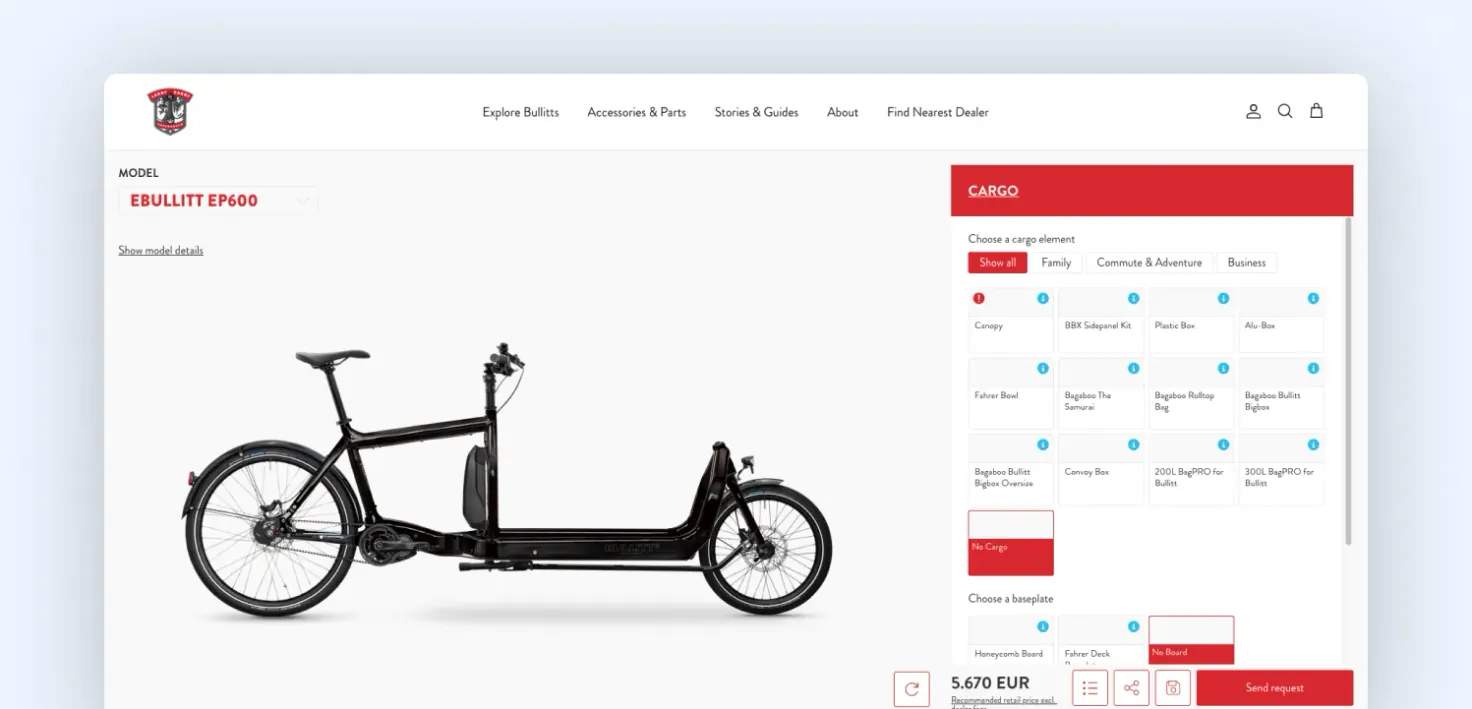
Bike Configurator by Larry vs Harry
For instance, certain cargo accessories appear only after selecting a specific rack type, and some drivetrain options limit available add-ons. These rules are defined in the configuration logic first, and the interface simply reflects them.
Without this decision mapping, a configurator becomes a guessing interface where customers can create combinations that are incompatible or impossible to manufacture.
2. Enforce rules up front (dynamic validation)
Late-stage validation is one of the most expensive mistakes in configurator design. If incompatibilities are discovered only at checkout or worse, after order submission, operations absorb the cost.
The product builder that Magebit created for Selfnamed illustrates proper rule enforcement. Selfnamed allows brands to configure private-label skincare products and upload packaging artwork. But the system does not allow arbitrary uploads.
Artwork is validated instantly for:
- Resolution
- Print-safe boundaries
- Packaging geometry
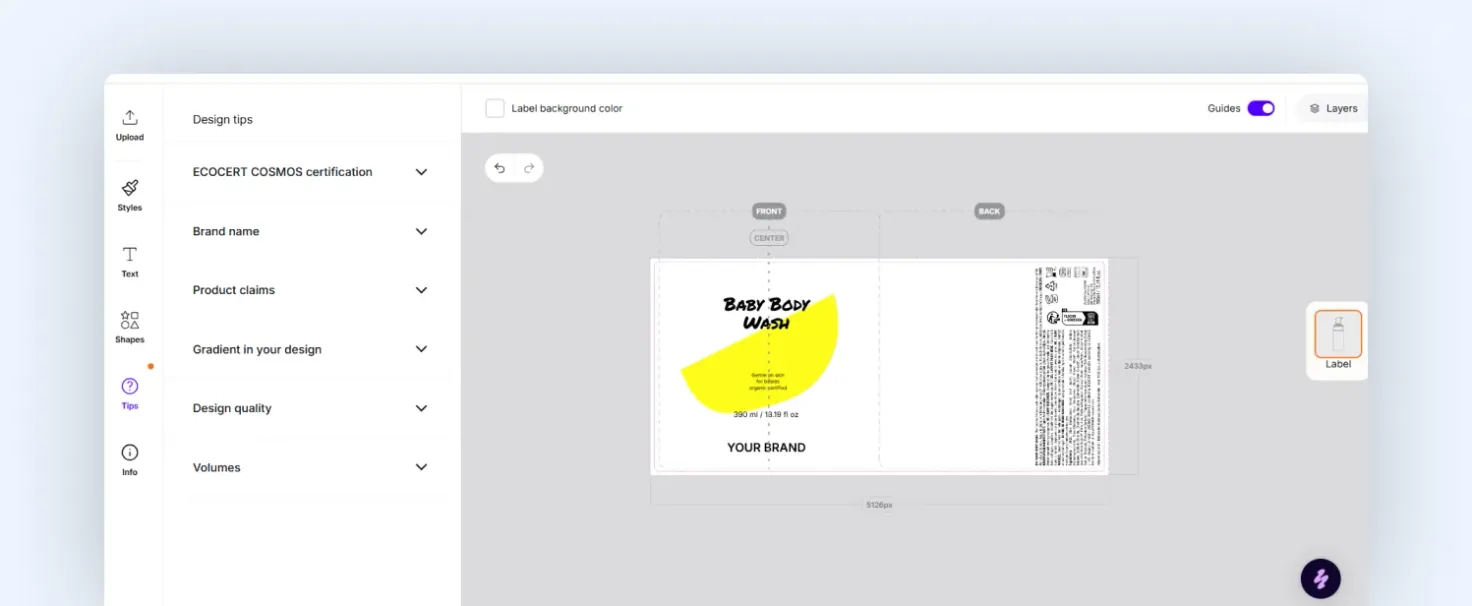
The Selfnamed cosmetic label configurator showing front and back label design preview
If a logo exceeds the permitted print zone, it is flagged immediately. If file quality does not meet production standards, it is rejected before the order proceeds. Nothing gets fixed manually. The builder enforces production feasibility in real time. That is dynamic validation.
3. Progressive disclosure (sequencing complexity)
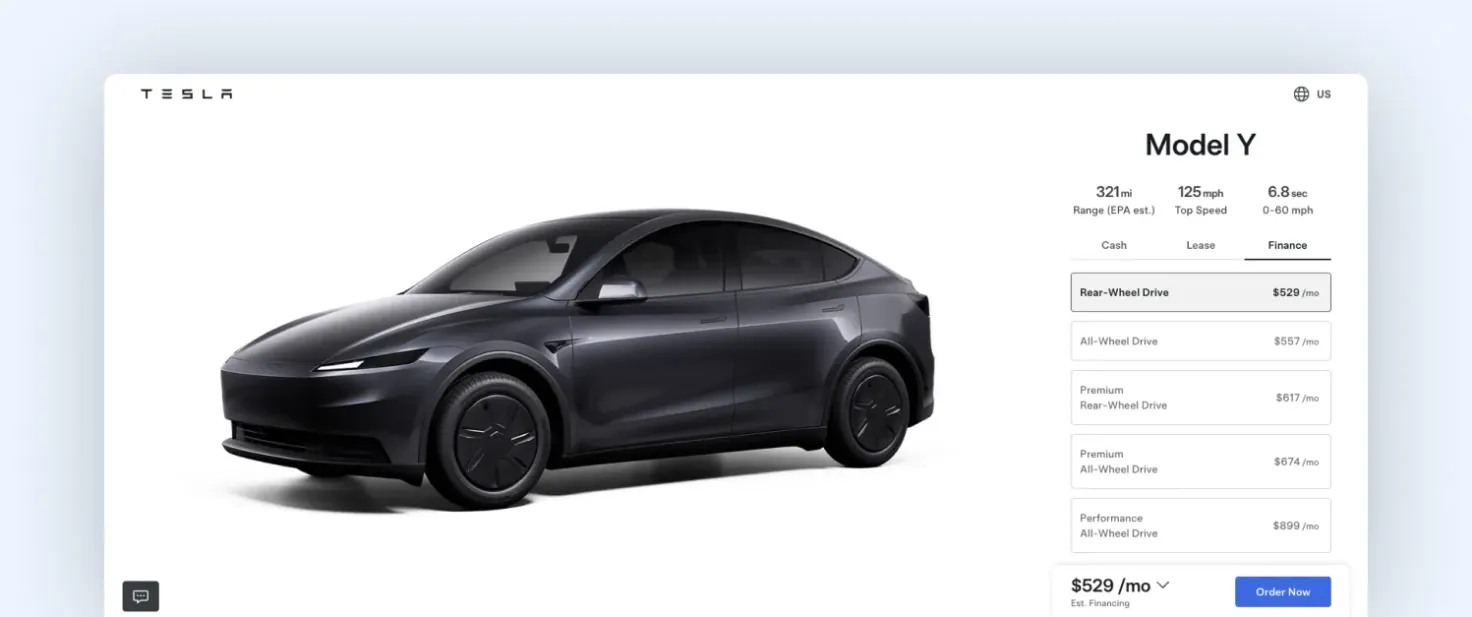
Tesla configuration step 1
Complex products should not expose every variable simultaneously. When too many options appear at once, users hesitate or abandon.
Effective builders introduce complexity gradually, aligned with how decisions are naturally made. A strong illustration of structured sequencing is Tesla’s vehicle configurator.
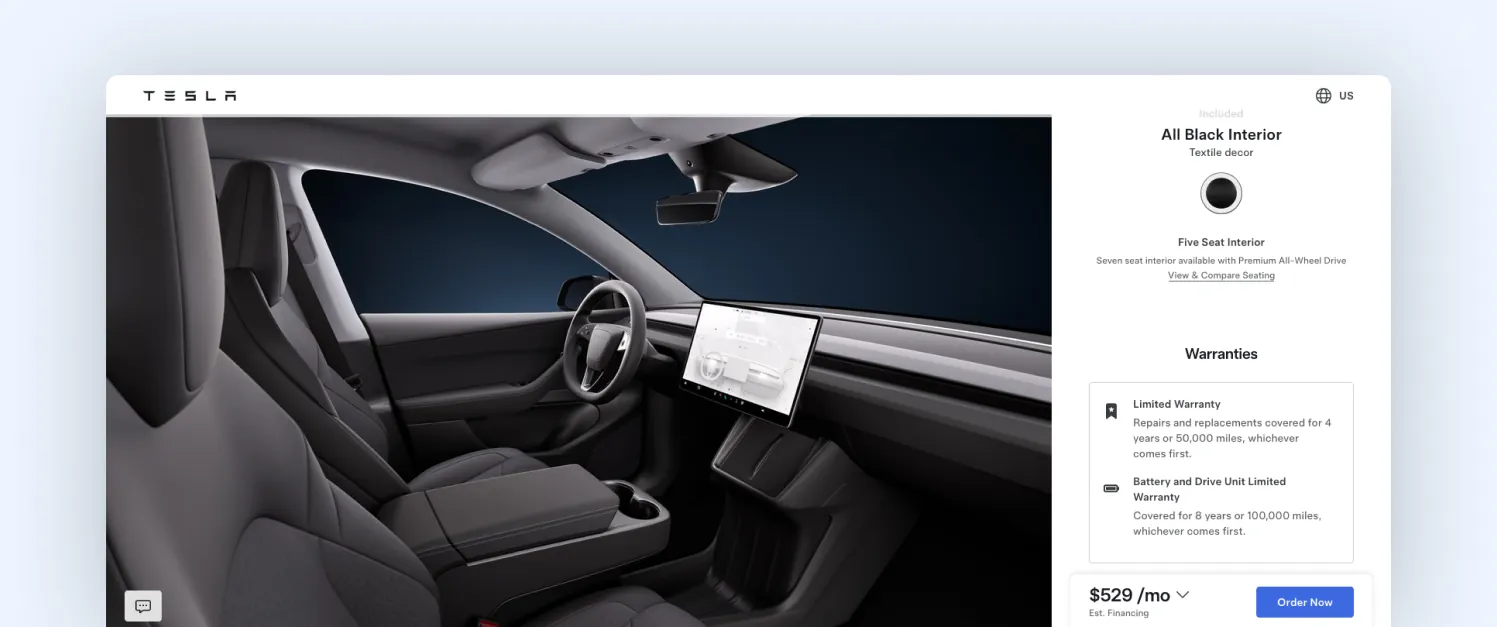
Tesla configuration step 2
The configurator does not start with small interior details. Instead, it follows a clear progression, wherein each decision narrows the next set of options.
The visual experience also supports this sequencing. The builder first shows the car’s full exterior, giving buyers a clear sense of the overall product. When configuring interior options, the view shifts inside the vehicle, and later returns to the exterior as the process continues.
This progression keeps the experience focused and intuitive. Instead of overwhelming users with every variable at once, the builder guides them through the product in the same way they would naturally evaluate it.
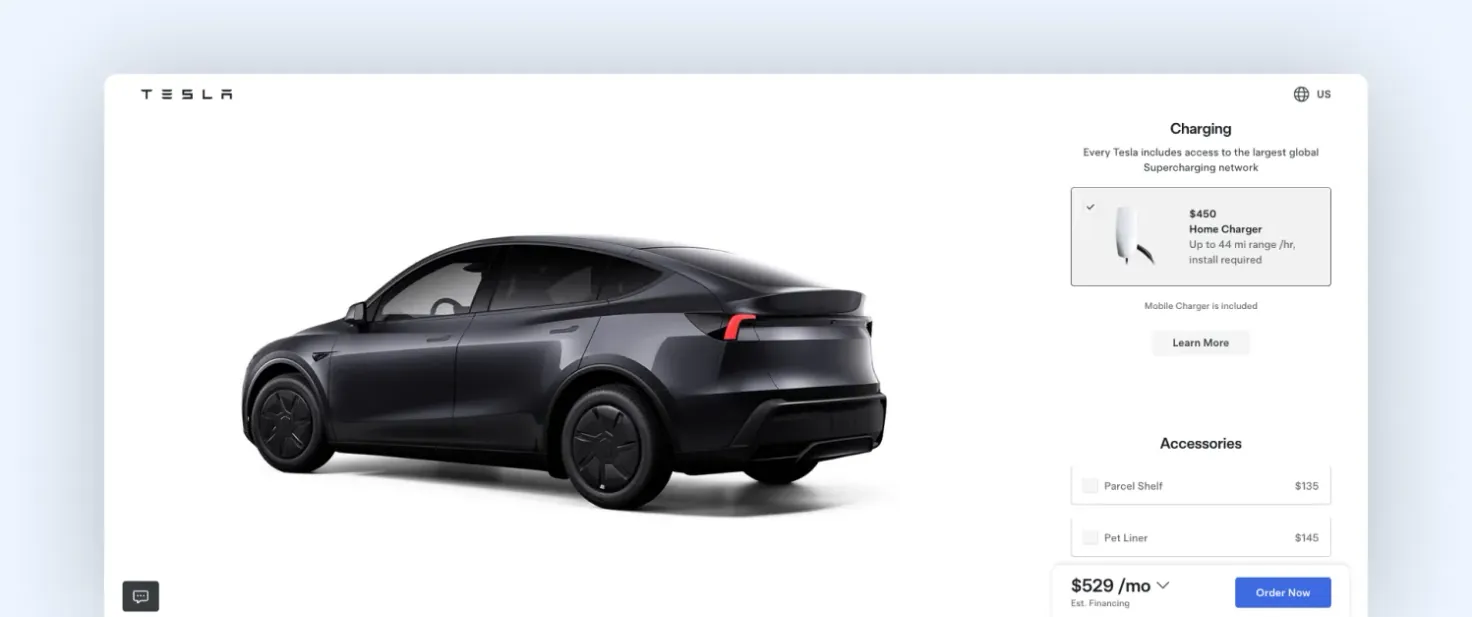
Tesla configuration step 3
4. Real-time feedback loops
Enterprise buyers make rational decisions. They need immediate visibility into trade-offs. If a component change increases price or extends lead time, the impact must be visible instantly.
Consider enterprise IT hardware configuration, such as server builds offered by Dell Technologies. When additional RAM or processors are added, the price and delivery timelines update immediately. Buyers can evaluate cost-performance trade-offs in real time.
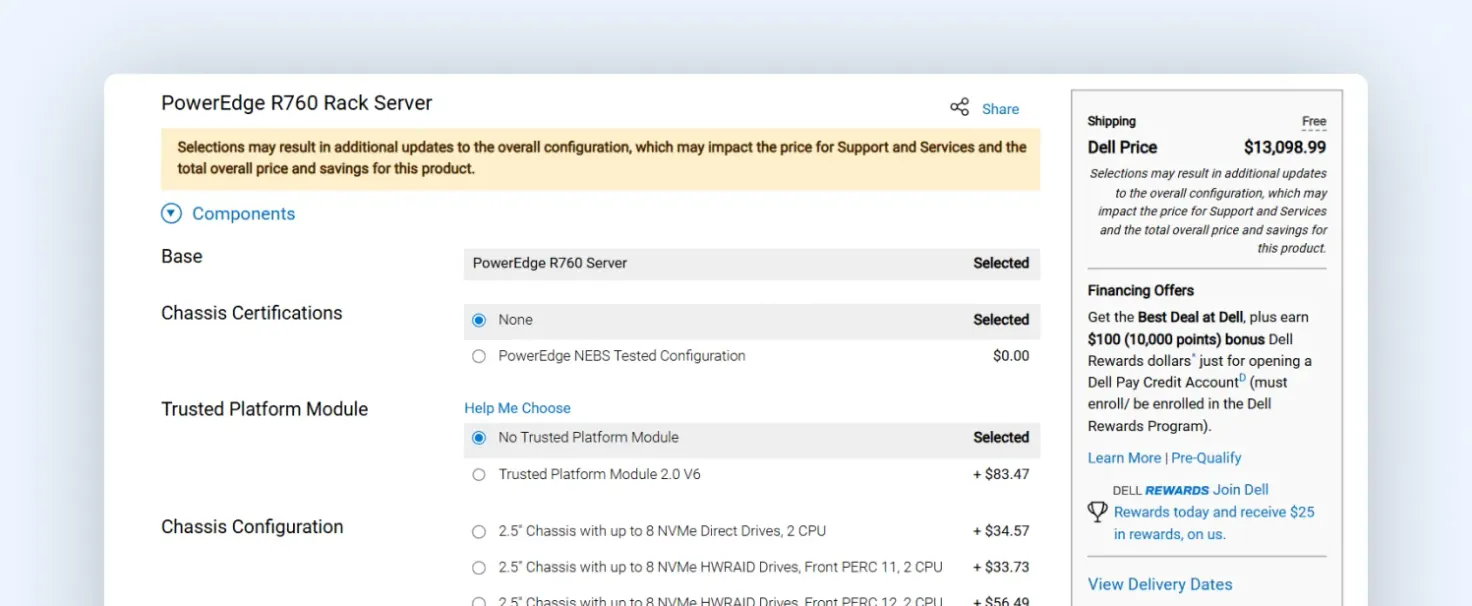
Dell PowerEdge R760 server configurator showing component selection
Good builders also guide users as they move forward. If a base configuration is not compatible with certain components later on, those options simply should not appear.
A good example is Herman Miller’s chair configurator. When a buyer selects a base chair size or frame finish, only compatible materials, arm options, and accessories remain available. Incompatible options are removed from the interface, which keeps the configuration path clear and prevents users from reaching combinations that cannot be manufactured.
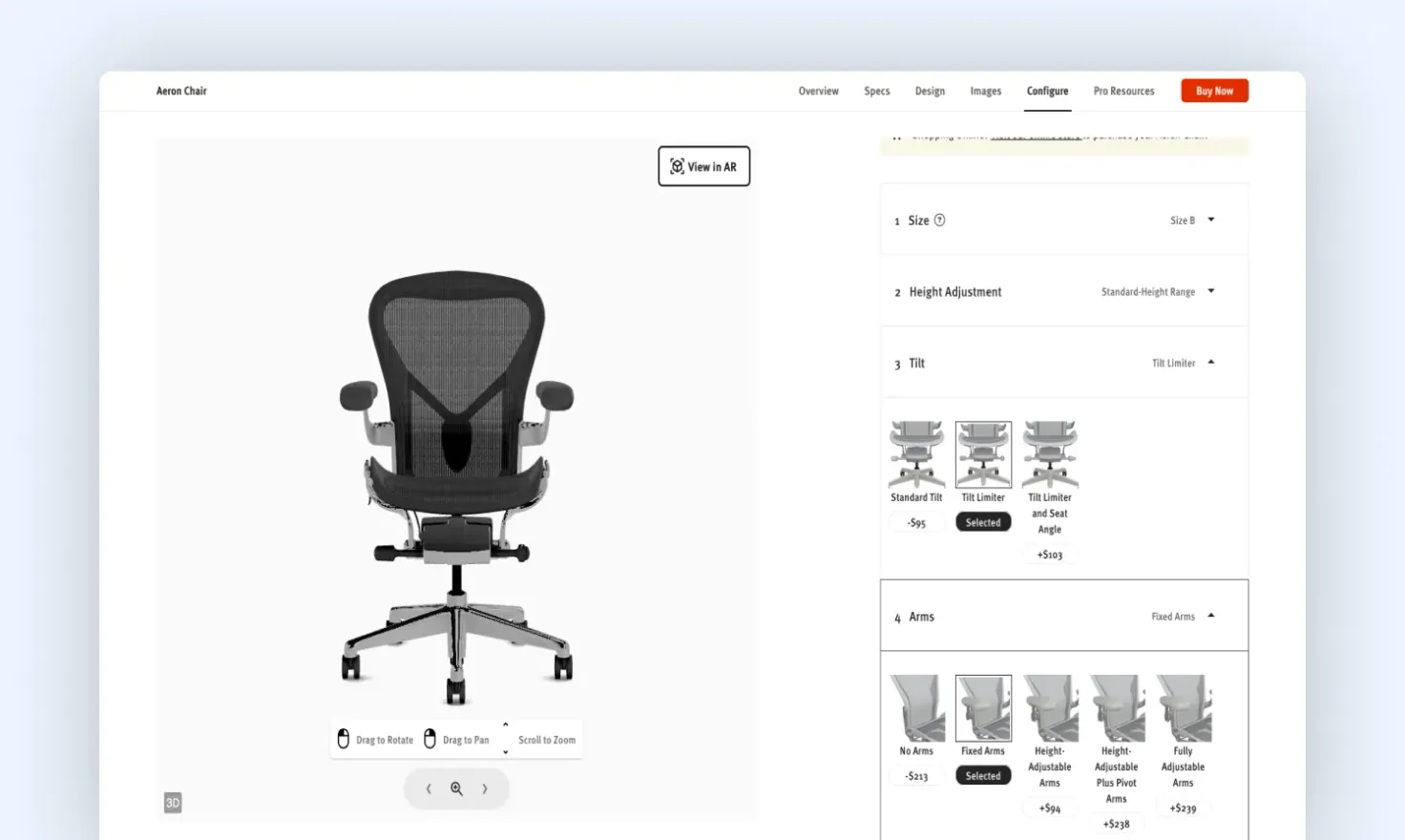
Herman Miller’s chair configurator.
5. Performance as part of the experience
Even the best-designed product builder can fail if it feels slow. When users make a selection, the system should respond immediately. Delays of even a few seconds break the flow of configuration and make the experience feel unreliable.
In product builders, users are making a series of quick decisions. If each step takes time to load or process, the interaction becomes frustrating and people abandon the process before completing it.
The product builder we created for Selfnamed is designed to keep interactions fast and responsive. As users move through configuration, selections respond instantly, and the visual preview updates without noticeable delay. This keeps the experience smooth and allows users to focus on building their product rather than waiting for the interface.
This emphasis on performance is one of the reasons the Selfnamed platform received 1st place at Latvia’s E-Commerce Award for innovation.
For high-volume brands like Dunkin’, we optimized the product builder to handle massive traffic surges while maintaining a 100/100 PageSpeed score, ensuring that customization never slows down the checkout flow.
Strategic capabilities that matter in 2026
A modern product builder has to do more than help someone click “Add to Cart.” For high-value or complex products, buying decisions don’t happen in one sitting. They involve discussions, reviews, and internal approvals. That means your configurator needs to support how people actually work.
As product builders evolve, the following capabilities are becoming important:
Realistic visual previews
In 2026, with advances in AI image generation and rendering, rough placeholders are no longer enough. Buyers expect to see a close representation of the final product as they configure it. However, we’ve taken this a step further for B2B environments.
For a global client, MerchHouse, Magebit developed a product builder where, instead of configuring one product at a time, the user uploads their logo at the very beginning of the session. The system then dynamically swaps product imagery across the entire catalog in real-time. This transforms the journey from a standard shopping trip into a fully personalized brand experience. We implemented this solution many years ago when the technological capabilities were much more limited, yet many brands still cannot find a way to implement something like this nowadays.
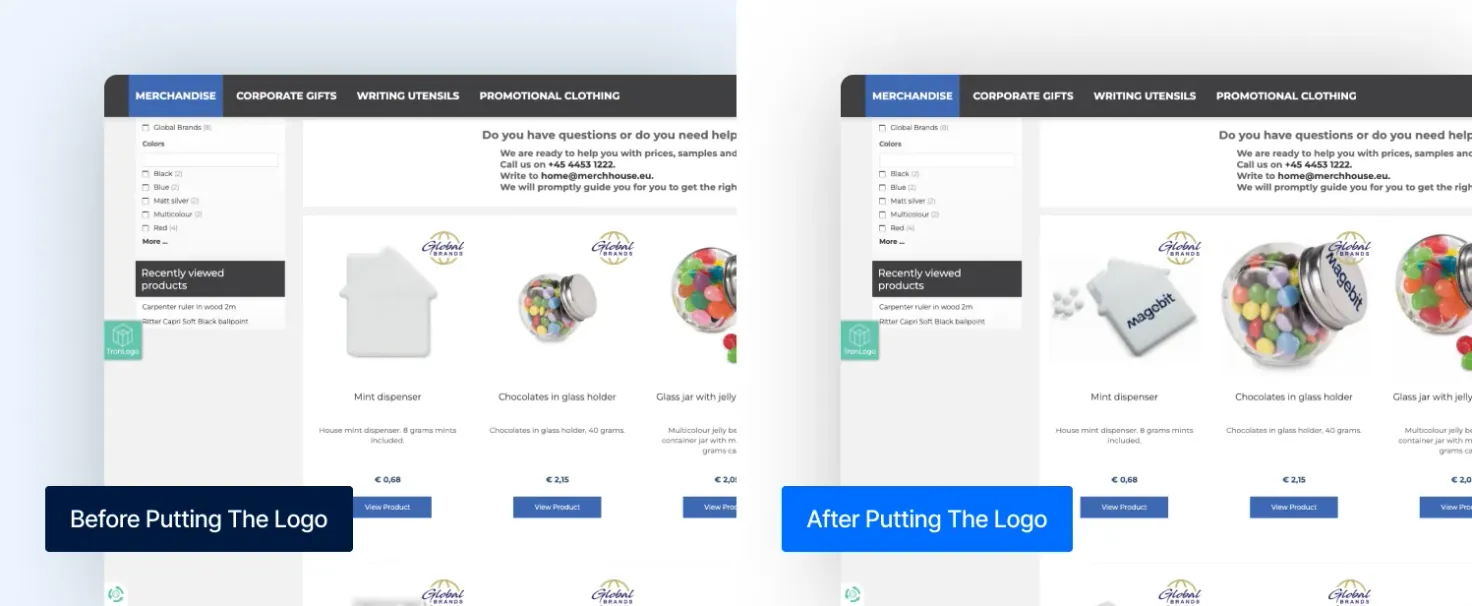
Example of a personalized catalog experience built by Magebit for MerchHouse
State persistence and deep linking
Complex configurations may span multiple sessions. Buyers may pause to check specifications or share the build with colleagues.
State persistence ensures the system remembers the exact configuration so the buyer can return later without rebuilding it. Deep linking allows that configuration to be shared through a unique URL, so others can open the same setup instantly.
CPQ integration
In many B2B environments, the configurator is only the first step. The configuration often feeds into a CPQ (Configure, Price, Quote) system that turns the selected options into a structured quote.
The system converts the configuration into a Bill of Materials, calculates pricing based on defined rules, and prepares the configuration for sales and procurement. When this integration works well, sales teams don’t need to re-enter configuration details or rebuild the order manually. The configuration moves directly into the quoting process, reducing errors and speeding up the sales cycle.
3D space and real-world molding
In 2026, the demand for visual certainty has moved beyond flat 2D overlays. For high-stakes customization, users need to see exactly how a product molds to their specific choices.
Magebit’s work with Selfnamed is a prime example of this advanced 3D execution. The configurator does not just place a static image of a logo onto a generic bottle; it utilizes 3D product rendering to show how labels and artwork wrap around the unique geometry of real cosmetic bottles.
This real-world molding serves two purposes:
- Consumer confidence: Buyers see the texture, the wrap, and the scale in a 3D environment, removing the guessing game of how a flat design will look on a curved surface.
- Production accuracy: Because the 3D model is tied to the actual manufacturing dimensions, the visual preview is a 1:1 representation of the final physical output.
Final thoughts
Customization is becoming more sophisticated, not simpler. As product lines expand and configuration logic deepens, the real pressure shifts from the interface to the systems underneath it.
The difference between a configurator that scales and one that creates friction rarely comes down to design alone. It depends on how well pricing, compatibility, compliance, and operational constraints are built into the experience from the start.
When that structure is in place, users move with confidence, and operations receive orders that can actually be executed. When it isn’t, the burden shows up later, in manual corrections, delays, and margin loss.
Complex products don’t need fewer options. They need stronger foundations. If you’re struggling to make product builders work at scale or trying to redesign one without disrupting operations, get in touch with Magebit.