Most eCommerce Stores Are Getting Shipping Pricing Wrong: Here's Why
It’s not because of bad couriers or slow warehouses; it’s because of a single number at checkout that feels off.
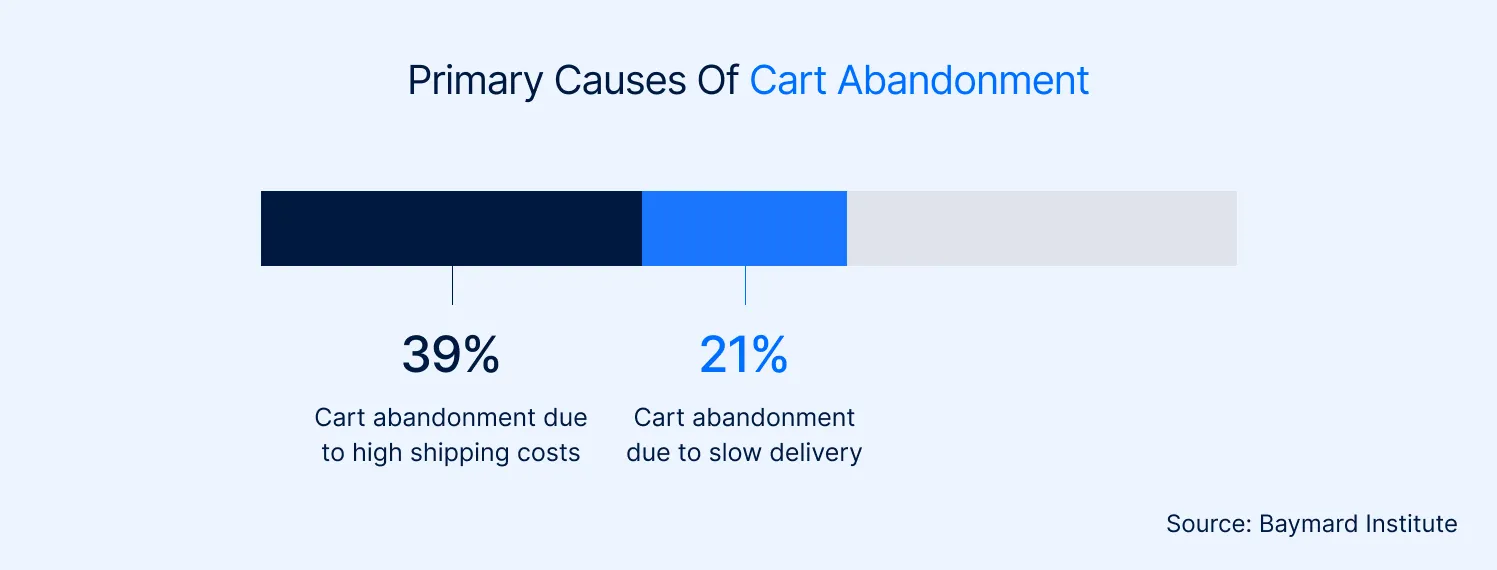
The moment a customer sees a shipping cost that doesn't feel fair, even if it's technically accurate, they leave. And they don't come back. According to the Baymard Institute, 39% of cart abandonments happen because extra costs like shipping feel too high. Another 21% leave simply because delivery looks too slow.
That's not a logistics problem. That's a pricing psychology problem.
Most brands approach shipping backwards: they look at the courier invoice, pass that cost to the customer, and wonder why conversion suffers. The smarter approach starts from the customer's perspective first - what feels reasonable - and works backwards from there.
If you're still debating whether free shipping is something you can or cannot offer, this post is exactly for you. And if you think your customers don't expect it by default yet, they already do.
The Reality of eCommerce Shipping Today
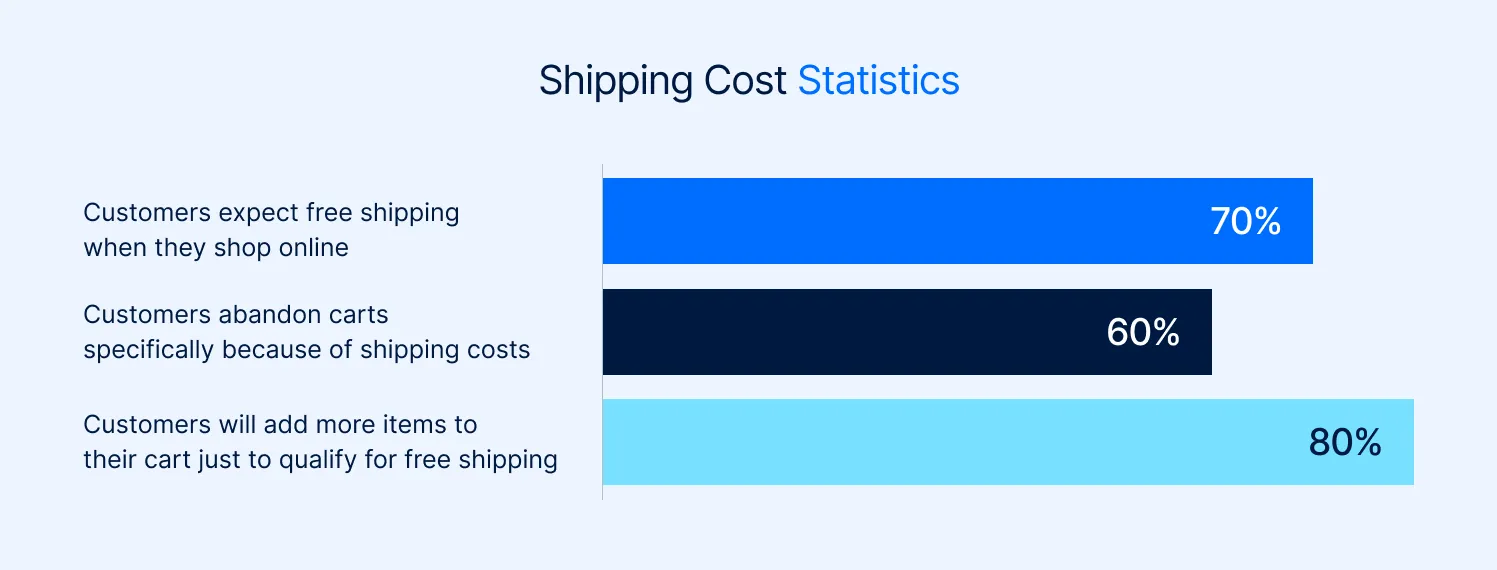
Free shipping is no longer a nice-to-have. It is the baseline expectation.
Studies consistently show the below:
But free shipping is never actually free. You always pay for it somewhere. The goal is not to eliminate the cost - the goal is to distribute and optimize it intelligently so that customers never feel it, and your margin still works.
That is exactly what this guide covers.
What Does Reasonable Shipping Actually Look Like?
There's no universal number, but there is a reliable benchmark most eCommerce managers can use:
Standard shipping should typically feel like 5-12% of the total cart value. Once it creeps toward 15-20%, friction rises sharply and conversion drops.
Here's how that plays out in practice:
This doesn't mean you can never charge more. It means that once shipping becomes too large a percentage of the basket, you're actively pushing customers away.
Speed Matters Just as Much as Price
Price and delivery time are equally important. Customers aren't all demanding same-day delivery, but they do have a patience limit.
McKinsey research is telling: more than 95% of consumers prefer free standard shipping over paid expedited. More than 80% will buy when delivery takes 4-7 days, as long as it's free. Less than 5% prioritize speed above everything else.
The practical takeaway: most customers will wait, as long as the price is right. Your goal isn't to be the fastest - it's to be fair.
Don't Choose Couriers Based on Price Alone
Here is something that doesn't get talked about enough. Choosing the cheapest courier very often ends up costing more in the long run.
Many bad reviews are not caused by a bad product, bad service, or a bad website. They are caused by:
- Late deliveries
- Poor courier handling
- Damaged packaging
- Rude or absent drivers
.webp)
And here's the painful part: customers rarely blame the courier. They blame your store.
Saving $2 on shipping but losing a returning customer is a very expensive decision. Reliable delivery is part of your customer experience, not separate from it.
Free shipping should be free, not bad. There is a critical difference between the two.
If you offer free shipping through a slow, unreliable provider with poor tracking and damaged boxes, you haven't created a positive experience - you've created a cheap one. And customers remember cheap in the worst way.
Choosing a courier that takes 12-14 days because it saves you a few dollars will cost you customer loyalty, reviews, and repeat purchases. That loss compounds over time in a way that's very hard to recover from.
Free shipping needs to be both free and good. If the only way to offer free shipping is to offer bad shipping, you are better off not offering it at all - and instead working on the economics until you can do it properly.
How Many Options Should You Offer?
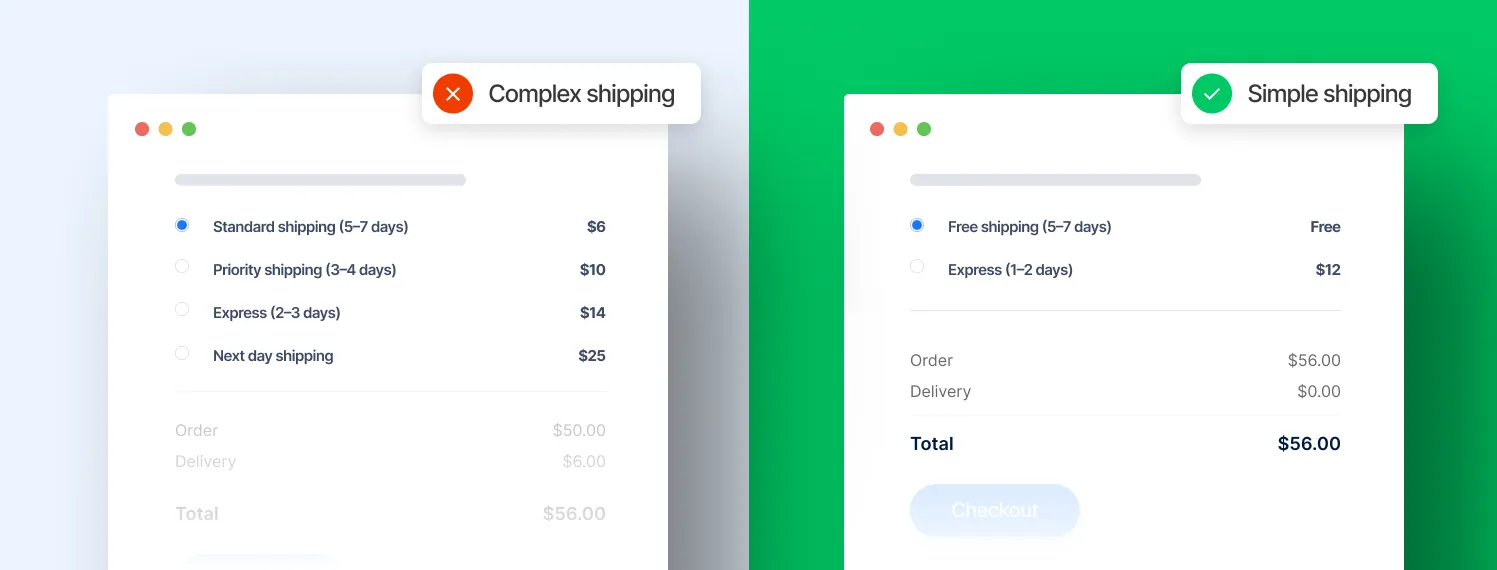
As few as possible.
The ideal setup is no shipping decision at all - shipping included in the product price, delivery already reasonable, nothing for the customer to choose. That is the cleanest version and the one most stores should aim for.
If that isn't possible yet, keep options minimal and make sure each one is clearly different. Two well-defined options beat three confusing ones every time.
A recommended structure for most stores:
Free is the default. Express is available for customers who genuinely need speed and are willing to pay for it. That's it.
If your store cannot yet absorb the cost of free shipping on your standard service, you can offer a separate lower-cost, slower free shipping tier - but only if you can keep the delivery experience good. Slow is forgivable. Unreliable, untracked, or damaged is not.
The goal isn't to offer more shipping methods. It's to make the decision as easy as possible - and ideally, to remove the decision entirely.
Price Shipping for Conversion First, Cost Recovery Second
Here's the mistake that hurts eCommerce stores at every size:
They set shipping prices by asking: 'What does shipping cost us?'
The better question is: 'What can we show at checkout without hurting conversion?'
Those two numbers are often not the same, and the gap between them is where the margin goes to die.
If your courier charges $8 but your category converts poorly above $5.99, showing $8 at checkout is the wrong move. You are not being more profitable. You are being less profitable because you are losing orders.
How to Make Paid Shipping Feel Acceptable
If your real shipping cost is higher than what feels reasonable at checkout, don't push the entire gap into the shipping line item. Move part of it into the product price - and keep the visible shipping number within the range customers accept.
Here's a simple example. Suppose your product costs $50 and shipping costs you $8. Instead of showing $8 at checkout, you price the product at $52.99, show shipping at $4.99, and the customer pays $57.98 total. That feels significantly better than $50 + $8, even though the difference is just $0.02.
The second option presents the same cost at a far more acceptable price. The shipping line item stays within the range customers expect, and the total is essentially the same. That's not manipulation - it's understanding how people perceive value.
The key rule: never absorb the full shipping cost into a single product price. If your shipping costs $8 and you add $8 to one product, that product is now overpriced relative to market. Spread small increments - $1 here, $2 there - across multiple products, and recover the cost over many orders rather than from a single SKU.
How to Make Free Shipping Work Financially
Free shipping is the goal. But it has to be funded somewhere. The good news is that you don't have to fund it all from one place - and you shouldn't try to.
There are three ways to distribute the cost of free shipping, and the healthiest models use all three together:
1. Small Increments Across Product Pricing
This is the most sustainable lever. Instead of adding the full shipping cost to any single product, add a small amount - $0.50 to $2, depending on your price points - spread across many products in your catalog.
Why small amounts matter: most customers buy more than one product. If you've added $2 to each of five products to fund 'free' shipping, a customer buying three items has effectively contributed $6 toward shipping before you've shipped a single box. That changes the economics significantly.
This is exactly why absorbing the full shipping cost into one product's price is a mistake. At $57.99 per product, a customer buying two items pays $115.98. Your competitor selling the same product at the real $50 price point with a $5 shipping charge looks dramatically cheaper. You haven't hidden your shipping cost - you've made it worse.
Keep increments small, spread them wide, and let the model work across your catalog and your order volume.
2. Conversion and Acquisition Efficiency
Free shipping improves conversion. Better conversion means your ad spend generates more orders. More orders mean a lower cost per acquisition. Part of the shipping cost effectively funds itself by making every marketing dollar more efficient.
This is one of the most overlooked parts of the free shipping calculation. It's not just 'revenue minus shipping cost.' It's 'revenue minus shipping cost, plus the margin recovered from orders you would otherwise have lost.'
3. Volume and Courier Negotiation
More orders give you negotiating power with courier partners. Brands shipping 500+ orders a month consistently access better rates than those shipping 50. As free shipping drives volume, the actual cost of each shipment decreases over time - making the model progressively easier to sustain.
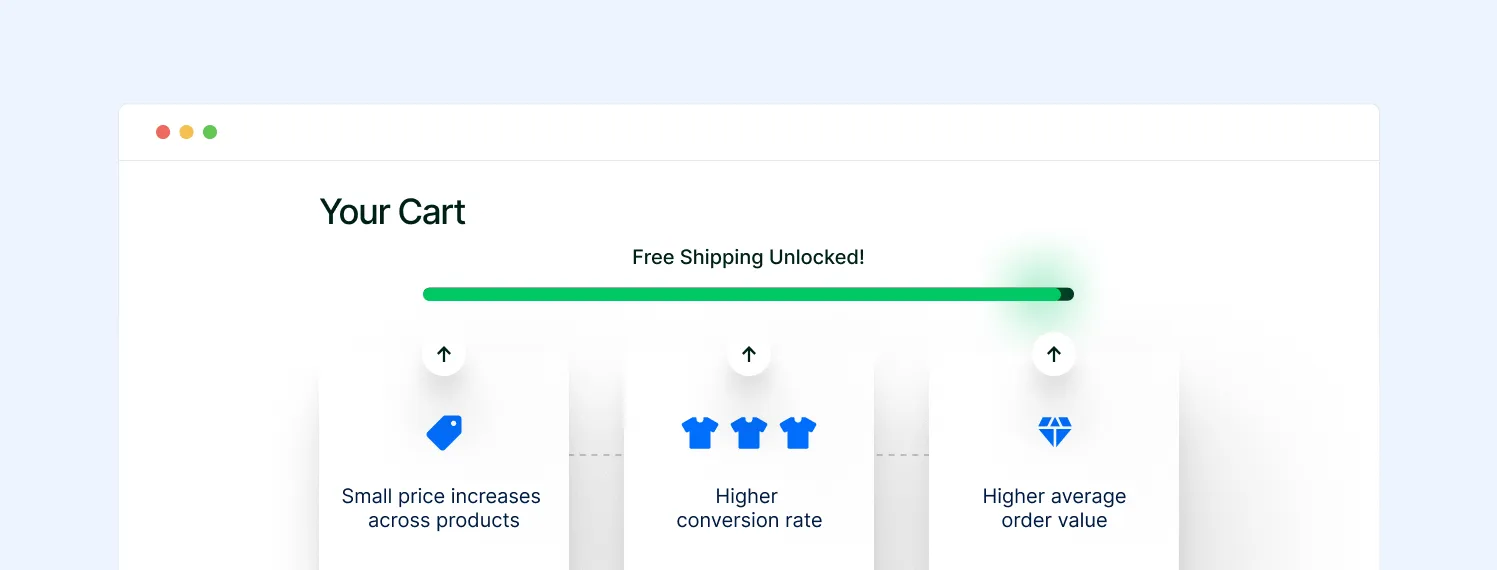
When Product Pricing Alone Isn't Enough: Use a Threshold
If your margins are tight, your products are low-priced, or you're early in your growth, absorbing the full cost of free shipping on every order may not be realistic yet. That's where a free shipping threshold solves the problem.
Set the threshold just above your current average order value, so it nudges customers to add one more item without feeling unreachable. And here's why this works so well: around 80% of customers will actively add items to their cart to qualify for free shipping. You're not just protecting your shipping margin - you're growing your basket.
The threshold needs to feel close. If the gap is too large, customers ignore it. If it feels like one more item away, they act on it.
A threshold improves the model in two ways at once: it keeps shipping attractive at checkout, and it increases basket size, which makes the shipping cost a smaller share of total revenue. At a $60 order, a $6 shipping cost is 10%. At an $80 order, that same $6 is 7.5%. The cost hasn't changed - the math has just become more favorable.
The threshold isn't a workaround. It's a growth tool. It funds free shipping and improves your average order value at the same time.
'But Our Competitors Charge More and Deliver Slower...'
This is one of the most common things we hear when stores start working on their shipping strategy. And it usually sounds like: our competitors don't offer free shipping, they charge higher rates, they deliver in longer windows - that's just how this industry works.
Great. You've just found a clear opportunity to become better.
If you are fulfilling a specific need for your customers, better shipping is a direct advantage over competitors who haven't figured this out yet. They won't understand it at first. They'll assume you're doing it wrong, that you're giving money away, that it doesn't make sense. Then they'll start noticing they're losing orders. Then they'll catch up - but by then, you'll have the reviews, the returning customers, and the brand trust that took time to build.
Being early on something your competitors underestimate is not a risk. It's a head start.
But there's a second, less obvious point here that's equally important.
If you're selling products that aren't completely unique - gifts, lifestyle products, accessories, general goods - you're not only competing with direct competitors selling the same thing. You're competing for the customer's decision itself.
If someone is looking for a gift and your shipping feels expensive or slow, they don't necessarily go find the same product somewhere else. They might just choose a different gift entirely. You didn't lose to a competitor - you lost to the customer's own hesitation.
Getting your shipping right isn't just about beating direct competitors. It's about winning the customer's decision in the first place - before they talk themselves out of it.
This is why shipping pricing is a must, not a nice-to-have. It determines whether you win the order at all.
Putting It All Together
The full framework is straightforward once you stop thinking about shipping as a cost to pass on, and start thinking about it as a conversion lever to manage:
- Free shipping is the baseline - not a bonus. Build your model around it.
- Start by defining what feels reasonable to your customer - 5-12% of cart value as a benchmark.
- If real shipping costs exceed that, move part of the gap into product pricing. Spread small amounts across the catalog.
- Recover the rest through better conversion, lower ad cost per order, and higher basket size.
- Add a free shipping threshold if your AOV needs a nudge - aim for around 110-130% of current AOV.
- Keep shipping options simple - free and express. Each option should be meaningfully different.
- Never choose a courier purely on price. Cheap shipping that damages trust costs far more than it saves.
Shipping isn't just math. It's psychology. Customers don't judge whether your shipping is technically accurate. They judge whether it feels fair - and whether it feels like you respect their time and their order.
The stores that understand this - and build their pricing model around it - convert better, spend less on acquisition, and scale faster. Not because they solved logistics, but because they solved perception.
Ready to Put This Into Practice?
If this makes sense for your store, the next step is knowing exactly where to start and what to change first.
We put together a step-by-step action guide and checklist that walks you through the full process - from checking whether your margins can support free shipping, to repricing your catalog, setting your threshold, and evaluating your courier. Everything in one place, in the right order.
Read the full action guide and checklist here.


Free tips to grow your store
eCommerce related news
New articles every month
Macaroni and cheese recipes
Check your inbox for tips.