


SAP
Enterprise ERP

Your ERP, PIM, CRM, POS and marketplaces, connected to Magento so nobody re-types an order again. Scoped and estimated in writing before anything gets built.
















Your ERP knows the truth about stock, price and orders. When the store doesn't, the difference gets paid in refunds and overtime.

Nobody invoices you for any of this, so it never gets counted. It comes out of margin and out of your team's week, and it never stops on its own.
The site sells what the warehouse doesn't have, because stock syncs overnight and demand doesn't.
Someone copies web orders into the ERP every morning, and every typo becomes a wrong delivery.
The store quotes one number, the invoice says another. Each gap is a credit note or an argument.
No status flows back from fulfilment, so where is my order gets answered by a human, every time.
A sync stopped three weeks ago. Nothing alerted, nothing retried, and now finance reconciles by hand.
Hours a week spent moving data between systems, work that has no upside and never ends.
The same systems, finally agreeing, and the manual work between them gone for good.
Availability that reflects the warehouse, per location, so overselling stops being a monthly event.
Web orders arrive in the ERP in seconds, complete, without anyone re-keying them.
Contract and tier pricing flow from the ERP, so what the customer is quoted is what finance invoices.
Fulfilment, tracking and invoices flow back to the customer's account, and the support queue shortens.
The manual reconciliation, the copy-paste, the morning export, gone, and nobody misses it.
The systems your business already runs on, wired in the directions your operation actually needs.
Enterprise ERP
SMB ERP
Microsoft ERP

Enterprise ERP

Cloud ERP

Mid-market ERP

Industry ERP

Cloud ERP

Distribution ERP

Open-source ERP

Accounting

We'll build the integration
PIM

PIM and DAM

PIM

PIM

PIM

Distributor catalogs

Large-scale ingest

Variants and options

Images and assets

DAM and media

DAM

We'll build the integration
CRM

CRM and marketing

CRM

CRM
CDP

CDP and tags

CDP
Companies and roles

Orders and service

Okta, Auth0, SAML

Privacy and cookies

We'll build the integration
Location inventory

Store pickup

Local availability

In-store orders

Across channels

Web and in store

Cross-channel returns

Order on behalf

Retail POS

POS

File or API based

We'll build the integration
Marketplace

Marketplace

Marketplace

EU marketplace

EU marketplace

EU marketplace

Marketplace platform

Product feed

Social commerce

Multi-channel

Feed management

We'll build the integration
Tax calculation

Enterprise tax

US sales tax

Tax and invoicing

E-invoicing

Cross-border VAT

Certificates

US obligations

Accounting
Accounting

Finance systems

We'll build the integration
Carrier

Carrier

Carrier

EU carriers

Lockers

Shipping platform

Delivery management

Rates and rules

Fulfilment partners

Warehouse management

RMA flows
We'll build the integration
Email and SMS

Lifecycle

Cross-channel

Lifecycle

Search

AI search

Search and recs

Personalization

Analytics

Tracking

Reporting

We'll build the integration
Something not on this list? Nearly every project has at least one system nobody else has integrated. That's normal, and it's the part we're good at.
The right architecture depends on your data volume, your ERP's API and how real-time it truly has to be. We build all four.
Where a maintained connector genuinely covers your data flow, it's the cheapest, fastest route, and we'll say so rather than build one for the sake of it.

Configured and mapped to your fields, not left on defaults
Vendor updates keep arriving, with no fork to maintain
We say when it stops covering what you need
Fastest to production, least flexible.
Built into the store using Magento's own APIs, queues and cron. Direct, maintainable, and right for most single-system integrations.
Magento APIs, message queues and cron, no core hacks
Configurable from the admin, by your team
Covered by tests and upgrade-checked every release
Right when the integration belongs to the store.
The integration runs outside Magento on Adobe's own platform, so core upgrades can't break it and heavy processing can't slow the storefront.
Runs off-platform, so upgrades can't break it
Heavy processing never touches storefront performance
Scales with volume independently of the store
Right when it's high-volume or has to survive every upgrade.
A dedicated service between systems, translating, queueing and reconciling, when several systems have to agree and none speak the same language.
One layer several systems talk to, instead of a web
Transformation, validation and reconciliation in one place
Swap a system later without touching the storefront
Right when the data flow is the actual product.
The timelines quoted elsewhere come from an era of hand-writing every mapping, transformation and test. That isn't how integrations get built now.
Field mappings and data transformations
Connector and module scaffolding
Test coverage across the data flows
Documentation and runbooks
Generated fast, reviewed by certified developers. The time comes out of the typing, not the quality.

Deciding what should sync, in which direction and how often
Getting API access and credentials out of your ERP vendor
Testing against real data instead of samples
No tool removes those, and any quote that pretends otherwise is a quote that slips.
Before anything is built we map the touchpoints, the data direction and the failure cases. What comes back is a written scope for your integration, phased so the parts that stop the bleeding go live first.
Nothing gets estimated from a guess, and nothing gets built before you have seen the plan.
Making two systems talk once is a demo. Keeping them talking through outages, upgrades and peak season is the engineering.
Data moves through queues, so a slow or offline back office can't slow down your storefront.
A failed sync is retried automatically, and a retry can never create a second order or charge.
Designed with no single point of failure, so their emergency upgrade isn't your emergency.
Did that order reach the ERP is a lookup, not an investigation, with logs you can audit.
Failed syncs raise alerts and tickets automatically, checked every 5 minutes on support plans.
No core hacks, App Builder where it fits, and compatibility tested against every release.
The systems that matter most are often the oldest ones in the building. A missing API has never ended the conversation.
A green-screen terminal, a Windows share, a database nobody documented.
SFTP, CSV and XML exchange, scheduled, validated and error-handled like a real integration.
Orders and invoices mapped to your ERP's reality, so an EDI document becomes a clean order.
Direct connections into old systems, with a translation layer keeping the ugly parts away.
Where nothing exists we build the service, with the same monitoring and retries as everything else.
Live platforms where the integration is the part holding the business together.










The newest system your store needs to talk to isn't an ERP. We build the layer that lets AI use your commerce data safely.
Our own open-source module connecting Magento stores to AI systems through the Model Context Protocol. Read it, install it, judge the engineering yourself.
Answers that come from your live catalog, stock and order data, because the integration is the whole point.
Scopes, authentication and audit logging, with a human wherever money or commitments are involved.
Mapped first, priced before the build, then watched in production.
Which data, which direction, how often, and what if one side is down. Written scope and estimate.
Work starts once you approve the scope, with the plan and the estimate agreed up front.
Four quality gates, validated on staging against real records, with alerts wired from day one.

Kevin Hughes
European Technical Director



Within just two to three months, they resolved issues that previously seemed unresolvable.

Tim Johnson
CEO

Magebit has been behind every one of our successes, and I recommend them without hesitation.

Will Aubuchon
CEO

What I value most is consistency. Magebit knows our store inside out, responds fast, and keeps it running smoothly year after year.
Marian Gaidoš
CEO

The top-ranked Adobe Commerce agency on the planet, by Adobe themselves.





The most certified Hyvä agency in the world. Confirmed by Hyvä themselves, twice.
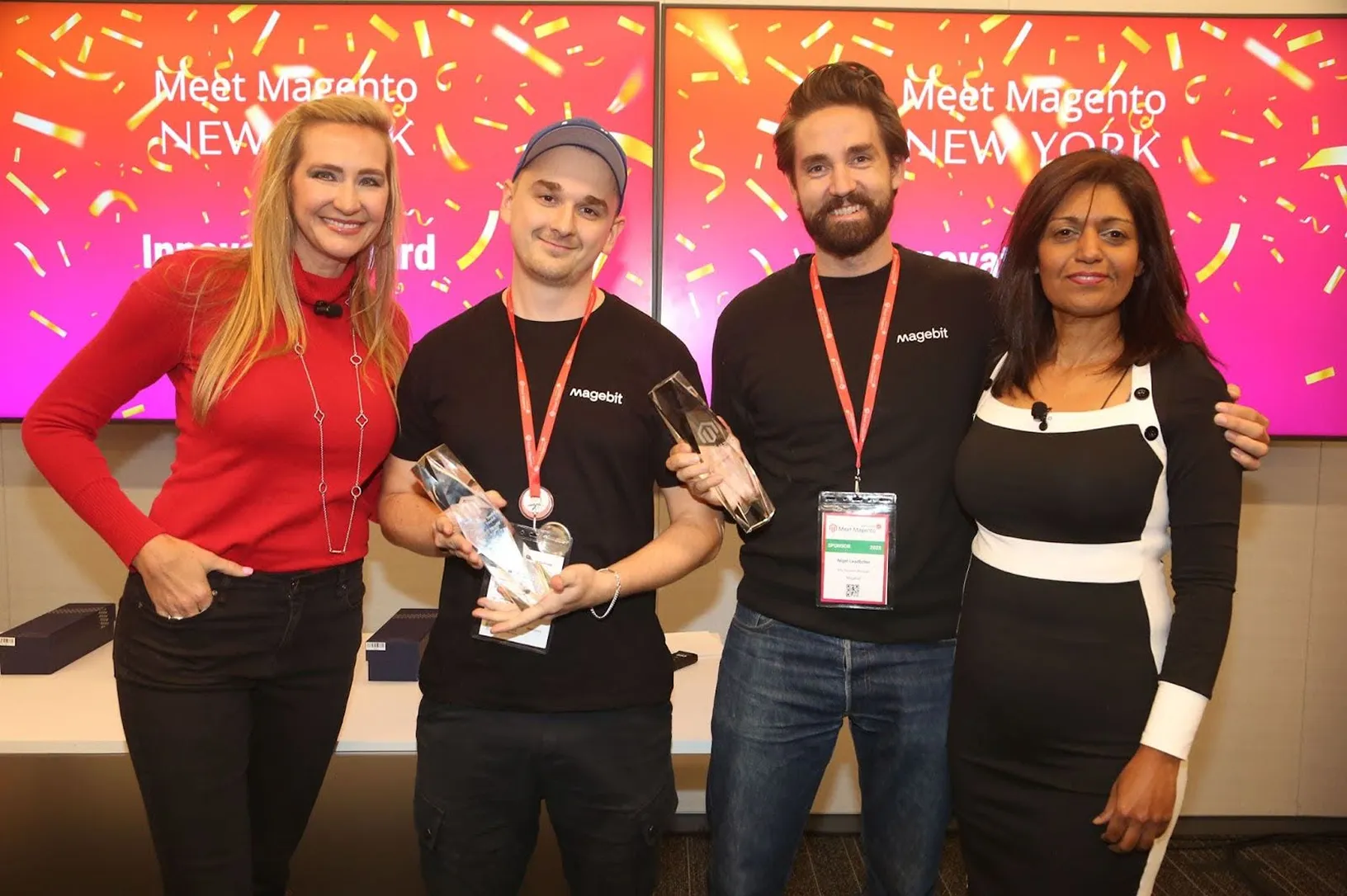
Innovator, World Traveler, and eCommerce Excellence awards across Meet Magento NYC and HIVE London, and more.

12 years running live stores, with 24/7 monitoring and emergency coverage behind every one.
ISO 9001 & 27001 for quality and security, independently audited every year.

Truly agile team that moves and adapts faster than your typical agency.

UX grounded in large-scale eCommerce research.
Almost every operational problem we're shown turns out to be two systems that don't agree. Tell me what you're running and where the re-typing happens, and I'll show you what it takes to make them agree permanently, scoped and agreed before anything starts.
Reviewed by Kristaps Rjabovs
Managing Director

If you can't find the answer you're looking for, feel free to reach out to us. We're here to help.
It depends on the number of touchpoints, your ERP's API and how much custom logic sits in your pricing or fulfilment. Rather than quote a range and revise it later, we run discovery first, map the data flows, then give you a written scope and an estimate you approve before anything is built. Where the work runs through a support plan, our Fixed Cost Estimate Guarantee applies to every task inside it.
Faster than the ranges you have probably been quoted, because AI-accelerated development takes the time out of mappings, transformations, scaffolding and tests. What is left is deciding what should sync, getting API access from your vendor, and testing on real data. Discovery gives you a written timeline for your integration specifically rather than a generic range.
The one you already run. NetSuite and Odoo tend to be the smoothest thanks to modern APIs, SAP and Dynamics are common in enterprise and need more mapping. The real question isn't which ERP, it's which integration method fits your configuration.
Buy when a maintained connector genuinely covers your data flow, it's cheaper and faster, and we'll tell you so. Build when your pricing, warehousing or B2B processes aren't standard, which is most of the time in B2B.
No, and paying for it everywhere is a common waste. Stock and orders usually justify real time, product data, pricing updates and reporting are often better scheduled. We map it per data type in discovery.
The integration is built so neither takes the storefront with it, queued messages, automatic retries and no single point of failure. We plan around known upgrades and monitor for unplanned ones.
Yes, file and feed exchange, EDI, secure database bridges or a custom pipeline built to spec, with the same monitoring, retries and reconciliation as an API integration.
Yes, under a support plan: monitoring, alerting, compatibility through Magento and vendor releases, and 24/7 emergency cover when a sync failure is costing money.
Your systems, your data flow, and the part your team still does by hand. You'll get a written scope, an estimate, and an honest read on whether a connector already does it.
Not a sales script.
Or buy this connector instead, free.
The scope is yours to keep.
We use cookies.
Some help us see how the site is used and measure our ads. You choose — until you do, no cookies are set and Google receives only cookieless signals that don't identify you. Privacy Policy
 Magento
 Odoo Sync



 Integration scope
 Monitors
 Order sync to Infor M3











Magebit teamon Stock qty
If Acumatica is down: queue, retry every 60 s, alert after 15 min.